


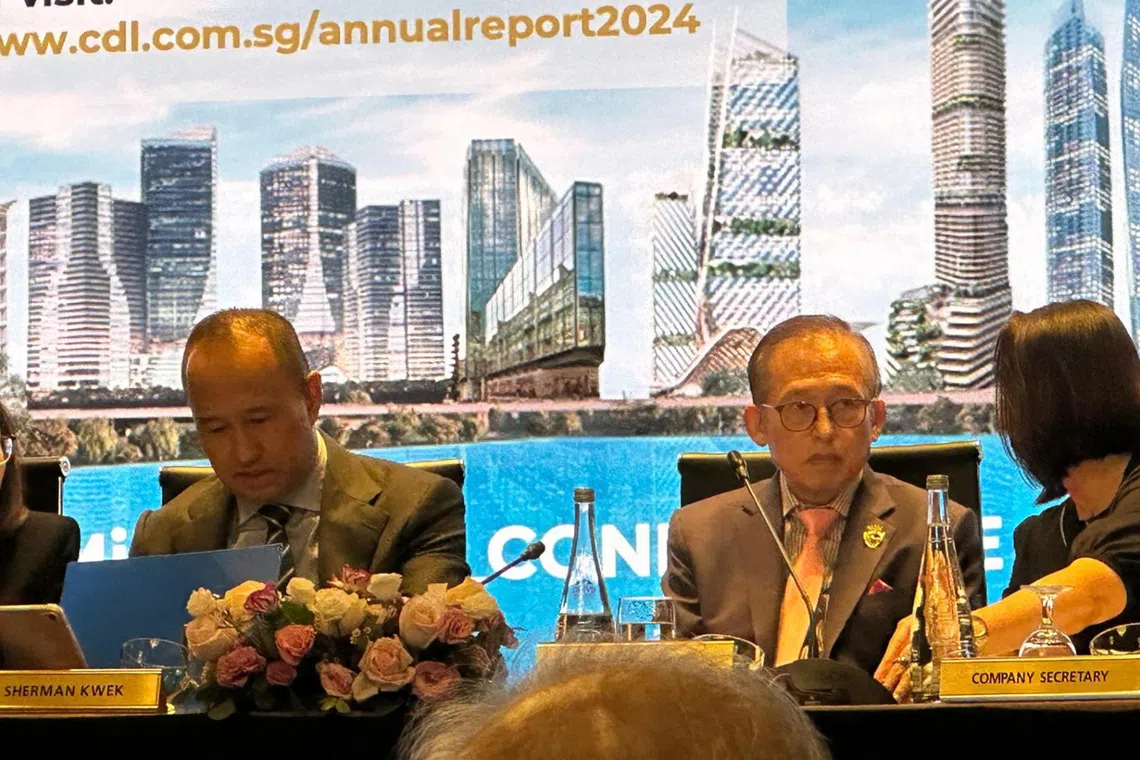
SINGAPORE – A year after a bitter family feud rattled City Developments Limited (CDL), the hotel and property group appears to have regained its footing. Its finances are steadier, its business is moving ahead and the father-and-son dispute has largely faded from the headlines.
On Sept 28, the group unveiled a three-year execution roadmap for 2027 to 2029 aimed at divesting non-core assets and redeploying capital into growth areas.
Yet the market is unhappy.
CDL has already staged a substantial recovery from its 2025 trough, when the stock fell as low as $4.35 in April amid the boardroom conflict, before ending the year at around $8, a 56% gain.
But since Sept 28, 2026, the share price has been sliding. It was trading around $7 on Oct 2, down from more than $8 before the review.
That is an almost 15% slide despite many analysts’ buy recommendations after CDL’s chief executive officer Sherman Kwek said the group is targeting $6 billion of divestments across the residential, commercial, hospitality and living sectors, and deploying $5 billion of growth capital across the four sectors.
Its plan is to achieve more than 35% in dividend payout annually; about 55% net gearing by 2029; and more than $1 billion net profit from divestment gains and $10 billion assets under management.
Tabitha Foo, an analyst with DBS Research, said: “Our view is that the strategic review does not disappoint on intent, but it leaves investors wanting more on execution details, near-term milestones and measurable financial outcomes.”
She added that the target achievements are all positive developments that should improve CDL’s capital efficiency and return on equity over time. It also offers investors measurable financial targets and greater accountability.
JPMorgan analysts Mervin Song and Terence Khi noted that investors welcome the plan, but management did not give enough clarity on how much extra profit and dividends they could expect. That uncertainty, along with its China plans, made investors less enthusiastic about the stock.
Vijay Natarajan, an analyst with RHB Group, pointed out that the shares are trading at a hefty discount to CDL’s revalued net asset value (RNAV) of about $20, as well as analysts’ RNAV estimates, which range from $14 to $18.
Rival property and hotel group UOL is trading at a discount of 30% to 40%.
CDL’s review contained many of the things investors had been waiting for: asset sales, lower gearing, higher dividends and a bigger fund-management business.
So, what is spooking the stock?
Remiser S. Nallakaruppan, better known as Nalla, said that while retail investors are buying CDL shares, large institutional funds are getting out.
It is the typical “buy the rumour, sell the news”, where prices move in anticipation of a future event, then reverse or stabilise once the news breaks.
A stockbroker with a local brokerage attributed the recent rise in CDL’s trading volatility to institutional funds which are not long-term investors.
He reckoned that hedge funds, which provide up to 50% of market liquidity, sensed an opportunity to “short” CDL shares, driving the price down. To short a stock, people borrow shares from brokers, sell them on the open market, and hope to buy them back later at a lower price to return.
Beyond these, nagging doubts remain in the market over whether the feud between the younger Kwek and his father, CDL executive chairman Kwek Leng Beng, is truly water under the bridge.
In early 2025, the father accused his son of orchestrating a boardroom takeover.
Brokers noted that the market may have construed negatively the fact that the senior Kwek, 85, was not at the unveiling of the crucial roadmap.
His reluctance to name the younger Kwek, 50, as his successor also suggests a lack of readiness to hand over the reins despite his age.
“The two main issues that triggered the strategic review were not addressed. They are the board unity and succession plan,” said one broker.
While the review is largely welcome, the problem is the execution risks.
For shareholders looking for an immediate catalyst, selling assets and then reinvesting the proceeds is less straightforward than selling assets and distributing the cash.
Analysts noted it may not be easy to dispose of $6 billion worth of assets in this environment, especially with London’s property crisis only just beginning.
A recent report from British daily The Telegraph cited CDL mothballing a £1.3 billion (S$2.2 billion) project – including 1,000 new homes, shops and offices – despite winning planning permission in May 2025, due to rising costs and tepid buy demand.
CDL’s net gearing – a measure of debt to equity – was more than 70% at the close of 2025, after accounting for fair-value gains on investment properties. The new target is to bring net gearing down to about 55% by FY2029.
“That is a meaningful target, but it also tells investors that the balance sheet still needs work,” said one analyst.
CDL has a large and valuable property portfolio, but property development is capital-intensive. Acquiring land, building projects and holding investment properties all require substantial financing.
So the market is likely to be watching not just whether CDL can sell $6 billion of assets, but also how much debt actually disappears as a result, and how quickly.
Another complication is CDL’s China ambition.
Of the $5 billion earmarked for new investments, about 60 per cent is intended for Singapore, while 30 per cent is allocated to China and Japan combined. The remaining 10 per cent will go to other markets.
That keeps Singapore firmly at the centre of the strategy, but it also means CDL remains exposed to markets where property conditions and returns can be less predictable.
For CDL, the substantial losses incurred in the China property market are still fresh in investors’ minds, Nalla said.
The group suffered a major financial and boardroom crisis after its disastrous acquisition of a roughly 51% stake in Chinese developer Chongqing Sincere Yuanchuang Industrial for $1.9 billion in 2020. CDL took a massive impairment write-down that year.
Investors want to know if the China partnerships and future cash flows will be ring-fenced to protect the group.
Perhaps one of the most important structural changes is CDL’s ambition to rely more heavily on fund management.
The company wants to double its assets under management from about $5 billion in June 2026 to $10 billion by 2029, under plans to establish a dedicated fund-management entity and expand through real estate investment trusts, private funds, partnerships and joint ventures.
The attraction is straightforward.
Instead of putting all of its own capital into every property, CDL can bring in outside investors while retaining exposure to the assets and earning management-related fees.
That could make the business less capital-intensive over time.
But again, this is a future earnings and capital-efficiency story, rather than something that immediately changes the current balance sheet.
What should investors do?
From the week-long slide in share price since the unveiling of the roadmap, it is clear that investors want more clarity on recurring net profit and what is a sustainable return on equity in the immediate term.
CDL has set a minimum 35 per cent dividend payout ratio, but the actual cash dividend will depend on earnings, cash flows, capital requirements and other considerations.
Investors want tangible evidence of the asset disposals, hotel monetisation, deleveraging and fund management initiatives, before assigning a meaningful value to longer-dated targets.
The next leg of performance will depend more on execution, particularly within the next six months.

