


SINGAPORE – A potent mix of trade wars, military conflicts and extreme weather events is pulling at the seams of the maritime supply chain network that feeds us the bulk of the goods and commodities we need.
Sea ports dealing with these disruptions daily sit at key junctures of this trade network.
Some port operators handle these disruptions alone, but others believe that they have a better chance of overcoming the odds together.
Singapore’s Maritime Port Authority (MPA), the Port of Los Angeles (POLA) and its adjacent Port of Long Beach (POLB) belong in the latter camp.
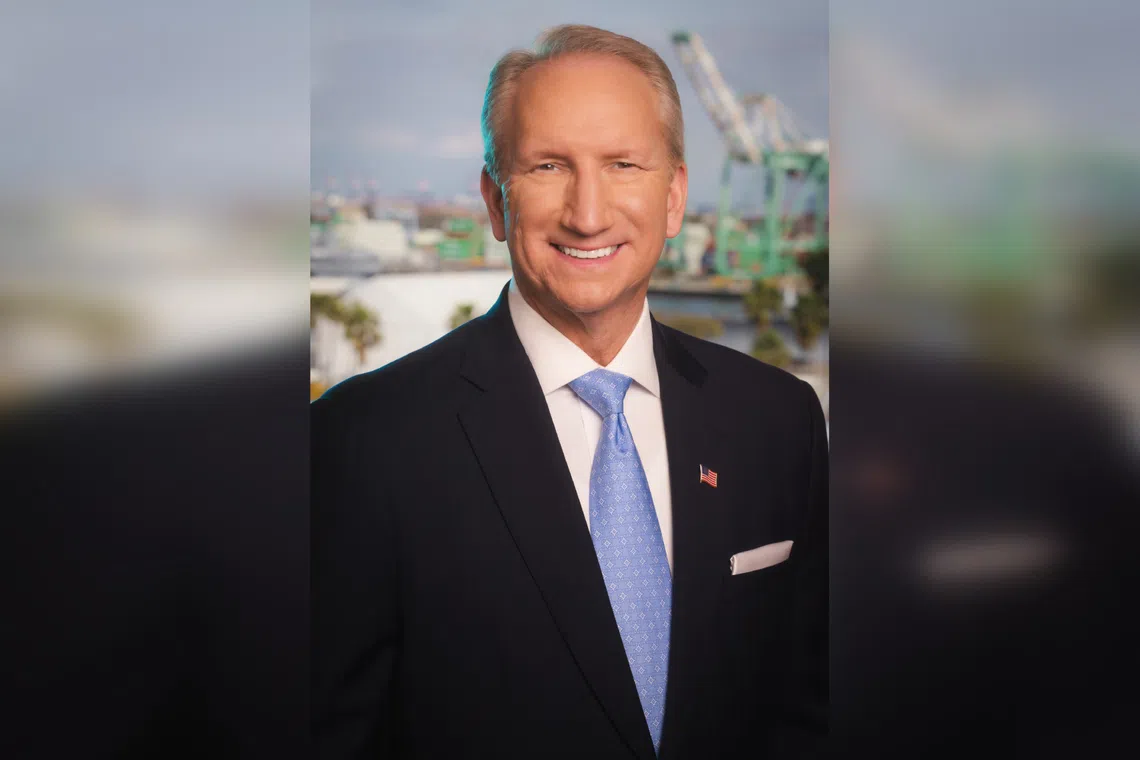
“This supply chain has so many complexities from policy to climate to geopolitics. And at the same time, it is a very interdependent conveyance,” said Eugene Seroka, executive director of POLA, which is the United States’ biggest container port.
For ports to function smoothly, they must coordinate with shippers and land transport entities. They also provide logistics services such as container yards, storage tanks and warehouses, and act as regulatory checkpoints for customs, immigration and biosecurity operations.
Ports cannot influence a nation’s trade, environment and national security policies. But they can work together to speed up cargo handling and help decarbonise one of the world’s most fossil-fuel-reliant industries at least in the shipping corridor they occupy.
The impact of better-managed ports cannot be overstated, with more than 80 per cent of global trade transported by sea – from electronics, clothing and cars to grain, metals, oil and gas. Los Angeles and Singapore have key ports on either side of the trans-Pacific route – the world’s busiest container trade lanes.
This route is getting even busier these days as extreme weather conditions have lowered water levels in the Panama Canal, adding to the maritime industry’s woes from threats to freedom of navigation in two Middle East waterways – the Strait of Hormuz and Bab el-Mandeb Strait.
Constrained shipping across these waterways is forcing many ships to head for the US West Coast through Singapore, Asia’s top transshipment hub.
Singapore’s port handled 44.66 million shipping containers, or twenty-foot equivalent units (TEUs), in 2025 – it’s highest on record – eclipsing the 41.12 million in the previous year.
While POLA saw a small drop in container counts in 2025, in June this year it moved 1,002,734 TEUs, making it the busiest June in the port’s 118-year history.
“So it makes sense for Port of Los Angeles to have very good, strong relations with Singapore. And Singapore has pretty much the same ambitions,” Seroka told The Straits Times.
MPA, POLA and POLB renewed their agreement on the Green and Digital Shipping Corridor for another three years in April.
First signed in 2023, the renewal reinforces the ports’ commitment to decarbonisation and digitalisation, and supports efforts to strengthen supply chains and provide energy security across the Pacific.
The digitalisation efforts entail boosting port-to-port data connectivity, system interoperability, common standards and cybersecurity.
Seroka said advanced technology such as AI-powered infrastructure not only helps customers book and track their cargo more efficiently, but also gives ports the visibility on what is incoming and outgoing so they can avoid the last-minute scramble that has become quite frequent at ports worldwide.
“Speed is important,” said Seroka. The last thing shippers want is to complete a weeks-long journey across the Pacific and then wait for days for their turn to offload, he said.
Tariffs and other trade curbs since 2018 have also impacted supply chains and shipping.
“Back in 2018, about 60 per cent of our business portfolio was China. Today that is 40 per cent. At the same time, Vietnam has grown fourfold,” said Seroka. Hence, POLA has worked with shipping companies to have non-stop services from South-east Asia to Los Angeles.
Still, Seroka said, the planning horizon for traders, shippers and port operators has shrunk with new trade policy announcements coming out now and then.
“There is always going to be domestic policy requirements, and national security requirements. But I still hope that there is a way the two biggest economies – the US and China – can continue to work together on international trade,” he said.
Environmental policies are also not aligned across the world.
While international frameworks like the Paris Agreement aim to unite nations under shared long-term climate goals, the actual implementation, stringency, and enforcement of environmental laws vary drastically around the globe.
Shipping emits about 1,000 Mt of carbon dioxide per year, which is 3 per cent of global emissions, according to the International Maritime Organisation. Shipping emissions are also set to increase by up to 50 per cent by 2050 if stringent measures are not taken.
The maritime industry is also a victim of climate change.
For instance, severe drought – more recently driven by El Niño climate patterns – has repeatedly lowered water levels in the Panama Canal, a critical global shipping route.
This forces authorities to limit the size or cargo loads of ships that can pass through the waterway, to prevent ships from running aground.
Seroka said the shipping industry and port operators understand that they have a role to play.
“If we were able to reduce pollution on a ship going from Shanghai to Los Angeles consistently every week by 10 per cent, that would be equivalent to all the pollution in the Port of Los Angeles for a year,” he said.
Since the launch of the Green and Digital Shipping Corridor, between Singapore and Los Angeles, several milestones have been achieved in terms of decarbonisation.
These include the completion of a baseline study in 2024, onboarding industry partners to explore potential pilot trials, and the establishment of workstreams to advance pilot initiatives in alternative fuels, digitalisation, and energy efficiency. These workstreams support the development of more diversified and resilient energy pathways for international shipping.
All three ports have also advanced their alternative fuels bunkering capabilities.
MPA completed methanol bunkering trials in 2023 and subsequently awarded three methanol bunkering supply licences. POLA and POLB have commissioned a study on clean fuels and are preparing for a methanol pilot in 2026.
These developments prepare the three ports for green fuel trials in the next phase of their partnership. They have also conducted port-to-port data exchange testing and started pilot collaborations with major Japanese shipping group Mitsui O.S.K.
Under the renewed pact, the partners will continue working with industry to deploy low- and zero-emission fuels and digital solutions.
“It’s going to be a long journey… It’s a lot of work. Nothing will happen overnight,” said Seroka.

