


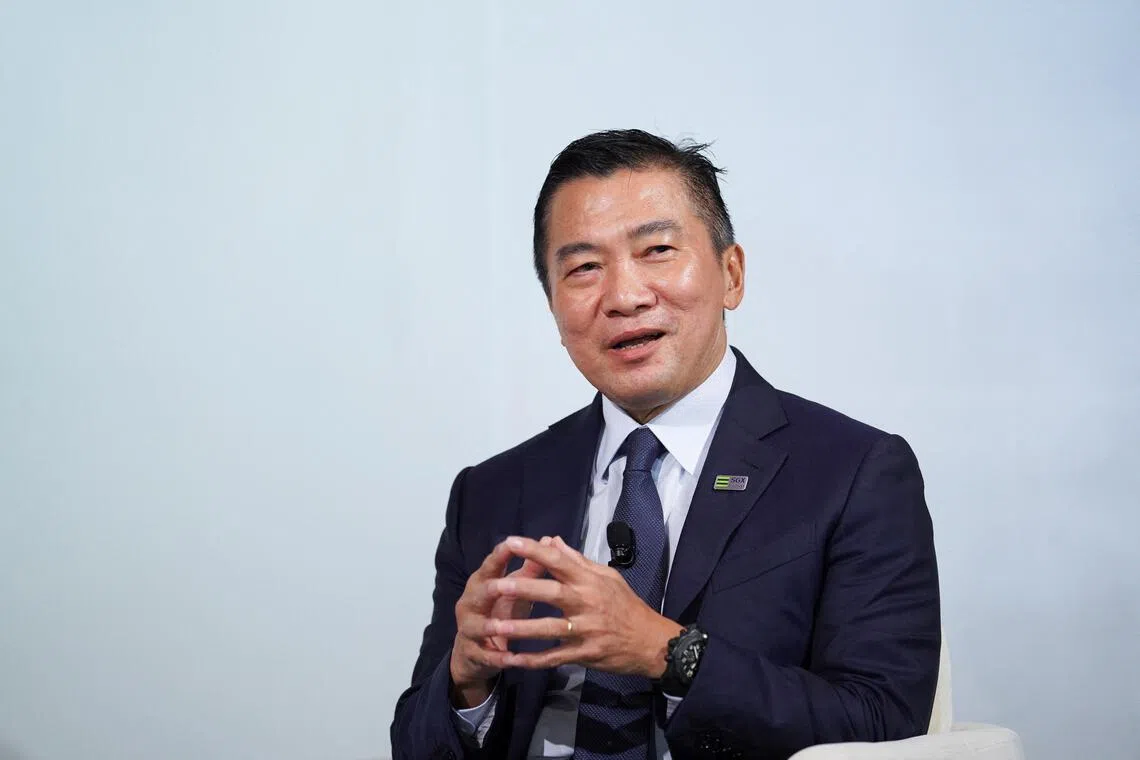
SINGAPORE – Singapore Exchange (SGX) chief executive Loh Boon Chye raked in $8.37 million in total pay for the financial year ended June 30, as the exchange delivered a standout year with record-high revenue and net profit.
This was up 7.1% from the $7.82 million he earned in FY2025, with higher cash bonuses and long-term incentives accounting for nearly 85% of his total remuneration.
Loh received a cash bonus of $3.54 million for FY2026, up 8.4% from a year earlier, after achieving specific quantitative and qualitative targets and objectives set for the financial year, according to SGX’s FY2026 annual report released on Sept 29.
He was also awarded $3.54 million in long-term incentives, up 8.4% from FY2025, comprising performance shares tied to targets measured over three years and awards under SGX’s deferred long-term incentive scheme.
His fixed pay remained mostly unchanged at $1.21 million.
The bourse’s other top-paid executives were president Michael Syn, whose annual remuneration rose 16.2% to $3.45 million in FY2026, and Tan Boon Gin, CEO of Singapore Exchange Regulation (SGX RegCo), who drew $2.44 million, up 7% from the year before.
These higher pay packages came after a standout FY2026 for SGX Group, which posted record revenue and net profit.
Revenue rose 13.9% to $1.48 billion, while adjusted net profit reached $759.5 million, up 24.6%.
Growth was broad-based across all operating segments, led by robust performance in the stock market following recent developmental and regulatory initiatives led by the Singapore Government and central bank.
The Straits Times Index crossed the 5,000 mark for the first time in February, while securities’ daily average value exceeded $2 billion in the final five months of FY2026.
In his annual letter to shareholders, Loh highlighted a healthy IPO pipeline, stronger trading activity and renewed participation across all investor and stock segments during the year, reflecting “growing confidence across the market”.
The exchange also recorded strong activity across its foreign exchange and commodities segments.
In the year ahead, Loh noted that the boundaries of traditional marketplaces are expanding, citing prediction markets in other jurisdictions as an example of how exchanges and trading venues are enabling participants to express their views and manage uncertainty.
Prediction markets are trading platforms where people buy and sell contracts based on whether a future event will occur.
He noted that SGX is studying these developments to determine whether new types of markets could meet its customers’ “genuine economic and risk-management needs”.
He added that SGX plans to fully repay its debt in FY2027 and remains confident of raising its quarterly dividend by 0.25 cent each year through FY2028.
The SGX board proposed a one-off additional dividend of 12.5 cents per share following capital recycling gains in FY2026, on top of a previously guided fourth-quarter dividend, bringing total dividends to 57 cents per share.
That is a 52% increase from the previous financial year.
Loh said SGX expects broad-based growth across its operating segments to continue into FY2027, and maintained the medium-term guidance for group revenue to grow by 6% to 8%.

