


SINGAPORE – Singapore’s manufacturing output expanded in August, as all clusters except chemicals recorded output growth.
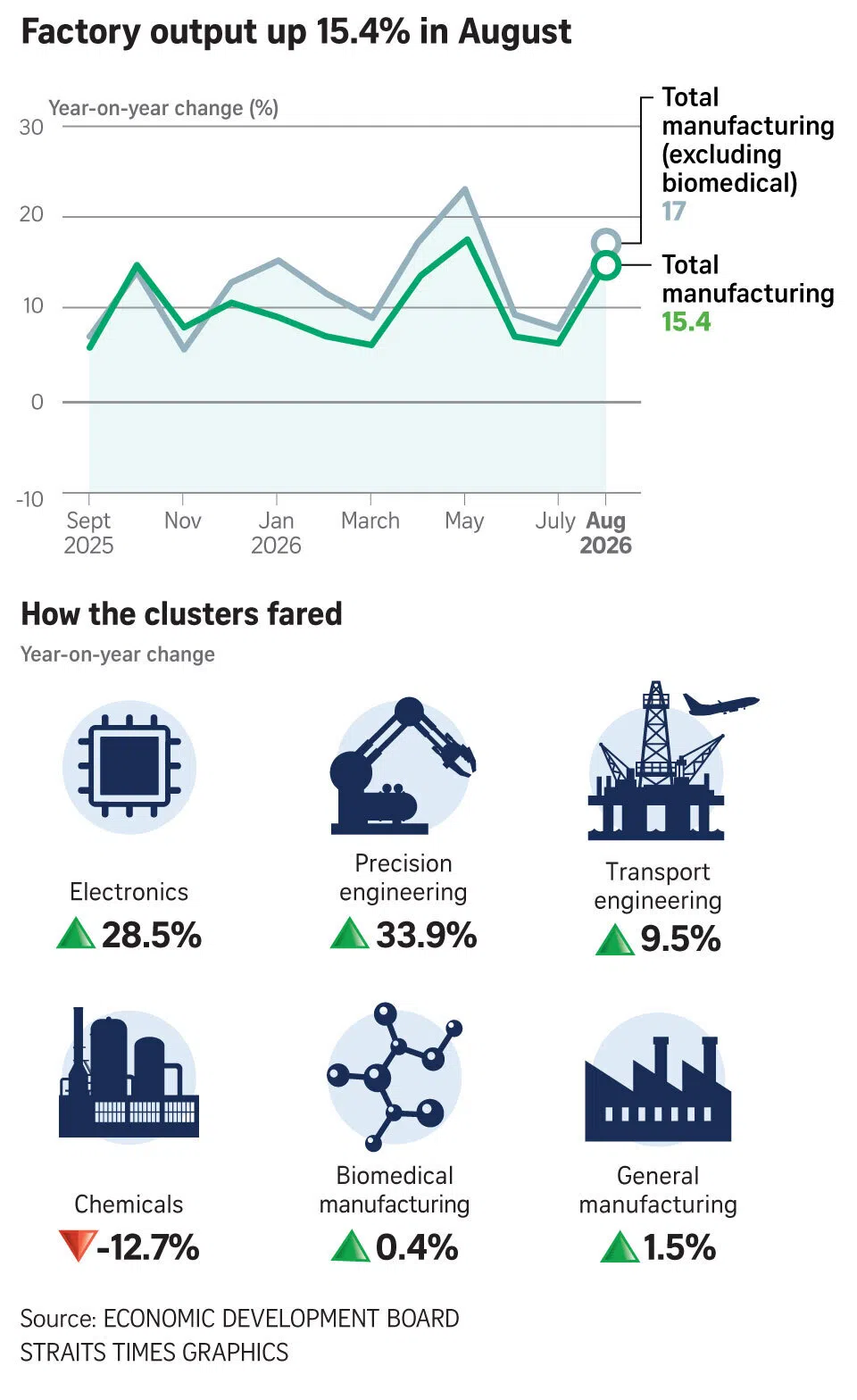
Total factory output climbed 15.4% year on year in August, after a revised 6.9% rise in July. However, the expansion missed the 17.1% growth forecast by economists in a Bloomberg poll.
Excluding the biomedical manufacturing industry, output increased 17%, data from the Economic Development Board on Sept 28 showed.
Output from the precision engineering cluster saw the largest growth in August, jumping 33.9% year on year, driven mostly by higher production of semiconductor equipment in the machinery and systems segment.
Within the cluster, the precision modules and components segment saw higher output of dies, moulds, tools, jigs and fixtures as well as precision components for the electronics industry.
The electronics industry saw an increase of 28.5% year on year, supported by strong production of servers and related products, semiconductors and data storage products amid robust artificial intelligence-related demand.
Within the cluster, semiconductor output surged 26.1%, while infocomms and consumer electronics added 66.3%, and computer peripherals and data storage expanded 20.4%.
Other electronic modules and components fell 6%.
Transport engineering grew 9.5%, led by the land and aerospace segments. In particular, the aerospace segment recorded higher production of aircraft parts and sustained maintenance, repair and overhaul jobs from commercial airlines.
General manufacturing output increased 1.5%, supported by higher production of beverage products, commercial printing and metal doors and windows.
Biomedical manufacturing output inched 0.4% higher from a year ago.
The medical technology segment recorded higher output of medical devices amid stronger export demand. This was partially offset by a decline in the pharmaceuticals segment due to a different mix of active pharmaceutical ingredients being produced.
Beyond electronics and the other clusters that grew, the chemicals cluster declined 12.7%, weighed down by the petroleum and petrochemicals segments.
Petroleum output was affected by plant maintenance, while petrochemicals production continued to be constrained by softer demand and feedstock supply disruptions. In contrast, the specialities segment recorded output growth on account of higher production of industrial gases and food additives.

