


SINGAPORE – SG Semiconductor is now the national brand identity of Singapore’s chip industry, a move aimed at enhancing global visibility of its strength and status.
The first dedicated national brand for the sector was jointly developed by the Republic’s lead science agency A*Star and investment promoter Singapore Economic Development Board (EDB).
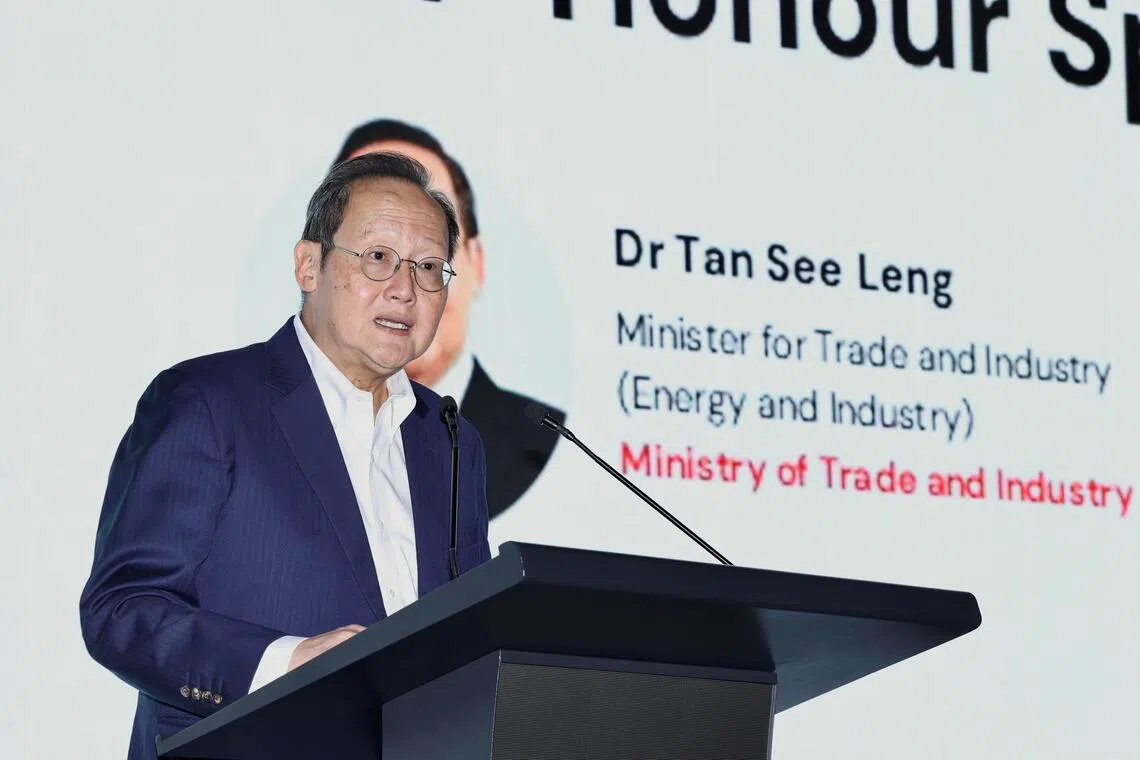
Announced on Sept 25 by Dr Tan See Leng, Minister for Trade and Industry (Energy and Industry), SG Semiconductor will make it easier for companies and talent to understand what the country and its chip ecosystem offers.
“SG Semiconductor will be launched as a common national identity, reflecting our coordinated approach to partnering industry and advancing Singapore’s semiconductor sector,” said Tan.
A*Star chief executive Beh Kian Teik said that Singapore’s strength in semiconductor innovation has been built through decades of sustained investment and close partnership across public research, universities and industry.
“SG Semiconductor brings this collective endeavour under a national identity. It signals our commitment to build frontier capabilities, translate them into industry outcomes and anchor high-value R&D and manufacturing in Singapore for the long term,” he said.
Jermaine Loy, managing director of EDB, said: “As semiconductor technologies and supply chains become more complex, the industry is turning to trusted locations where they can access research platforms, advanced manufacturing capabilities, skilled talent and established partners to accelerate innovation.
“SG Semiconductor will showcase the depth of Singapore’s ecosystem and how companies can tap these strengths to innovate and scale, while creating new business and job opportunities here.”
Experts note that a national brand identity helps invoke country-of-origin effects, promote collective competitiveness and sets the sector apart in the global marketplace.
Simon Anholt – the British independent policy adviser who coined the term “nation branding” in the late 1990s – described it as favourable images of a country resulting from “strategy, substance and symbolic actions.”
For Singapore, the unique nation brand is built on strong governance and policy execution, demonstrated by the resource-poor city-state’s emergence as a trusted global hub for business sectors such as shipping, finance and manufacturing.
Singapore’s chip ecosystem has also come a long way over the past six decades, and has grown in terms of both depth and breadth.
It now spans chip design, wafer fabrication, assembly and testing, equipment and materials synthesis and manufacturing, and research and development (R&D).
It is a key economic contributor, accounting for one in 10 chips produced globally and a fifth of semiconductor manufacturing equipment production.
However, Tan said Singapore will not take this achievement for granted.
“We will continue to invest in advanced manufacturing innovation to capture the next wave of semiconductor growth,” he said at an A*Star-organised event – Innovate Together – on the sidelines of the Singapore Semiconductor Industry Association Summit 2026.
As AI applications become more sophisticated, they place greater demands on semiconductor performance.
Hence, Tan said: “Singapore will strategically adopt AI to enable productivity gains and accelerate innovation cycles to keep our advanced manufacturing sector globally competitive.”
This will be driven by the AI Mission for Advanced Manufacturing, a Budget 2026 initiative to accelerate artificial intelligence adoption, build smart factories, and drive productivity.
The initiative will reimagine manufacturing on three fronts.
First, to grow manufacturing output and productivity by anchoring best-in-class plants that are software-defined, agentic and autonomous.
Second, to advance product and process innovation in manufacturing.
And third, to build a strong base of companies and talent that develop AI solutions from Singapore to the rest of the world.
Tan said: “R&D investments will allow semiconductor manufacturers to stay ahead of technological change.”
Hence, the branding effort will build upon the strong foundations of Singapore’s chip sector through closer research-industry collaboration and talent development.
The funding support will be provided by an $800 million investment from 2026 to 2030 through the RIE Flagship in Semiconductors, a national research and translational programme launched under the $37 billion Research, Innovation and Enterprise 2030 (RIE2030) master plan.
Demonstrating SG Semiconductor in action, Innovate Together 2026 also saw the announcement of new and expanded partnerships spanning several key semiconductor technology areas.
These collaborations connect research expertise with industry-grade platforms and manufacturing capabilities to develop, validate and scale emerging technologies.
In advanced packaging, Applied Materials and A*Star will embark on Phase 4 of their longstanding collaboration, significantly expanding the joint laboratory infrastructure, equipment and headcount to develop technologies for AI and advanced computing.
A*Star and KLA will establish a new collaboration in process control solutions to improve manufacturing reliability and yield, while the science agency and STATS ChipPAC will collaborate in co-packaged optics to create a pathway towards high-volume production.
In silicon photonics, A*Star and GlobalFoundries will deepen their R&D collaboration to develop next-generation technologies, supporting higher-volume manufacturing for high-performance computing and data communications.
In MEMS (Micro-Electro-Mechanical Systems) sensing, Tacta Systems and A*Star will develop intelligent sensing technologies for robotics, tapping the agency’s Lab-in-Fab platform, which brings together research and manufacturing capabilities for industry-relevant development, prototyping and validation.
Tacta Systems, a US-based robotics pioneer focused on giving machines human-like touch and precision, recently opened its Singapore operations to strengthen local technology development.
The wider ecosystem represented by SG Semiconductor includes a new research collaboration between the National Centre for Advanced Integrated Photonics, hosted at Nanyang Technological University, and Battery Age Minerals, an Australian mineral exploration company.
Tan said that as semiconductor technologies become more complex, Singapore will need more researchers, engineers and technicians with specialised capabilities to execute them well.
While Institutes of Higher Learning and industry partners already play an important part in building the talent base, new initiatives will follow.
For undergraduates, the Singapore Institute of Technology will pilot its “2+2” model from September 2027.
Students will spend two years on campus and nearly two years in workplace immersion to become industry-ready before graduation.
The talent initiatives follow SSIA-led initiatives announced on Sept 24.
They included a two-year pilot initiative, which aims to reach more than 600 pupils, by using LEGO Education’s Computer Science & AI, a collaborative, hands-on learning platform that combines physical bricks, interactive hardware and safe local AI tools.
SSIA and local industry partners will add the semiconductor context to the platform.
SSIA and ams-OSRAM, a German company that develops optical solutions for the chip industry, are also developing a Semiconductor Future Makers Camp for those aged seven to 16, planned for 2027.
Ams-OSRAM will contribute engineers and mentors with hands-on experience in light, sensing and semiconductor technologies.
Under a three-year partnership between SSIA and the National Youth Council, the semiconductor industry will support up to 1,000 job taster opportunities and 300 industry mentors, alongside broader industry engagement expected to reach more than 4,000 young people.
These initiatives are expected to build a robust pipeline of talent to meet the evolving needs of advanced semiconductor R&D and manufacturing.
Tan said: “Success will depend on how effectively Singapore brings together sophisticated research capabilities, quality talent, and leading industry partners to strengthen competitiveness across the semiconductor value chain.”

