


SINGAPORE – Banks and financial institutions in Singapore will get more support to help their workforce transform, with five new initiatives launched on Sept 24.
They were announced by the Institute of Banking and Finance (IBF), a not-for-profit industry association, during its awards dinner.
Among these measures is an IBF artificial intelligence workforce co-lab, which will bring companies and partners together to assess how jobs are changing and test practical approaches to training and job redesign.
These findings will be shared with the wider finance sector.
Some 23 partners across the financial sector have committed to train their entire local workforce – over 80,000 employees in total – in critical AI skills by 2028 through IBF-recognised programmes.
These partners, which include banks, insurers and asset managers, make up 40 per cent of the financial sector workforce.
The organisations have also committed to creating reskilling pathways together with IBF for AI-enabled roles and building a stronger pipeline of young talent.
Deputy Prime Minister Gan Kim Yong, who delivered the keynote speech at the awards ceremony, said: “As AI adoption grows, some roles will expand, while others will change. Developing our workforce must therefore be part of this effort from the start.
“We want AI to translate into better careers for Singaporeans and a more productive workforce.”
He added that financial institutions must plan for their people even as they plan for AI, by identifying how jobs will change, preparing employees early, and helping them benefit from these new opportunities.
Besides helping existing staff, young people also need to be prepared for the next generation of careers in finance, he said.
Gan, who is also Minister for Trade and Industry (Trade) and chairman of the Monetary Authority of Singapore (MAS), said: “As AI takes on more routine work, we must give young people opportunities to build strong foundations and develop professional expertise.”
MAS managing director Chia Der Jiun, who is IBF chairman, said separately in his speech: “Equipping workers with new emerging skills is only part of the equation. We also need to support workers as jobs and tasks evolve.”
He added that new technologies will continue to reshape financial services and create new opportunities for the sector.
“We will need to continue strengthening capabilities, supporting people as roles evolve, and building a strong talent pipeline. This will require a continued and collective effort across the sector.”
Together with the co-lab, IBF also announced three pathways for employees to develop new skills for specific roles.
These are for leaders who have to identify how AI can be applied and lead workforce transformation; for wealth managers who have to learn to combine AI skills with client engagement and advisory expertise; and for operations staff who have to develop capabilities in areas such as process improvement, exception handling, risk oversight and validating the AI output.
Gan said that rising demand in wealth management across Asia creates opportunities for Singapore.
“AI can help relationship managers analyse information faster and therefore spend more time with clients, while they continue to provide advice tailored to each client’s circumstances,” he added.
In operations, AI is changing how routine processes are carried out, he noted.
The operations pathway will bring together major banking and insurance employers to redesign such jobs and help develop progression for employees.
“In many cases, this will involve higher responsibilities in an existing role. In others, it may involve moving to a related job or new work involving AI,” Gan said.
In addition, to support job redesign, IBF is also launching a playbook in partnership with other agencies to give business leaders and human resource practitioners practical guidance and assistance as companies adopt AI.
IBF is also working with Ngee Ann Polytechnic on a pilot that combines skills mapping, coaching and change management tools to help finance professionals and their managers take on new responsibilities.
Lastly, IBF also signed an enhanced agreement with the National Trades Union Congress Financial and Professional Services Cluster of Unions and seven industry associations.
The enhanced partnership will focus on helping the workforce adapt to AI through wider industry outreach and greater access to training and career support, said Gan, who witnessed the signing.
He added that it will also create opportunities to develop programmes tailored to the needs of each sub-sector.
“As we pursue new opportunities of AI, let us bring the same commitment to developing our workforce,” he said.
“Together, we can build a more competitive financial centre, and help Singaporeans at every stage of their careers share in its success.”
Financial institutions welcomed these new measures.
OCBC head of group human resources Lee Hwee Boon said the co-lab initiative builds on the work that the bank is doing, with almost all its employees here having attended AI, digital or data-related programmes.
Lee said: “As AI continues to reshape how work is done, we will ramp up our efforts even more to support colleagues so that they keep learning, adapting and building critical skills.”
She added that in parallel with the three pathways, OCBC also maps out career pathways based on a skills-first growth and mobility strategy, so staff can explore adjacent roles, acquire new skills, and pursue career growth within the bank.
DBS has also worked with IBF to equip some 14,800 Singapore-based employees with foundational AI capabilities.
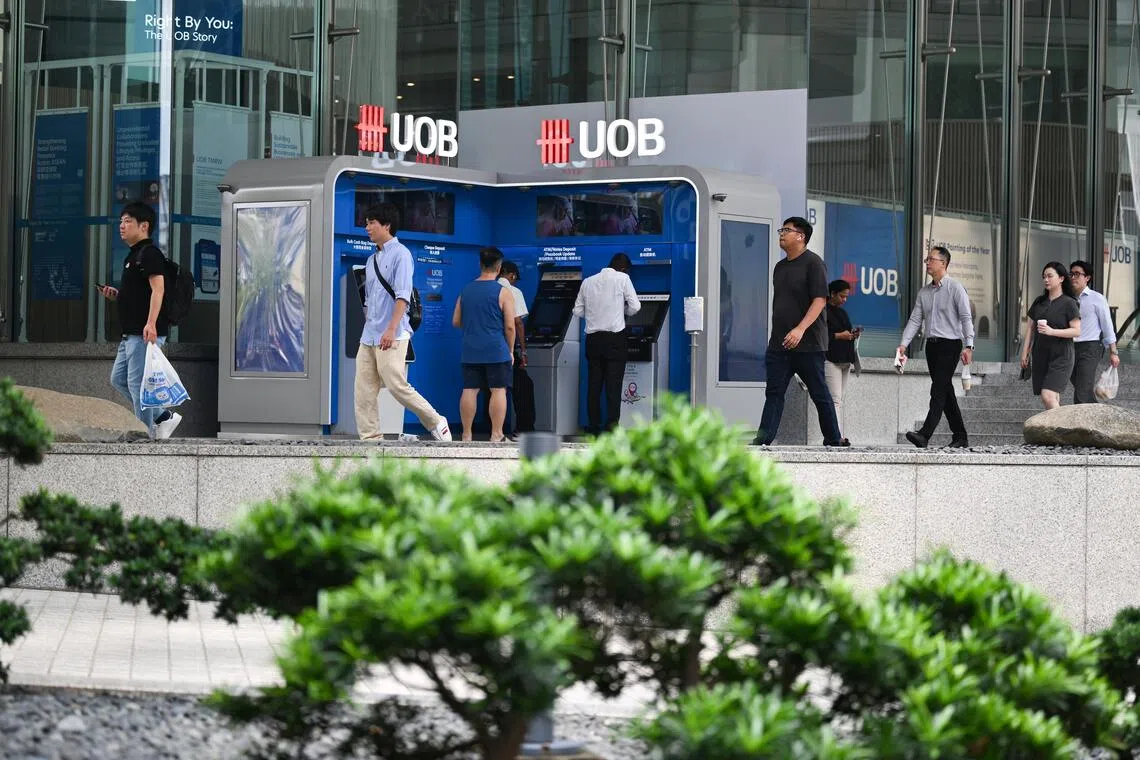
UOB head of group human resources Dean Tong said the co-lab initiative provides a platform for financial institutions and ecosystem partners to better understand how jobs are evolving.
He said UOB’s focus is on ensuring staff have the opportunities, support and skills needed to grow with the business and build sustainable careers in a changing industry.
He added that the bank has made good progress in building foundational AI capabilities in its staff, but that the next phase is about helping employees adapt as jobs and skills evolve, while strengthening enduring human capabilities such as judgement, critical thinking, communication and leadership.
Deep Thomas, JPMorganChase’s Asia Pacific chief data and analytics officer, also said that AI’s “true promise” is in empowering people. He noted that the company is focused on enterprise AI tools, practical upskilling, and the guidance required to deploy AI responsibly at scale.

