In an industrial corner of western Singapore, trailers that would normally take up individual parking lots are instead stacked side by side – upright.
For Allied Container Group, this allows a single parking lot to hold as many as eight trailer chassis vertically, freeing up about 0.4 hectares of land (about the size of 10 basketball courts) for other uses.
The vertical trailer parking system, developed with support from Enterprise Singapore’s (EnterpriseSG) Enterprise Development Grant (streamlined to EDGE Grant from Sept 30), is an eye-catching answer to a very Singaporean problem: how does a company continue to grow with the little land available?
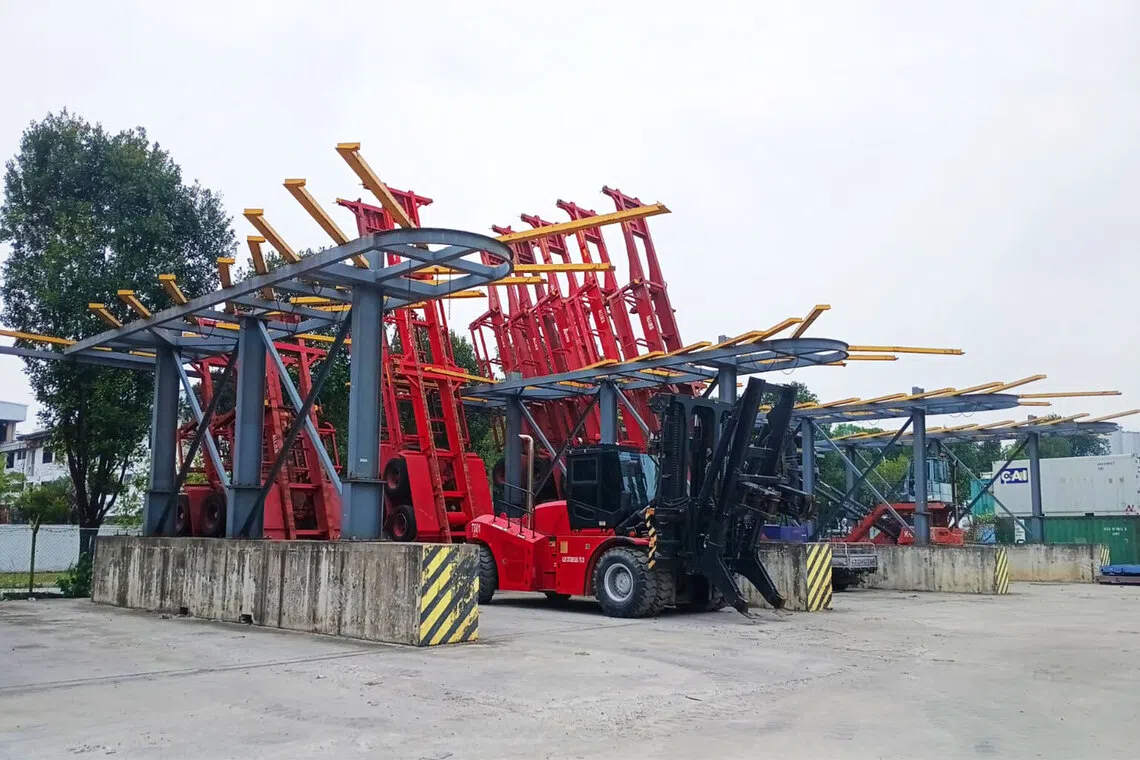
Allied’s vertical parking system reduces the space needed for trailer chassis parking by up to seven times, helping the haulage operator work around land constraints.
PHOTO: ALLIED CONTAINER GROUP
Allied’s solution is to get more out of not just its land, but also its manpower and time. The home-grown logistics company has also been digitising container inspections, automating routine processes and moving workflows online.
Its managing director Lim Kian Chin says: “In Singapore, you cannot simply buy more land. Operating in Singapore requires us to be relentless about efficiency.”
The pressure extends across Singapore’s logistics sector. As companies seek to get more out of their resources while meeting demands for faster and more visible deliveries, improving productivity has become increasingly important.
At the same time, disruptions to global supply chains have put a premium on the ability to adapt quickly.
Jesse Satria Oeni, director for the logistics and mobility division at EnterpriseSG, says logistics companies must adapt as global disruptions and geopolitical tensions reconfigure global supply chains.
He adds: “The transformation of our logistics ecosystem through adoption of the latest digital and automation solutions will help companies enhance their productive capacity to capture a greater share of these global goods flows.”
Moving people into higher-tech roles
Founded as a single-truck operation in 1975, Allied has grown into a logistics group with more than 300 full-time employees and container depots in markets such as Malaysia, Myanmar, Thailand and beyond.
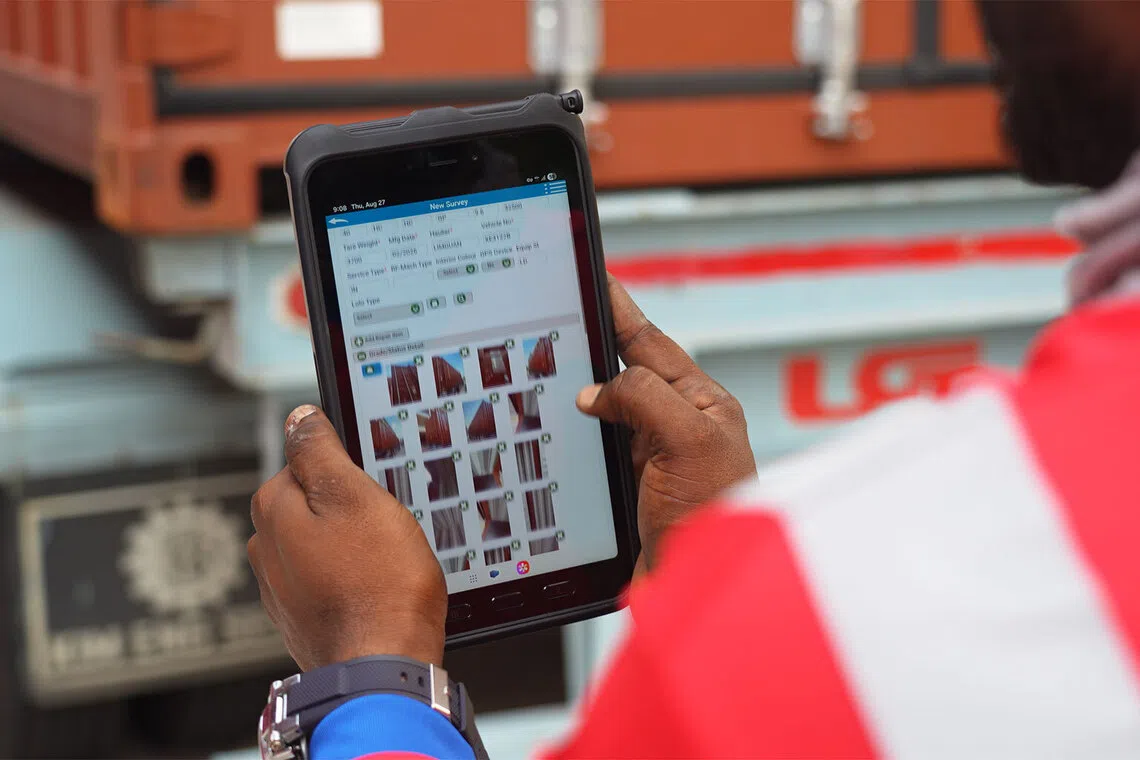
Allied’s ground staff use its Interactive Depot Operating System (iDOS) to carry out tasks such as container inspections digitally, replacing paper-based processes.
PHOTO: SPH MEDIA
Lim, who joined his father in the family business in 1989, has long pushed for greater use of technology.
That effort accelerated after Allied’s leadership team took part in EnterpriseSG’s Enterprise Leadership for Transformation programme in 2021. The programme equips business leaders with the skills to develop and carry out plans for growth and transformation.
For Allied, it prompted a broader rethink of how technology could be used across its operations. Processes that once relied heavily on people and paperwork are now automated or have moved online.
As the work changed, so did the jobs. Ground staff, who previously carried out manual inspections or gate processing, are trained to manage automated equipment.
The company has also introduced automated seal dispensers with the support of EnterpriseSG, reducing the need for workers to handle the process manually.
Such changes shift employees away from repetitive tasks towards roles that involve overseeing and operating technology.
“By investing heavily in continuous learning, we are building a tech-literate workforce capable of managing sophisticated logistics tech, improving job safety, and driving overall productivity,” says Lim.
How logistics firms can cut emissions without slowing deliveries
Improving productivity is only one part of the transformation under way in logistics. Companies are also looking for ways to cut emissions while keeping goods moving reliably.
One way is to replace diesel-powered heavy vehicles with electric ones, reducing emissions from fleets that spend long hours on the road. For heavy goods vehicles (HGV), making that switch viable for day-to-day operations means overcoming another challenge: time.
Large batteries take up to four hours to charge, potentially keeping vehicles off the road for longer. Battery swapping offers one alternative: a depleted battery can be replaced with a fully charged one in about five minutes.
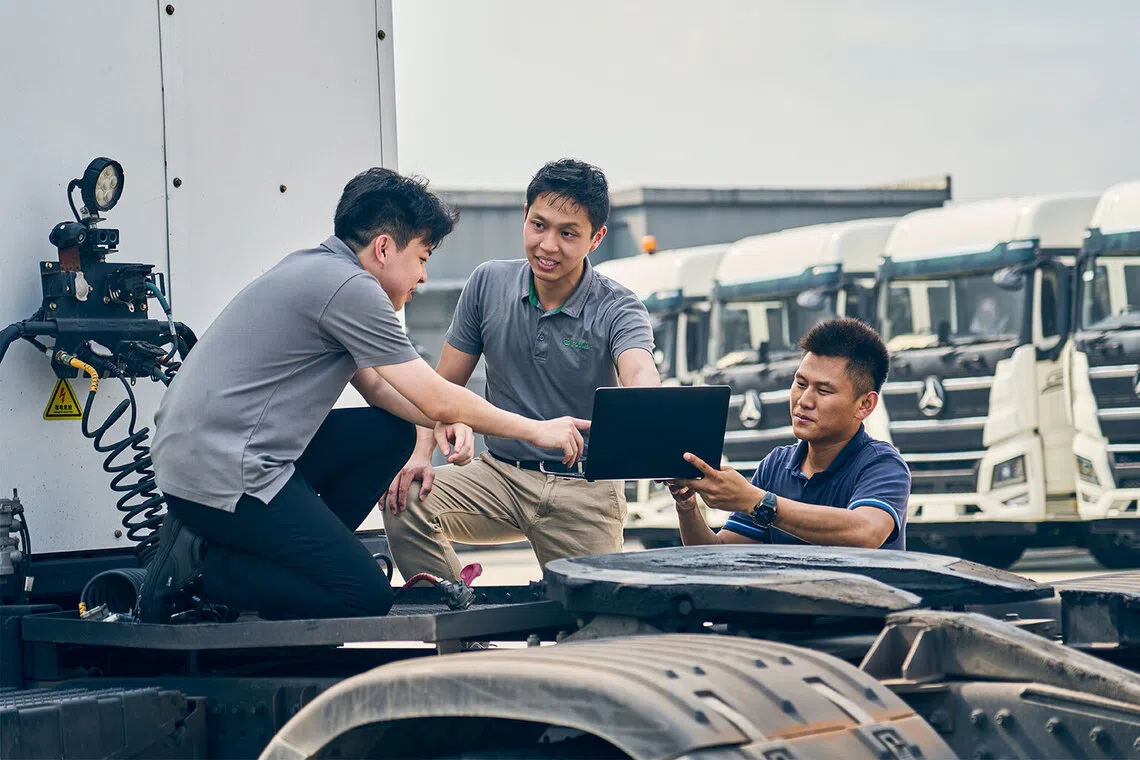
EcoSwift director Ryan Woon (centre) with his team. The company is testing battery swapping as a way to make electric heavy vehicles more practical for logistics operators.
PHOTO: SPH MEDIA
EcoSwift began exploring cleaner transport solutions after director Ryan Woon calculated the emissions from the roughly 100 heavy vehicles operated by parent company Hup Hin Transport, which his grandfather founded in 1969.
The exercise put the scale of the challenge into perspective: the fleet generated about 1,000 tonnes of carbon dioxide emissions a year.
Woon says: “I am not proud of the resulting number and I thought that if we are to remain relevant as an industry, we had to change the way things are done.”
That prompted EcoSwift to start building the infrastructure to support the use of electric heavy vehicles. It launched a heavy goods vehicle charging hub in 2023. Two years later, it launched a truck battery swap station in Tuas – the first open to the public for electric HGVs in Singapore.
The station is operating under a four-year Land Transport Authority trial. EnterpriseSG helped EcoSwift navigate the regulatory process and supported logistics operators taking part in its electric prime mover trial.
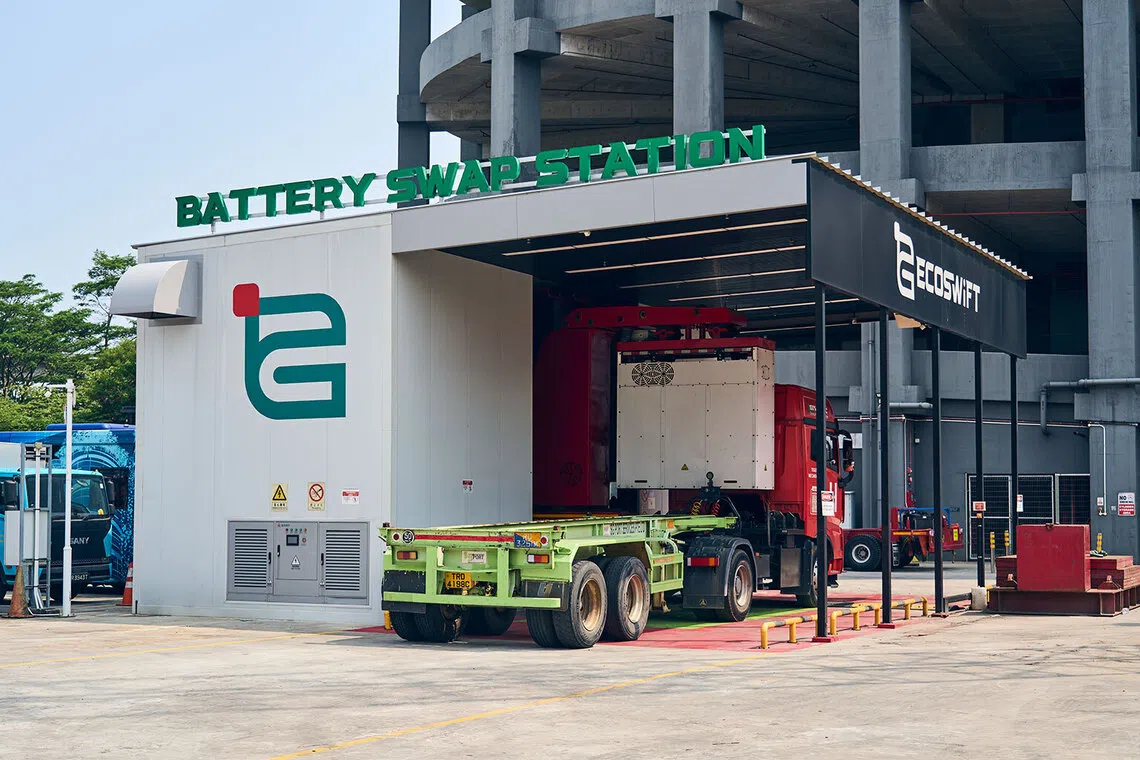
EcoSwift’s battery swap station in Tuas allows electric heavy commercial vehicles to exchange a depleted battery for a fully charged one in about five minutes.
PHOTO: SPH MEDIA
Woon says that support was crucial. For a new system such as battery swapping, getting the technology to work was only part of the challenge. The standards and requirements for how such stations would operate also had to be worked out.
“Without the EnterpriseSG team proactively engaging the regulatory bodies to study and develop standards for swap stations, we couldn’t have done it,” he says.
Staying ahead of supply-chain disruptions
Some logistics challenges are harder to see coming. Sudden changes in supply and demand can leave companies with too much stock, too little or with goods in the wrong place.
For food supply-chain company Seo Eng Joo Frozen Food (SEJ), getting earlier warning of such problems has become increasingly important as its operations have grown.
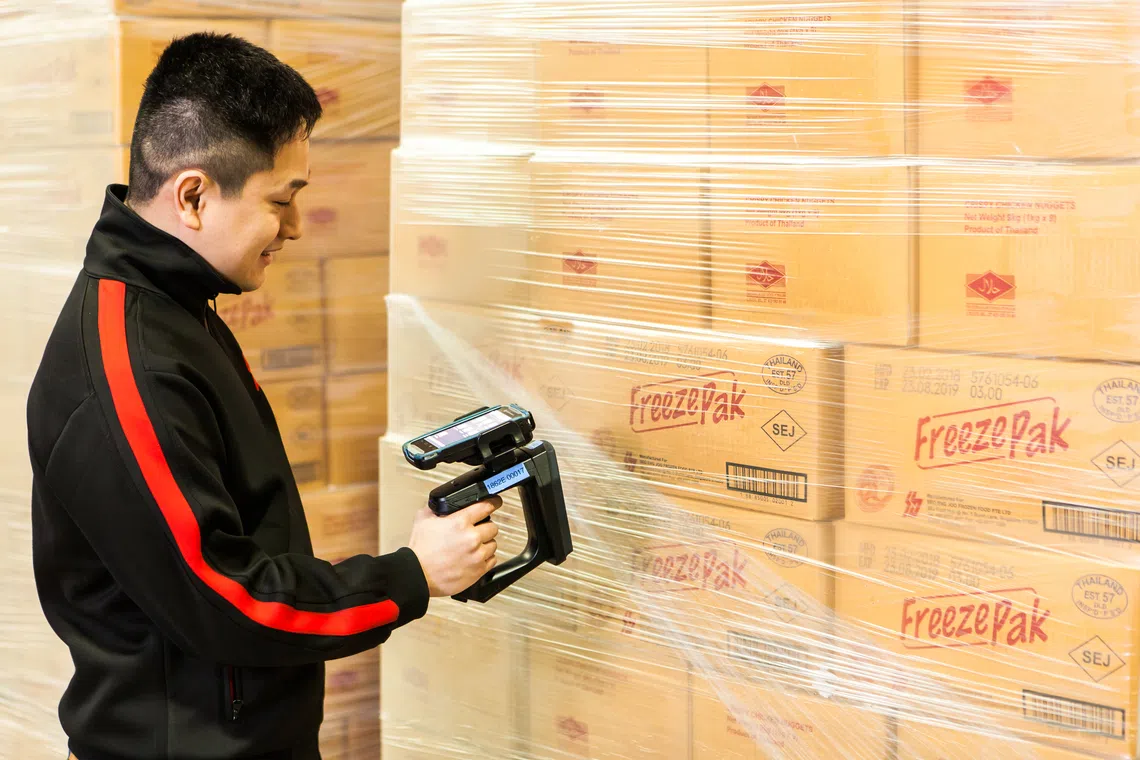
SEJ staff members use digital systems to support traceability and warehouse control, with Ouroboros providing replenishment alerts and more structured procurement workflows.
PHOTO: SEO ENG JOO FROZEN FOOD
Founded as a wet market butcher in 1956, SEJ has grown into a food supply-chain business spanning cold-chain logistics, distribution and manufacturing. Its revenue has roughly doubled over the past decade with director Vincent Seo attributing part of that growth to technology.
For a business handling temperature-sensitive products, spotting potential disruptions early is particularly important. By bringing together data from across its supply chain, SEJ can get a clearer picture of its stock and respond more quickly when problems emerge.
The company is now developing Ouroboros, a digital platform that helps it track stock replenishment and procurement.
The need for earlier warning became clear during Covid-19, when a sudden spike in demand for its FreezePak Nuggets coincided with supply disruptions, leaving SEJ short of stock despite holding several weeks of inventory. Ouroboros is intended to flag such changes earlier and recommend when to order or move stock.
The lesson, says Seo, is that holding more stock is not enough. “Resilience requires earlier information, better forecasting and faster coordinated decisions,” he says.
The idea took shape after SEJ’s management team participated in EnterpriseSG’s Scale-Up programme, which helps high growth local companies sharpen their growth strategies and strengthen leadership capabilities.

Seo Eng Joo business development director Charlie Seo (standing, first from left), one of the family members involved in the business, with fellow participants at Enterprise Singapore’s Scale-Up programme.
PHOTO: SEO ENG JOO FROZEN FOOD
As its supply-chain operations have grown more complex, the focus has shifted from simply digitising processes to using data to respond faster when conditions change.
“Nimbleness in adapting is a cornerstone in managing such crises,” says Seo.
Building next-gen logistics capabilities
Allied, EcoSwift and SEJ are tackling different challenges, but their solutions and efforts point to a broader shift in Singapore’s logistics sector.
The players are finding new ways to stay competitive, with technology and new infrastructure playing a bigger role in how goods are stored, moved and managed.
Allied’s new automated Sunview Logistics and Container Hub in Jurong will consolidate its depot and warehouse operations. Targeted for completion in 2027, it is expected to increase storage capacity by 30 per cent, while using about 67 per cent less land than its existing operations.
EcoSwift is using its ongoing trial to test whether battery swapping can work across different types of heavy vehicle operations. SEJ, meanwhile, plans to add AI-driven demand forecasting replenishment and real-time supply chain visibility to its digital platform.
Together, the three companies show logistics players are adapting to an ever-changing business environment and global landscape – whether that means doing more with existing resources, moving towards cleaner transport or reacting faster when supply chains are disrupted.
As Allied’s Lim puts it: “In our industry, standing still is falling behind. Anticipating market shifts through early automation is what keeps us competitive.”
This is where EnterpriseSG comes in, supporting companies at different stages of transformation as they navigate operational challenges and identify solutions to address their needs, says Oeni.
“We stand ready to partner them on their transformation journey, as Singapore seeks to advance its position as a trusted and reliable connectivity hub,” he adds.
This story is part of a series of how Singapore businesses are innovating, building capabilities and finding new ways to grow, with support from Enterprise Singapore. Find out more here.