


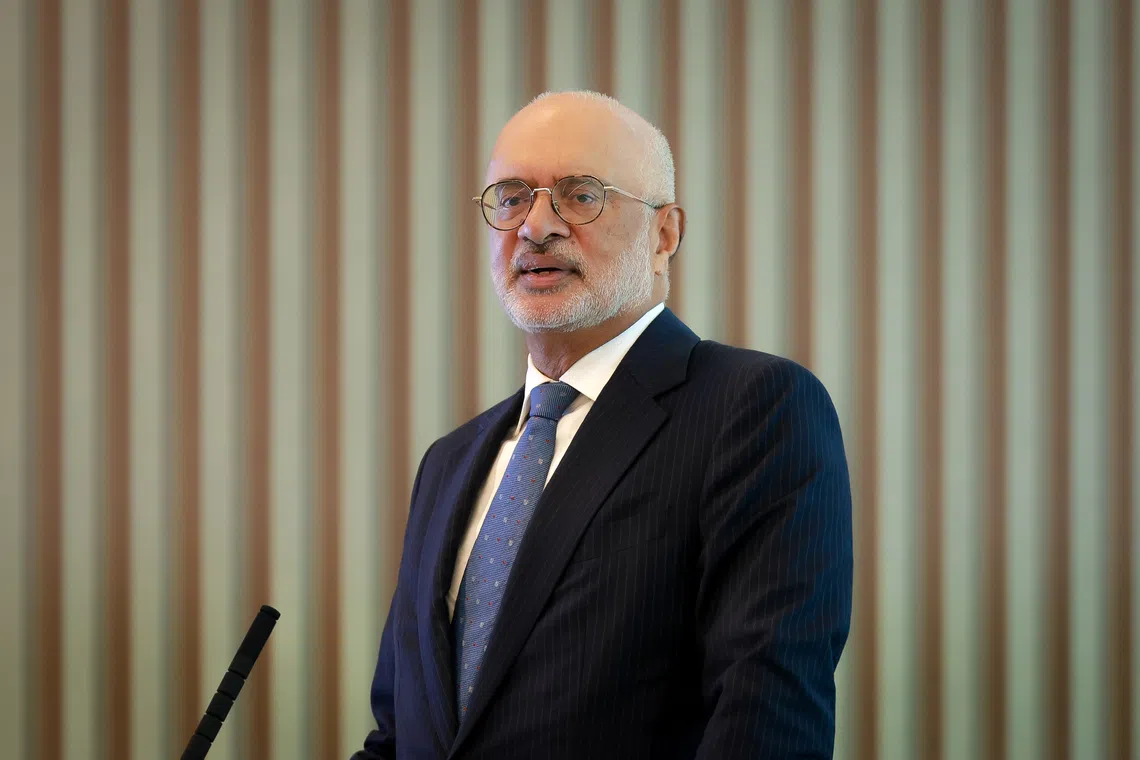
SINGAPORE – As artificial intelligence makes knowledge instantly accessible, universities will have to shift their focus from transferring information to training students how to think.
That means developing their curiosity and judgement, as well as their ability to understand context and connect ideas across disciplines, instead of preparing them narrowly for one profession, said Piyush Gupta, chairman of the board of trustees at the Singapore Management University (SMU).
“The university has to modify to create the platform for this,” he told The Straits Times in an interview.
Gupta, who is 66, stepped down as DBS chief executive in March 2025 after 15 years at the helm. He is currently also chairman of Singapore-listed Keppel Corporation and the Mandai Wildlife Group.
His comments come as universities grapple with how to prepare students for a workplace where AI can increasingly perform the routine research, coding, accounting and administrative tasks traditionally assigned to junior employees.
Automating the “grunt work” traditionally done by fresh graduates has raised concerns about whether they will possess the depth of knowledge and practical experience needed for more advanced roles.
It also suggests that the “graduate premium” – the higher salaries that university graduates have traditionally commanded over non-graduates – could narrow, Gupta said.
Employers may become less willing to pay that premium if graduates bring little to the workplace that distinguishes them from school-leavers with access to the same AI tools.
10 minors over one major
Universities have traditionally performed two functions: transferring knowledge and training the mind. However, the former is becoming less valuable when ChatGPT can retrieve and explain information in seconds.
As such, universities must now ensure that students develop their minds through questioning and discussion instead of simply receiving information, Gupta said.
Students, too, must also reconsider how to get the most out of their years in university.
“So far, the focus has been on choosing a major. In the future, I would say: Forget one or two majors and focus on 10 minors, so you get enough cross-disciplinary and eclectic learning.”
In other words, while deep expertise will remain necessary in areas such as scientific research and semiconductors, many graduates will increasingly gain an advantage by knowing which questions to ask, judging whether an answer makes sense and “connecting the dots” across different domains to understand the broader context, Gupta said.
He noted that SMU’s College of Integrative Studies already allows students to design an individualised major instead of following a conventional course centred on one subject by combining areas such as economics, law and accounting to create their own programme.
Gupta said the university was initially unsure whether enough students would want such flexibility. This year, however, the school received around 900 applications for 100 places.
“There’s obviously a lot of demand from students who are willing to sign up and do this.”
But encouraging students to acquire broader knowledge will achieve little if they outsource its interpretation to AI, as overreliance on the technology could erode the very reasoning skills that a broad education is meant to develop.
He described this as “cognitive debt”, where mental capabilities weaken because people no longer exercise them.
Students may, for example, use AI to produce polished assignments while failing to understand the subject matter, develop an argument independently or recognise when the technology is wrong.
Still, universities should not ban AI, which is now an important tool in the workplace, he said. Instead, they must change how students learn and are assessed.
At SMU, for example, students are being taught to identify flaws and hallucinations in AI-generated answers and verify the technology’s work instead of accepting its output at face value.
“You’ve got to embrace AI, but you’ve got to then shift the pedagogy to make sure that by getting the help of AI, you’re not giving up on reasoning, conceptual, understanding skills.”
He added that universities must double down on “application of mind skills”, including critical reasoning, communication and working with people.
Working with corporations
With more companies expected to reduce entry-level hiring in favour of AI automation, graduates may be expected to take on more advanced responsibilities when they join the workplace without first having the opportunity to practice the basics and learn their trade.
Part of this grunt work will now have to be front-loaded into university through internships, apprenticeships and projects with companies, Gupta said.
Students who do not undertake an internship or apprenticeship, join a start-up or participate in substantial applied work could increasingly be disadvantaged, he added.
SMU plans to deepen its corporate partnerships so that students can apply their knowledge to real life projects and help shape more of such programmes before they enter the workforce. Gupta added that this experience should also extend beyond Singapore to give students exposure to regional markets.
He noted that companies have been “very receptive” to taking on interns because they recognise the potential longer-term problems of hiring fewer graduates.
While more companies are likely to reduce entry-level recruitment as AI takes over junior work, Gupta said the smart ones would not stop hiring graduates altogether.
This is because doing so may save costs in the short term, but it could leave them without a pipeline of employees ready to assume more senior positions several years later.
He cited DBS, which announced plans to hire 600 graduates despite being an extensive user of AI, as an example of a company continuing to invest in its future talent pipeline.
One solution would be for companies to work directly with universities to provide students with the training and practical exposure they would previously have acquired in their first few years of employment.
Graduates could then enter roles that require more experience, rather than having to start in junior positions that companies are increasingly automating or removing.
Government support may also be required. Gupta noted that during the Covid-19 pandemic, the authorities subsidised programmes that encouraged banks to continue hiring and training young people.
A similar programme could motivate companies to provide internships and other forms of workplace learning, he said, with universities, employers and the Government jointly building an industry-wide training structure.
Learning must be for life
Universities must also evolve from providing four years of education to supporting learning throughout a career, as people change jobs and AI reshapes existing occupations, Gupta said.
SMU has around 10,000 undergraduates and 4,000 postgraduate students. In comparison, about 30,000 people attend its continuing education, executive education and academy programmes.
Its lifelong learning population is therefore already more than twice the size of its undergraduate and postgraduate population combined.
Universities will have to help people continuously reinvent their skills rather than assume that knowledge acquired in early adulthood will last for the next several decades.
The structure of employment itself could eventually change, with big companies hiring fewer people and more workers creating their own jobs.
Gupta expects AI to drive the growth of micro-enterprises or “one-person companies”, as AI tools can already perform functions such as accounting, finance, marketing and administration that once required a large organisation, Meanwhile, entrepreneurs can outsource production and reach customers internationally through the internet.
“For all the challenges of AI and job losses, the big silver lining is that it makes it possible to be an entrepreneur and even build a global business by yourself,” he said.
Still, a substantial change in mindset and culture, particularly in Singapore, is needed before this can happen, Gupta said.
He estimated that nine out of 10 students here may lack the risk appetite or inclination to start something themselves.
In Silicon Valley, failing at several start-ups can be viewed as valuable experience and even make an entrepreneur more attractive to investors. In Singapore, failure can carry a lasting stigma and make it harder for someone to obtain financing or another job, Gupta said.
Many people also choose salaried employment because Singapore’s high cost of living makes financial stability important. Regular jobs also provide predictable income, medical benefits and retirement contributions.
If one-person companies and irregular work become more common, support systems will therefore have to change too.
For example, CPF and medical coverage may need to cater better to workers without conventional employers, while banks may have to reconsider their reliance on monthly payslips when assessing applications for housing loans and credit cards.
“While SMU is expanding its incubators and accelerators to help students build businesses and learn from failure, wider changes will also be needed,” Gupta said
“We’re going to have to rearchitect many other systems to prepare for this possibility.”

