


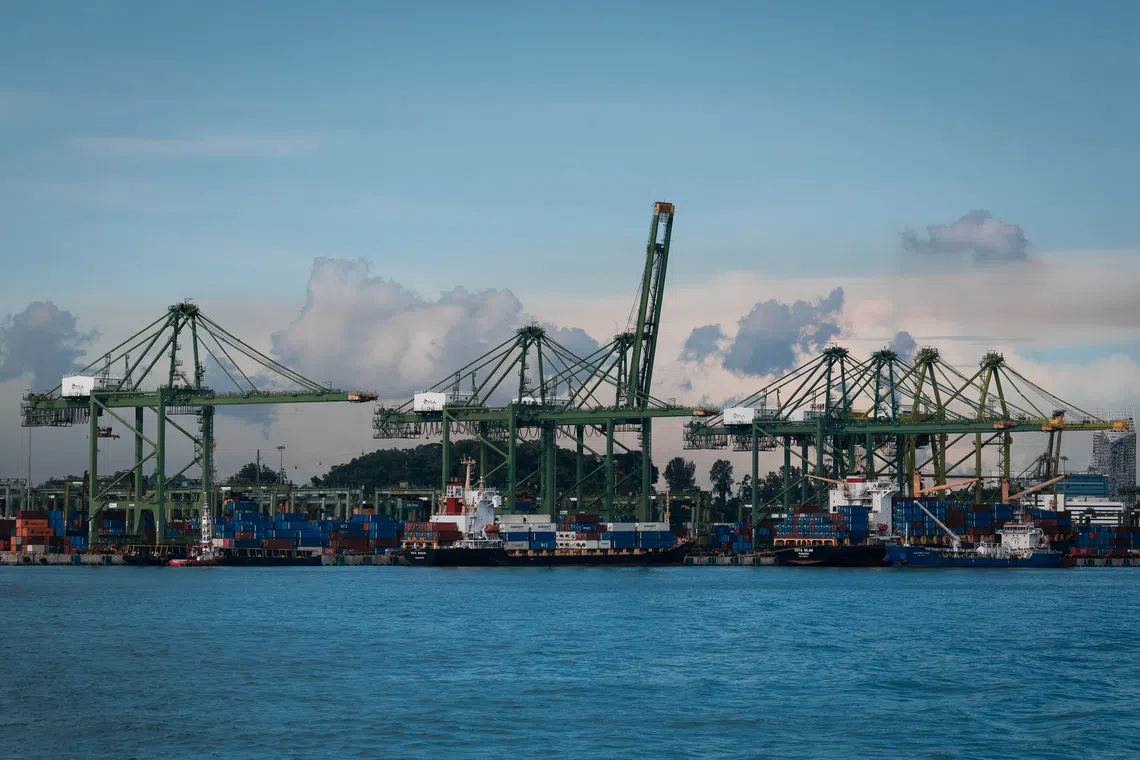
SINGAPORE – Singapore saw more vessel arrivals in August compared with the same period in 2025, according to statistics released by the Maritime Port Authority of Singapore on its website.
However, bunker sales fell again, figures on Sept 14 showed.
Some 11,631 vessels came to the Republic in August, marking a 4 per cent increase year on year.
Vessels came for a variety of reasons, such as for cargo, supplies, bunkering, refuelling or repairs.
Coface chief economist for the Asia-Pacific Bernard Aw said the broad trend is upward in terms of the number of vessels coming to Singapore, but that there is no linear month-on-month increase.
For instance, August saw a year-on-year rise but a month-on-month drop, with a slightly higher 11,655 vessels arriving in July.
Aw said: “Several factors are supporting this growth. Singapore lies at the intersection of the Asia-Europe, trans-Pacific and intra-Asian shipping routes. It is therefore well placed to receive ships adjusting their schedules because of disruption in the Middle East.”
The prolonged Middle East conflict has disrupted shipping lines, primarily through the Strait of Hormuz – a vital global channel for oil and gas – while regional routes also contend with ongoing strikes and attacks in the Red Sea.
Saudi’s East-West pipeline and United Arab Emirates’ Fujairah port have also been affected.
CMC Markets Singapore sales trader Oriano Lizza said: “Ships are still keeping their distance from Hormuz, and some are still sailing round the Cape of Good Hope.
“However, it is unlikely that a substantial number are trading a Gulf call for a Singapore one.”
Aw said that cargo owners have also been holding larger inventories and reorganising supply chains to manage longer and less predictable delivery times.
“This has supported demand for container shipping and transshipment through Singapore,” he said.
However, whether more vessels will come to Singapore in the long term remains to be seen.
Aw said that some of the additional traffic is likely to ease if Middle Eastern shipping routes and port operations normalise.
“Singapore should therefore not assume that all conflict-related diversions will become permanent,” he said.
He noted that Fujairah as well as Jebel Ali port in Dubai, for example, retain important structural advantages because of their locations near Gulf energy production and major shipping routes across the Indian Ocean.
Still, part of the shift could last, especially if the conflict continues.
“A prolonged period of disruption may encourage shipping companies to redesign routes, diversify bunkering locations and avoid excessive reliance on any single port,” Aw said.
“In that environment, Singapore may retain additional business as a dependable alternative or complementary hub, even if Gulf ports recover.”
Lizza said the Republic’s advantage is also the range of services that it offers.
In one port call, a ship can select its fuel with mass-flow-metered assurance on the quantity, use a shipyard, change crew, arrange financing and insurance, and settle disputes through arbitration, for instance.
If Singapore keeps being reliable and fuel is priced competitively, relationships built during this period of disruption can remain even beyond the conflict, Lizza added.
Bunkering sales continue to fall
Despite more ships arriving in Singapore, the amount of marine fuel they buy has continued to decline.
Total bunker sales stood at 4.77 million tonnes in August, a 4 per cent decrease compared with the same period in 2025.
But Aw noted that over the first eight months of 2026 in total, bunker sales were 2.5 per cent higher year on year.
Analysts said earlier that ships might be “slow steaming” to conserve fuel in times of uncertainty and as oil prices soared due to the energy crisis triggered by the effective blockade of the Strait of Hormuz.
Brent crude was still hovering around US$100 per barrel on Sept 22.
Aw said that there has been a change in the composition of bunker demand, as sales of high-sulphur marine fuel oil increased while sales of low-sulphur fuel oil fell.
Low-sulphur fuel oil sales have been falling since the Iran war started, he noted.

