


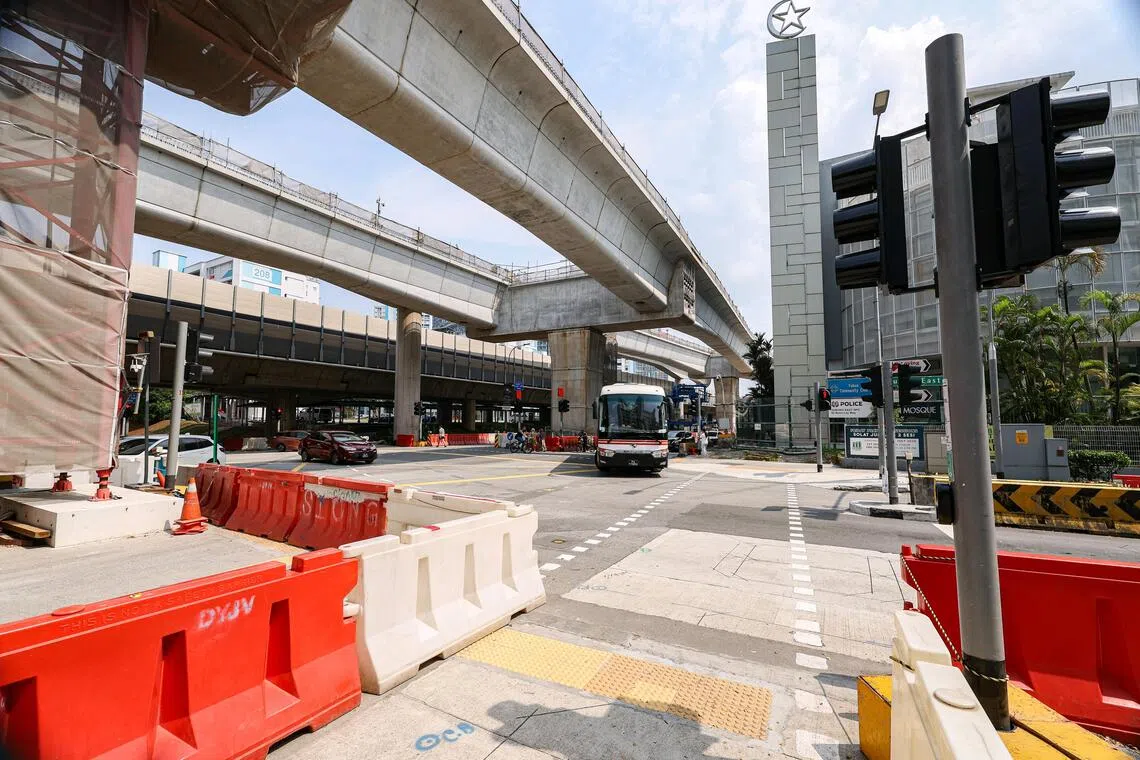
SINGAPORE – The Republic allocated more than $3.7 billion from its green-bond proceeds to finance the expansion of its electric rail network – specifically the Jurong Region Line (JRL) and Cross Island Line (CRL) – in its 2025 fiscal year ended March 31, 2026.
This sum comprised: $142.1 million from the sovereign issuer’s second offer of 30-year green bonds in May 2025; $1.5 billion from the third tranche of 50-year green bonds issued in October 2024; and, $2.1 billion from the first 30-year green bonds issued in June 2024.
The $142.1 million that was allocated came out of the $1.8 billion of 30-year green bonds issued in May 2025.
The Government also raised another $1 billion through its fourth sale of 50-year green bonds in October 2025, though none of the proceeds raised from that latest offering has been allocated yet.
This leaves a total of $2.7 billion that has not yet been allocated, though these are expected to be earmarked for the two rail lines by the end of FY2026, according to the Singapore Green Bond Report for FY2025 released on Sept 21.
This sum has either been temporarily held in a separate cash account maintained with the Monetary Authority of Singapore (MAS) and ring-fenced for other eligible green expenditures, or invested by the Accountant-General’s Department in short-term liquidity instruments, in line with the Singapore Green Bond Framework, added the report by the Ministry of Finance (MOF).
This does not include the $2.4 billion of 20-year green bonds that were issued in July 2026, as these were issued in the current financial year.
Since Singapore’s inaugural green-bond issuance in August 2022, the Government has allocated a total of $9.3 billion towards financing the development of JRL and CRL, as at March 31, 2026.
This consists of the $3.7 billion that was allocated in FY2025, as well as: the inaugural issuance of $2.4 billion in 50-year green bonds; another $2.8 billion raised from the reopening of the same 50-year bonds in September 2023; and, $404 million out of the $2.5 billion in 30-year green bonds issued in June 2024.
The use of these proceeds for the construction of the JRL and CRL was deemed to be eligible green expenditures for clean transportation, and was approved by the green bond steering committee, which was set up by MOF.
The report also stated that the proceeds were used in a manner that complied with the eligibility criteria in the Singapore Green Bond Framework – which was last updated in January 2025 to align with the national taxonomy defining which economic activities qualify for sustainable financing. It added there were no ESG controversies reported in FY2025.
Key to cut emissions
The JRL is a 24km train track that is expected to be completed in 2029, with 24 stations serving the western part of Singapore.
The CRL is expected to be completed by 2032, and is projected to be the longest fully underground line with more than 50km of train tracks cutting across the city-state when it becomes operational.
There has been debate over the alignment of the track, with nature groups raising concerns about how a particular stretch slated to be built across the Central Catchment Nature Reserve and MacRitchie Reservoir could potentially cause environmental damage.
Nonetheless, the report noted that the development of both train lines will be a key enabler to halve land-transport emissions by 2040 from their peak in 2016, and for Singapore to achieve net-zero emissions by 2050.
The land-transport sector accounts for 15 per cent of the country’s carbon emissions.
“One key strategy to reduce carbon footprint in this sector is encouraging greener commutes, among other initiatives such as vehicle electrification and greening infrastructure and operations. Expanding our public-transport infrastructure and electric rail network is a core element of this strategy,” said the report.
The completion of these lines will expand the rail network to 360km by around 2030, and help increase mass public transport peak modal share to 75 per cent, from the current 66 per cent.
The report estimated that both rail lines, when fully running, would likely prevent between 99,900 and 122,100 tonnes of carbon dioxide equivalent (CO2e) from being emitted annually over the course of its operational lifetime.
This represents an estimated emissions reduction of 81 per cent, compared with the baseline scenario where the projects do not exist.
Financed emissions avoided for the green-bond portfolio is estimated to be between 16,100 and 24,100 tonnes of CO2e annually, based on the total amount of $9.3 billion allocated thus far.
The avoided emissions intensity is projected to be between 1.7 and 2.6 tonnes of carbon emissions for every $1 million allocated.
The report added that, besides the climate impact, the JRL and CRL are also expected to generate wider economic and social benefits, including enhanced connectivity and accessibility, increased public-transport usage, commuter travel-time savings and job creation.
“While it is not possible to attribute the number of jobs created to specific rail lines, the JRL and CRL combined is projected to create about 1,500 jobs by 2030, growing the rail workforce by around 16 per cent,” it stated.
The Singapore government has indicated that a pipeline of up to $35 billion of sovereign and public-sector green bonds will be issued by 2030.
A total of $25.8 billion has been raised as at the end of FY2025, with $12 billion from MAS, which is acting on behalf of the Government, and the rest from statutory boards. THE BUSINESS TIMES

