


SINGAPORE – The US central bank raised interest rates by a quarter percentage point to a range of 3.75 per cent to 4 per cent on Sept 16 – the first such move in three years, with analysts expecting more rate hikes to come.
But what exactly does this mean?
The Federal Reserve raising interest rates shows that it aims to bring down further gains in inflation, especially amid higher energy prices as a result of the prolonged crisis in the Middle East, among other factors.
Higher interest rates help tame inflation by making borrowing more expensive and saving more attractive, which cools spending and investment and slows price increases.
Fed chief Kevin Warsh said the tighter monetary policy was due to strong US economic and job growth, alongside price pressures that are not just rooted in oil prices or import tariffs.
Analysts also expect that this rate bump is only the first in a series of hikes to come, with UOB economists expecting two additional hikes in December and in the first quarter of 2027.
St James’s Place Asia senior investment manager Eugene Tan said of the rate hike: “The immediate impact of higher interest rates is often seen in bond markets, where yields can rise and borrowing becomes more expensive for households, companies and governments.
“Higher financing costs can affect consumer spending, corporate investment decisions and the cost of servicing and refinancing government debt.”
What are “Fed rates”?
This refers to the range set by the Federal Open Market Committee for the overnight interest rate at which US banks lend to one another.
The rate also influences broader borrowing conditions, spending, employment and inflation.
The range before the September decision was 3.5 per cent to 3.75 per cent. It is now raised to 3.75 per cent to 4 per cent per annum.
A rate hike makes money more expensive, and is normally described as a “tighter” or “hawkish” policy. Meanwhile, a rate cut makes short-term money cheaper, said Fullerton Fund Management head of investment strategy Robert St Clair.
The impact of Fed rates is global, as the US is the world’s largest financial market and the US Dollar is the main currency used in global trade, finance and reserves, he added.
The US Dollar also finances much of global investments, while US Treasury yields provide a benchmark for borrowing costs and investment returns worldwide, noted OCBC head of wealth advisory Chez Anbu.
Higher US rates therefore affect currencies, businesses and households well beyond the US.
How does this affect the USD and SGD?
A Fed rate hike typically boosts the USD, although this can also depend on other financial conditions.
The magnitude of the recent hike will depend on whether the Fed ultimately follows through with additional hikes and whether inflation proves as persistent as policymakers currently fear, said Invesco’s David Chao.
Meanwhile, the Singapore Dollar is a little different from other currencies because the Monetary Authority of Singapore (MAS) manages it against a basket of currencies of major trade partners.
A stronger USD may push the USD/SGD exchange rate higher, but the Singdollar can still be supported over time against the broader basket of currencies if MAS allows it to appreciate, said St Clair.
CGS International Securities Singapore’s portfolio manager Gunawan Wijaya added that the SGD’s strength against the USD is likely to hold up despite the rate hike.
“In addition, Singapore’s strong economic pillars and fiscal discipline are favourable attributes that would further underpin the currency’s strength,” he said.
Impact on Singapore rates
MAS does not control domestic interest rates.
Instead, its monetary policy around the Singapore dollar helps to contain imported inflation, which is especially relevant now when global energy prices are rising, said OCBC’s Anbu.
“Singapore does not automatically match a Fed hike with a domestic policy rate hike,” he said.
Singapore uses the SORA – the Singapore Overnight Rate Average – which reflects what banks pay to borrow SGD overnight.
“Global interest rates influence it, but local funding availability and currency expectations also matter,” he said. “A Fed hike can therefore put pressure on SORA without producing an identical increase.”
But he also noted that the three-month compounded SORA incorporates the rate from the preceding three months, so any adjustment takes time. Meanwhile, fixed rate loans will retain their agreed rates.
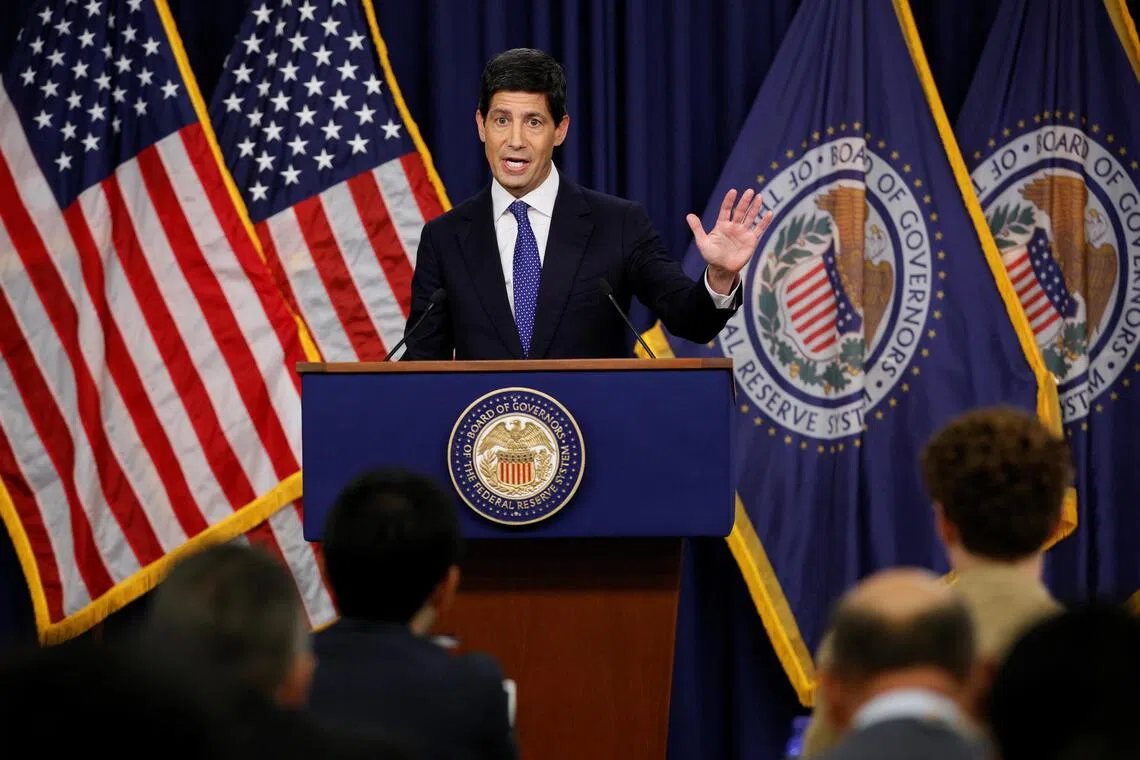
Fed chief Kevin Warsh said the tighter monetary policy was due to strong US economic and job growth, alongside price pressures that are not just rooted in oil prices or import tariffs.
PHOTO: REUTERS
St Clair added that it is “premature to judge” how the Fed rate hike will affect Singapore’s borrowing costs and loan rates.
“Nevertheless, Singapore interest rates are connected to global rates through trade and open capital markets, but the relationships are not straight-forward,” he said.
Eastspring Investments’ Goh Rong Ren said fixed-rate borrowing costs in Singapore remain relatively low compared with levels seen over the past few years.
Borrowers who are concerned about rates rising further can reduce that uncertainty by considering fixed-rate packages that lock in borrowing costs for the next two or three years, he said.
Impact on bonds
There could be some impact on local bonds.
US rates matter to Singapore bond investors because they compare the returns available from SGS and US Treasuries.
CMC Markets Singapore sales trader Oriano Lizza noted that Singapore Government Securities (SGS) yields have followed US Treasury yields up over the past month.
This means holders of existing SGS may lose out as the market value of existing bonds falls, while new SGS buyers gain from the higher returns.
But Singapore’s bond yields still trade significantly lower than the US because Singapore has a high national savings rate and strong government financials, although a Fed rate hike can still put some upward pressure on Singapore’s short-and medium-term yields, St Clair said.
Strong demand for SGS allows the Government to borrow at lower rates.
He added that the demand for Singapore bonds is likely to remain robust as yields are more stable than global rates, and the Singapore government has a very high credit rating.
Impact on Singapore equities
The Straits Times Index responded to the hike by rising 0.5 per cent to close at 5660.52 on Sept 17.
However, analysts said the higher rates could also mean more volatility in the markets in the days ahead.
CGS’ Wijaya said that in a higher interest rate environment, equity risk premiums also rise. Investors would demand a bigger potential return from shares to compensate for the greater risk of holding them compared with safer assets.
“This will tamper investors’ risk appetites for risky assets such as equities and seek defensive assets such as cash,” he said.
Higher rates also translate into higher financing costs, particularly for small and medium enterprises (SMEs) that might have limited access to capital. This could affect their earnings and share price.
However, he noted that as a safe haven, the STI has so far held up well, with strong inflows into Singapore’s equity market.
JP Morgan Asset Management’s Tai Hui said growth stocks could also feel pressure from the higher rates.
“Resilient growth and higher rates could benefit sectors such as financials, consumer discretionary and industrials,” he said.

