


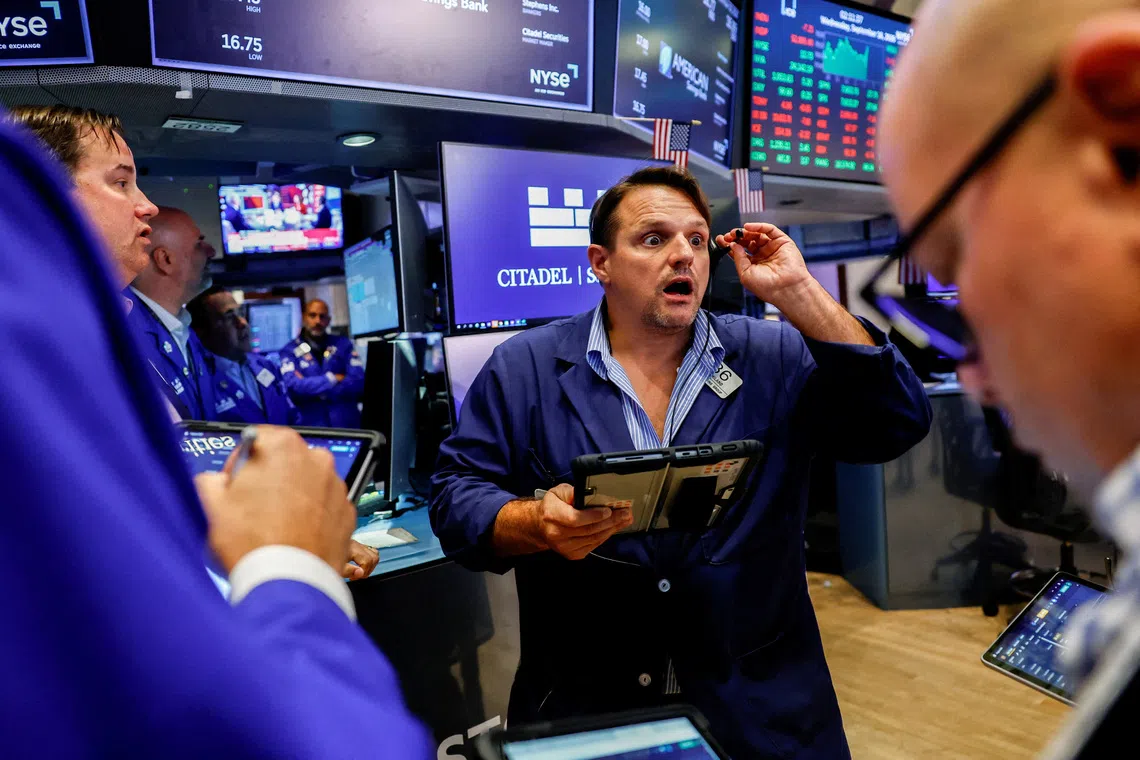
NEW YORK – US stocks whipsawed lower on Sept 16 after the Federal Reserve raised its key interest rate for the first time in over three years to fight stubbornly high inflation stemming from soaring crude oil prices during the US-Israeli war on Iran.
In its accompanying statement, the Fed said its decision was unanimous and more tightening is likely in the near future to effect a timelier drop in inflation.
“As widely expected, the Fed hiked interest rates for the first time in more than three years,” said Ryan Detrick, chief market strategist at Carson Group in Omaha. “The reality is the Fed seems unified in the fight against inflation.”
In his subsequent press conference, Fed Chair Kevin Warsh said the US economy has strengthened since the last Fed meeting, but the inflation trend has shown little improvement.
“The good news is the (Fed) doesn’t think multiple hikes over the coming months will do much to dent the solid overall economy,” Detrick added. “At the same time, inflation has been above the 2 per cent target for five years now.”
Before the Fed’s announcement, the three major US stock indexes had been gaining ground, with a chips rebound, giving the tech-heavy Nasdaq the edge.
Earlier in the session, robust retail sales data suggested consumers were still spending, despite an affordability squeeze due to rising prices, particularly at the petrol pump.
The war in the Middle East expanded as Saudi warplanes pounded Yemen while Iran-backed Houthi fighters launched drones and missiles at Saudi cities in a signal of Iran’s extended reach in the widening conflict.
Even so, oil prices dipped after reports that Saudi Arabia was offering additional crude cargoes via Oman eased concerns about supply disruptions. Crude is up over 20 per cent in the last 2-½ weeks.
Front-month WTI settled down 3.2 per cent and Brent crude settled down 2.7 per cent.
The Dow Jones Industrial Average fell 631.33 points, or 1.21 per cent, to 51,461.78, the S&P 500 lost 33.59 points, or 0.44 per cent, to 7,552.14 and the Nasdaq Composite lost 3.15 points, or 0.01 per cent, to 25,978.43.
Tech shares were the biggest gainer among the 11 major sectors of the S&P 500, while energy, weighed down by easing crude prices, suffered the largest percentage drop, falling 3 per cent.
Chevron and Exxon Mobil fell 2.9 per cent and 3.5 per cent, respectively, while Devon Energy and ConocoPhillips lost more than 5 per cent each.
Tech got a lift as semiconductor shares, advanced 0.6 per cent in their first decisive gain since a joint call from AI executives seeking a slower rate at which capabilities are advanced and industry-wide safety coordination.
Robinhood shares dropped 5.5 per cent after the US Senate failed to advance sweeping cryptocurrency legislation in a major blow to digital asset companies.
Separately, the US Department of Justice on Sept 15 charged two former Robinhood engineers with insider trading and misuse of confidential information.
Intel jumped 4 per cent after a report said South Korea’s SK Hynix was in talks with the company about memory chip manufacturing in the United States. US-listed shares of SK Hynix rose 0.6 per cent.
IBM fell 4.4 per cent after the company said Anderon, its chip unit, has signed a funding agreement with the US government.
Planemaker Boeing slid 3.7 per cent after Chief Executive Officer Kelly Ortberg said it is “taking longer than expected” to stabilise 737 MAX production rate at 47 aircraft per month.
Declining issues outnumbered advancers by a 1.75-to-1 ratio on the NYSE. There were 76 new highs and 430 new lows on the NYSE.
On the Nasdaq, 1,913 stocks rose and 2,840 fell as declining issues outnumbered advancers by a 1.48-to-1 ratio.
The S&P 500 posted 10 new 52-week highs and 20 new lows while the Nasdaq Composite recorded 51 new highs and 257 new lows.
Volume on US exchanges was 18.42 billion shares, compared with the 15.33 billion average for the full session over the last 20 trading days. REUTERS

