In early 2026, a 13-year-old girl and her family faced a worrying possibility: the liver she had received in a transplant as a baby might have deteriorated.
Seeking an additional – and objective – assessment, her specialist turned to Singapore biotechnology company HistoIndex for a clearer answer. Its technology found only minimal scarring, bringing relief to the family.
Behind that reassuring result were years of research to turn complex science into a tool doctors can now use.
How precision medicine can improve disease assessment
HistoIndex’s technology, the result of 16 years of hard work, helps doctors see how a disease is changing and whether a treatment is working. Drug companies can also use the technology to assess potential new medicines.
The firm’s approach is rooted in precision medicine, which uses a person’s genes, environment, and lifestyle to guide disease prevention, diagnosis and treatment.
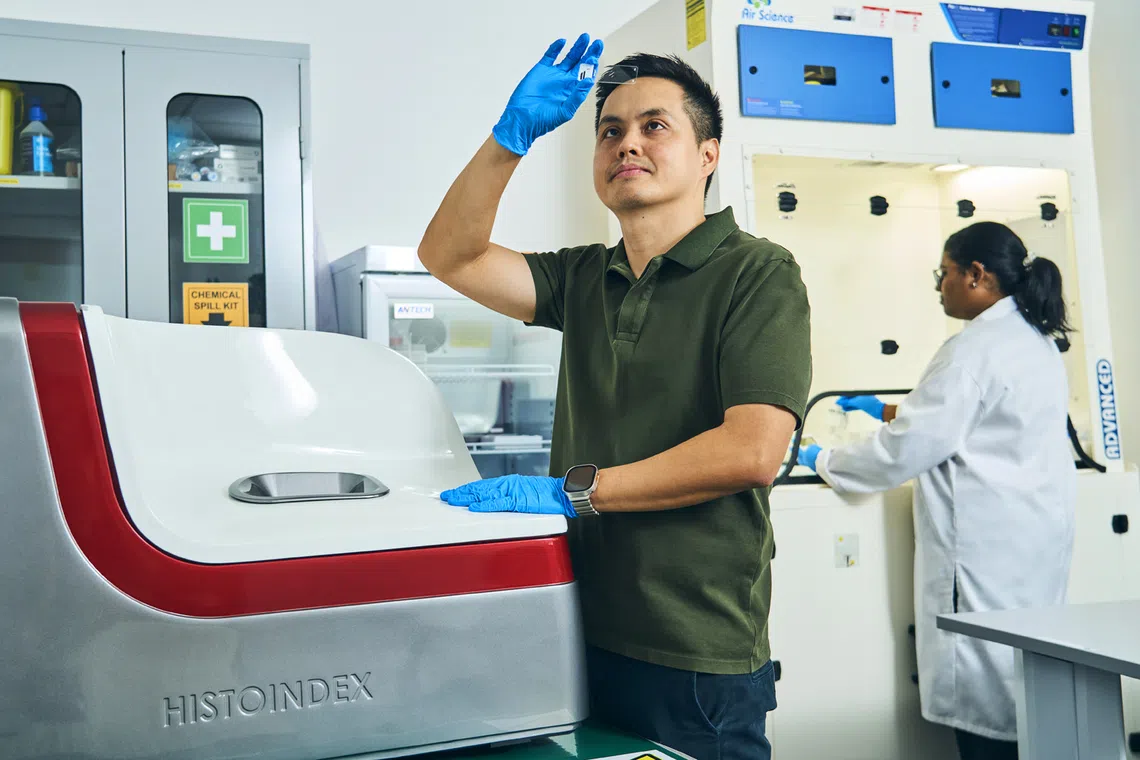
HistoIndex’s Genesis200 imaging system can examine tissue without the usual staining process, helping doctors measure the extent of fibrosis.
PHOTO: SPH MEDIA
As HistoIndex moved from research to commercial use, Enterprise Singapore (EnterpriseSG) supported the development and validation of its AI-powered analysis tools.
Its co-founder and chief executive officer Dr Gideon Ho says: “EnterpriseSG’s support enabled us to strengthen the underlying AI analytics, test the approach using clinically relevant liver-biopsy datasets and evaluate its performance against established pathology standards.”
That helped lay the groundwork for the company to take its technology overseas and widen its international clinical adoption and collaborations, as its solutions gained traction and became a standard of use today in the diagnosis of certain liver diseases.
Today, among many other collaborations, HistoIndex partners Peking University and Mt Sinai Health System in New York, and its customer base has expanded to include 21 large pharmaceutical companies, 20 biotechnology companies, and 60 universities, hospitals and research institutes.
It is now looking to take the next step: bringing its AI-powered diagnostic and prognostic tests into more hospitals, while growing its business in the US.
How doctors can test cancer treatments before prescribing them
What if doctors could see how a cancer patient might respond to different drugs before deciding on a treatment?
Singapore-based Kyan Technologies is working to do just that. Its platform, Optim.AI, tests medicines on a patient’s cancer cells outside the body, then analyses the results to help doctors identify promising treatment options. Results are typically available within seven to 10 days.
The technology was first developed in the US before research continued at the National University of Singapore (NUS) from 2013. Clinical studies began in 2016, before the work was commercialised through the launch of Kyan Technologies in 2022.
By 2023, the technology had moved into commercial patient use in Singapore, after Kyan’s laboratory was licensed by the Ministry of Health and accredited by the College of American Pathologists. The laboratory has since supported tests from more than 10 countries and patients cared for by nearly 200 clinicians worldwide.
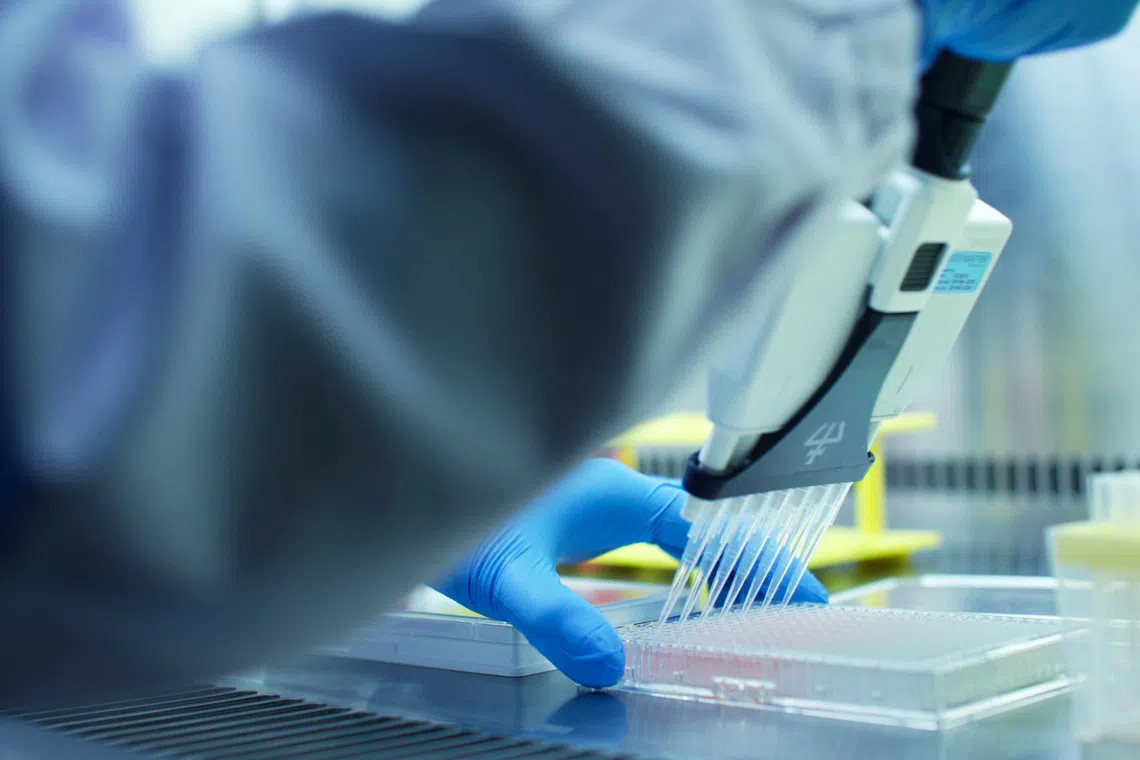
At Kyan Technologies’ laboratory, cancer cells are exposed to different drug combinations outside the body to assess their response and help inform treatment decisions.
PHOTO: KYAN TECHNOLOGIES
Kyan’s journey reflects a broader shift in Singapore’s precision medicine sector, as more research makes its way out of laboratories into clinical and commercial use.
The precision medicine sector is growing rapidly worldwide, with its value projected to rise from about $100 billion today to $266 billion by 2034. In Singapore, it forms part of the country’s $32 billion biomedical sciences industry, with further development being driven by Phase III of the National Precision Medicine programme, which began last year.
Dr Clarice Chen, director of healthcare and biomedical at EnterpriseSG, says: “Advancements in genomics, AI and digital health are enabling more personalised, preventive and predictive care, making precision medicine one of the most significant growth areas in healthcare today.
“EnterpriseSG is committed to partnering innovative local companies to co-develop and validate these solutions with industry and global healthcare partners, helping them commercialise globally and contribute to healthcare systems worldwide.”
Kyan co-founder and chief executive officer Hugo Saavedra remembers a much younger precision medicine sector when the technology was being developed in the 2010s.
“What is stronger today is the pathway from research to commercialisation,” he says.
Saavedra credits EnterpriseSG for helping to accelerate Kyan’s growth, saying the company has worked with the agency like “an extended team”, providing strategy and market insights.
“Without support from EnterpriseSG, Kyan would be pursuing the same mission more slowly, with greater execution risk and under more financing pressure,” he says.
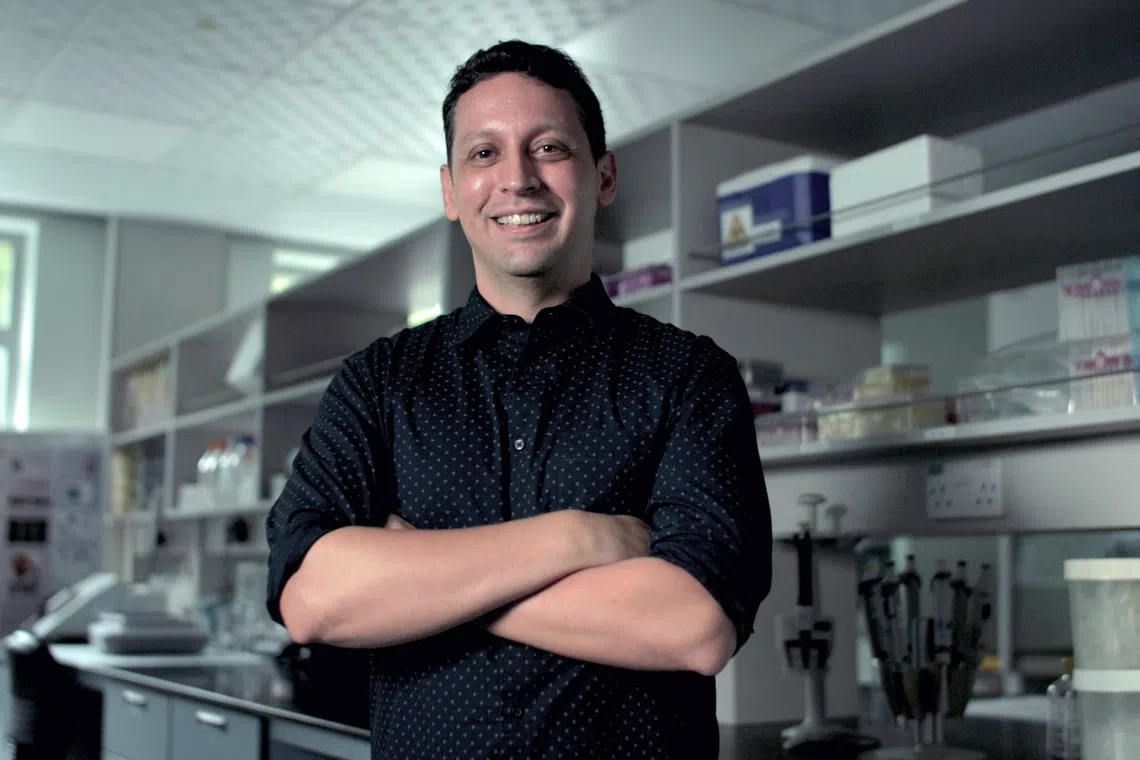
Kyan Technologies’ co-founder Hugo Saavedra says Enterprise Singapore has helped the company understand new healthcare markets and connect with potential clinical partners.
PHOTO: KYAN TECHNOLOGIES
The challenge now is to show that the method can deliver consistent results across different healthcare systems and patient populations.
To support that next stage, EnterpriseSG has introduced Kyan to teams at institutions including Mayo Clinic, MD Anderson and Memorial Sloan Kettering in the US, and Charité Hospital Berlin in Germany. The agency has also worked with the company to assess potential laboratory partners and advance plans for clinical validation.
For Saavedra, that support has helped Kyan navigate unfamiliar markets and reach the right partners more quickly.
“EnterpriseSG’s networks, market knowledge and support have helped us reach the right partners and move through a complex healthcare market more efficiently than we could have done alone,” he says.
Why matching cancer patients to clinical trials remain difficult
But identifying what may work for a patient is only part of the challenge. Another is connecting patients to possible treatments beyond standard care, including clinical trials.
Dr Huren Sivaraj, co-founder and CEO of the home-grown company Oncoshot, says: “Therapies are moving faster than the systems that connect patients to them. That gap is operational, not scientific.”
Part of the problem is how information is stored and then analysed. Hospitals hold vast amounts of patient data in pathology reports, imaging reports and doctors’ notes, much of which is written as free text that are historically challenging to search through.
At the same time, clinical trials can have lengthy and highly specific eligibility requirements that need precise information from such documents.

Oncoshot’s platform helps hospitals make better use of patient data for research and clinical-trial recruitment.
PHOTO: SPH MEDIA
Founded in 2018, Oncoshot developed RecommendTx, a platform that uses large language model AI to extract information from medical records and then match cancer patients with clinical trials.
The platform can also help research teams identify relevant patient cohorts in minutes rather than months, while allowing researchers to analyse patterns across broader patient populations.
Oncoshot has grown from its first hospital partnerships in 2021 to operations in Singapore, Australia, India, Japan, Taiwan and the US.

Medical oncologist Dr Huren Sivaraj (left) co-founded Oncoshot with chief technology officer Ruslam Enikeev to tackle a gap in cancer care: making it easier to match patients with suitable clinical trials.
PHOTO: SPH MEDIA
Its technology could be built quickly with the help of EnterpriseSG’s Enterprise Development Grant (streamlined into EDGE Grant from Sept 30), which supported the development of its Well Characterised Repository, the underlying infrastructure that converts raw hospital records into structured, usable information.
The company’s goal now is to turn individual deployments into a wider regional data infrastructure.
“Our priority now is scaling up hospital deployments, to become the first and leading federated data infrastructure across Asia-Pacific,” says Sivaraj.
What’s next for precision medicine in Singapore
As technologies such as these move from research into patient care, the challenge is making them work reliably across more hospitals and for many more patients.
That will become increasingly important as Singapore expands precision medicine nationally. Phase III of the National Precision Medicine programme aims to involve about 450,000 residents and bring precision medicine further into the public healthcare system.
For companies such as HistoIndex, Kyan Technologies and Oncoshot, that means working more closely with hospitals and other healthcare partners, while proving that their technologies can work beyond the settings in which they were developed.
Ultimately, the promise of precision medicine will be measured not just by advances in the laboratory, but by what they change for patients. For one 13-year-old girl, that change was simple but significant: knowing that her transplanted liver was doing better than her family had feared.
Says EnterpriseSG’s Chen: “The future of healthcare lies in delivering the right intervention to the right patient at the right time.
“While the journey has not been easy, Singapore companies have demonstrated the ability to translate R&D to meet clinical needs and improve healthcare outcomes locally and globally. EnterpriseSG’s goal is to help Singapore companies become global leaders in this field and establish Singapore as an international innovation hub for precision medicine.”
This story is part of a series that explores what’s next for Singapore businesses across industries, and how they are partnering Enterprise Singapore to build resilience, seize new opportunities and grow. Find out more here.