


SINGAPORE – Mary Chia Holdings’ stock exchange sponsor has disagreed with the beauty and wellness group over its decision not to disclose court proceedings concerning unpaid Central Provident Fund (CPF) contributions, saying the case was a material development that should have been announced to investors.
This came as the Catalist-listed company’s independent auditor, Foo Kon Tan, issued a disclaimer of opinion on its financial statements for the year ended March 31, citing unresolved issues across 12 areas, including revenue, inventories, borrowings, staff costs and its ability to continue as a going concern.
A disclaimer of opinion means the auditor was unable to obtain sufficient evidence to form an opinion on the financial statements.
Mary Chia said in a regulatory filing on Sept 11 that its wholly owned subsidiary, Mary Chia Beauty & Slimming Specialist, appeared in the State Courts on Sept 10 over outstanding CPF contributions, as first reported by The Straits Times.
The company was responding to a query from the Singapore Exchange Regulation (SGX RegCo), which asked why the matter had not previously been disclosed.
Mary Chia said it began reviewing its CPF records after receiving feedback from employees around September 2025 regarding possible omissions involving certain variable-income components. It subsequently found similar discrepancies at some subsidiaries and submitted rectification reports to the CPF Board.
Mary Chia also disclosed that its subsidiary has paid $91,925.50 towards its CPF liability, with the latest payment of $11,291 made on Sept 9. An amount totalling $50,208 is still outstanding as at Sept 10.
The court was told that payments were being made under an arrangement with the CPF Board. The case was adjourned to Oct 8.
Mary Chia said the arrears initially amounted to an “operational payroll compliance matter” that was being rectified and was not likely to materially affect its share price or create a false market in its securities. It also said the arrears resulted from administrative lapses rather than an inability to pay, and noted that there had been no conviction or adverse order against its subsidiary.
The company therefore continued to hold the view that even the commencement of court proceedings did not trigger a disclosure requirement.
In the same Sept 11 statement, Mary Chia’s sponsor, Evolve Capital Advisory, said that it disagreed with the company’s decision.
Evolve said it first learnt about the CPF arrears at an internal audit meeting on May 25, but was not informed that court proceedings had begun or were imminent. It became aware of the proceedings only on Sept 11 and considered them a “significant escalation” from an operational compliance matter undergoing rectification to formal proceedings over a failure to comply with statutory CPF obligations.
The payment arrangement and absence of a conviction did not remove the need for disclosure, Evolve Capital Advisory said. It concluded that the proceedings should have been announced promptly to allow shareholders and investors to assess their implications for Mary Chia.
Separately, Mary Chia also disclosed that its auditor was unable to express an opinion on its financial statements for the 2026 financial year (FY) because it could not obtain sufficient evidence covering 12 areas.
These included opening balances, impairment of assets, inventories and purchases, receivables, lease liabilities, borrowings, payables, revenue, staff costs, related-party transactions, income taxes and going concern.
Among other issues, the auditor could not verify the appropriateness of the group’s reported FY2026 revenue of $11.88 million or contract liabilities of $4.01 million. It also could not obtain adequate evidence for accrued staff costs of $2.85 million, which included outstanding salaries and CPF contributions.
Mary Chia recorded an audited net loss of $2.64 million for FY2026. This was also $289,000, or 12 per cent, wider than the unaudited loss of $2.35 million announced in May.
The company attributed many of its accounting difficulties to significant employee departures from its finance function. By August, it had substantially fewer finance staff, while the employees who left included those familiar with its historical records.
It added that it would rebuild its finance function, improve the central storage of accounting records and consider hiring temporary or outsourced accounting support, subject to its financial resources.
The audit also raised significant doubt over the group’s ability to continue operating.
Its controlling shareholder, Suki Sushi, which is also controlled by Mary Chia chief executive Ho Yow Ping, has said it will provide financial support for at least 12 months and not demand immediate repayment of amounts owed by the group.
However, the auditor said it was not given sufficient evidence, including Mary Chia’s cash-flow forecast for FY2027 and financial information showing Suki Sushi’s ability to provide that support.
Despite the uncertainties, Mary Chia’s directors said it remained appropriate to prepare the accounts on a going-concern basis. The group is considering ways to raise additional working capital, including a rights issue, share placement or shareholder loans, it said.
Mary Chia added that it will hold its annual general meeting at 10am on Sept 28.
Govt defends SIA’s Air India investment, DBS sued
The Straits Times Index (STI) softened across the week, closing Sept 11 at 5,695.93, down 1.8 per cent.
Shares of STI component stock Singapore Airlines was among the losers during the week, closing down $6.66, down around 1.2 per cent.
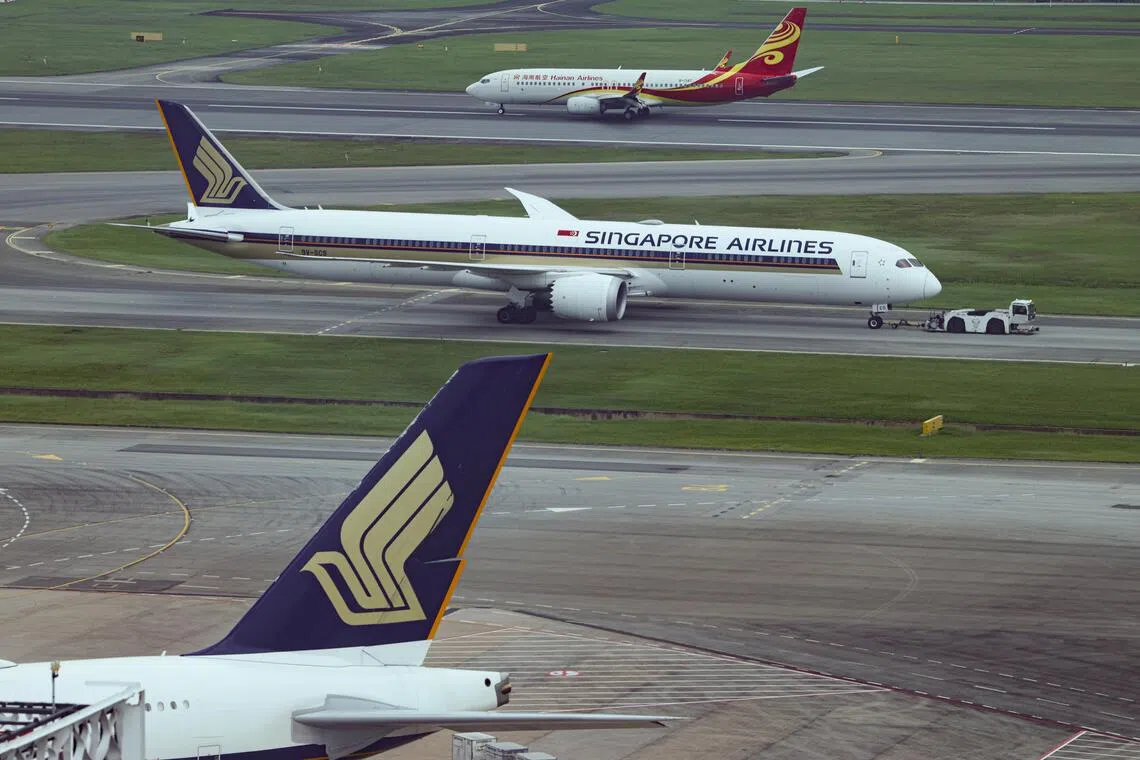
Speaking in Parliament on Sept 8, Transport Minister Jeffrey Siow said SIA’s investment in Air India has no adverse impact on its ability to operate, and added that the airline must continue to stay the course in challenging markets to remain competitive globally.
Since acquiring a 25.1 per cent stake in Air India in 2024, the joint venture has been the single largest drag on SIA’s earnings. For the 2026 financial year (FY) ended March 31, it booked a $945.2 million loss for its share in the joint venture.
SIA has also injected capital into Air India to support the struggling airline, which is reportedly seeking another US$1.5 billion (S$1.9 billion) in fresh equity from SIA and Tata Sons, months after posting a record annual loss.
Siow said Air India’s losses do not automatically become the Singapore carrier’s liabilities, and that SIA is also not obliged to accede to the Indian airline’s request for capital injection.
He added that the onus is on SIA’s board and management to decide whether an investment would make commercial sense for the company and its shareholders, “because it is their duty and responsibility to do so”.
He was replying to a parliamentary question by Workers’ Party MP Kenneth Tiong (Aljunied GRC) on whether SIA’s losses from its foreign investments have been assessed against its capacity to provide essential transport services.
Tiong also noted that there could be further challenging conditions in the Indian aviation market, where the government is mulling over a policy change that would allow the operators of the New Delhi and Mumbai airports – two of Air India’s largest hubs – to operate their own airlines.
DBS Group, a major component stock of the STI, closed the week at $77, down 1.5 per cent.
Singapore’s largest bank is being sued for an estimated $1.3 billion in damages linked to the multibillion-dollar 1Malaysia Development Berhad (1MDB) scandal in Malaysia, it said on Sept 9.
The claimants include the liquidators of four companies: Blackrock Commodities (Global), Platinum Global Luxury Services, Affinity Equity International Partners and TKIL Global Investments.
DBS rejected the claim and said it would fight it vigorously, adding that the company has made no provision for the lawsuit. The bank did not provide any more details on the allegations it faces.
Malaysia media have since reported that the claims filed in Singapore against DBS are tied to accounts opened by a Malaysian associate of fugitive financier Low Taek Jho, or Jho Low, who is accused of siphoning about US$4.5 billion from 1MDB between 2009 and 2014. The associate is reported to have acted as Low’s proxy.
Other market movers
Shares of newly listed Singapore-based freight forwarder All-Link Air & Sea jumped 6.1 per cent to close at 52 cents on Sept 11, after it reported a strong set of results for the six months ended June 30.
The group achieved a 38.2 per cent year-on-year increase in first half revenue to US$40.1 million, compared with US$29 million for the same period in 2025.
The increase was driven by a combination of organic volume expansion across existing operations and contributions from its Malaysia business following the acquisition of MF Logistics freight forwarding business in August 2025.
However, reported profit after tax for the first half was US$2.4 million, compared with US$3 million in 2025, primarily reflecting US$1 million of non-recurring listing expenses. Excluding these expenses, adjusted profit after tax increased 11.6 per cent to US$3.4 million, the company said.
All-Link, which listed on the Singapore Exchange mainboard on Aug 5 at 53 cents per share, said it expects its second half results to be better than the first, and has plans to expand into Vietnam, Thailand and Indonesia.
What to look out for next week
It will be an important week for global markets, with the US Federal Reserve scheduled to announce its latest interest rate decision and release its monetary policy statement on Sept 17.
With US inflation now at 3.4 per cent, exceeding the Fed’s long-term inflation target of 2 per cent, most of the market now expects the central bank to hike interest rates to tame rising costs.
But higher interest rates could also add more volatility to US Treasury yields, which hit their highest levels in years this week, as investors demanded higher returns to hold bonds.
While attractive to bond investors, rising US yields can affect everything from Singapore government bonds and corporate bonds to share prices, exchange rates and, indirectly, borrowing costs here.
To learn more about The Straits Times Index, go to the SPH campaign website.

