


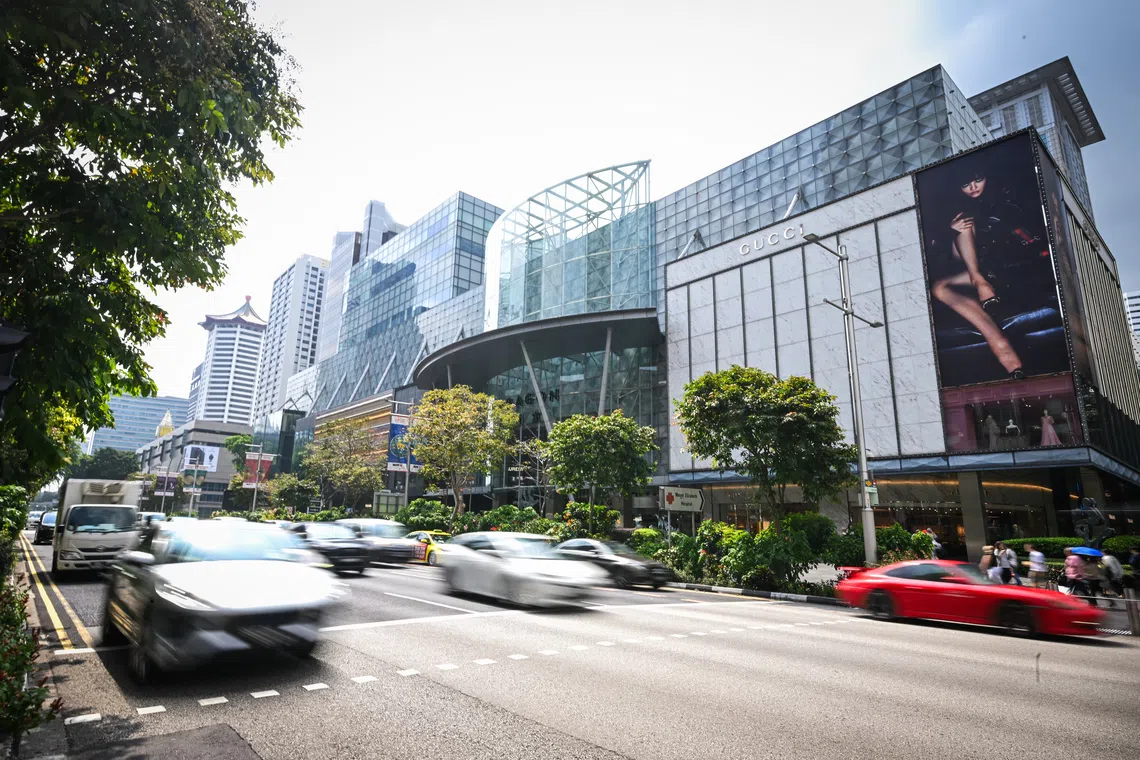
SINGAPORE – Singapore’s shopping malls are being reinvented.
Orchard Road, once the Republic’s premier shopping strip, is now making room for more offices, while suburban malls are undergoing extensive facelifts and tenant revamps.
The mix of shops and experiences is also changing, with once-empty plazas now hosting temporary pickleball courts and malls installing permanent climbing walls.
These changes, aimed at increasing footfall and supporting rents, matter to Singapore’s real estate investment trusts (REITs), many of which own local malls, as well as their investors.
REIT managers interviewed by The Straits Times said strong rental reversions have showed that retail remains resilient despite rising costs, while new tenants and experiences could support further growth.
However, analysts cautioned that higher rental income may not translate into larger dividends, as costly refurbishments and rising borrowing costs absorb some of the gains. REIT managers must therefore balance the need to keep their malls relevant with the imperative to deliver returns to unitholders.
Death of the department store?
One of the biggest changes in Singapore’s retail landscape has been the fading role of department stores as anchor tenants for malls.
Shopping malls once relied on large department stores as flagship anchor tenants, using their broad range of brands and products to draw shoppers. But the e-commerce boom since the Covid-19 pandemic has dented demand for physical retail, gradually diminishing their appeal.
Metro’s impending closure of its last two Singapore stores at Paragon and Causeway Point, for example, follows the exits of Robinsons and John Little over the years, while Isetan has shrunk from six outlets to just one at Shaw House.
Guy Cawthra, chief executive of the manager of Lendlease Global Commercial REIT, said cinemas, supermarkets and large electronics retailers remain relevant anchors, but tenants of different sizes and categories can now draw shoppers.
For Lendlease, whose portfolio includes 313@somerset, food and beverage outlets have become anchors in their own right, with new and trendy tenants like tea brand Black Tree and frozen yogurt shop Yo-Chi drawing snaking queues.
Moving away from large anchor tenants could provide opportunities for higher rental reversions, as REIT managers would be less tied to long leases that may carry below-market rents, said Tan Choon Siang, chief executive of the manager of CapitalLand Intergrated Commercial Trust (CICT), at the REIT’s results briefing in August.
Tan said department stores historically provided footfall and stability in exchange for lower rents, but malls must now reconsider the role they play.
Metro, for example, is exploring more flexible formats, including smaller stores, multi-specialty outlets, curated shopping experiences and pop-ups. CICT’s manager said Metro has expressed interest in remaining at Paragon under a new retail concept, with discussions ongoing.
Frasers Centrepoint Trust (FCT), Singapore’s only pure-play retail REIT, is reworking space vacated by Isetan at NEX as part of the mall’s $90 million enhancement programme.
Judy Tan, FCT’s head of investor relations, said at a panel organised by investment platform Syfe in August that the space would be turned into a lifestyle and family-focused cluster featuring new food and beverage offerings.
Richard Ng, chief executive of FCT’s manager, noted that the traditional department store concept is evolving in response to changing consumer demand.
“This creates opportunities to rethink the traditional format, including breaking up larger spaces into multiple concepts that can enhance space productivity and offer greater variety to shoppers.”
New experiences, more diverse mix of tenants
Fast-changing consumer tastes and demands require malls to continually update their offerings, while the exit of underperforming retailers and traditional concepts gives landlords opportunities to reshape their tenant mix and secure higher rents.
More recently, experiential concepts like sports and fitness activities, pop-up brand collaborations and international-themed events such as Taiwanese night markets have become an important way for malls to differentiate themselves beyond the usual mix of shops and restaurants.
In its August report on Singapore’s retail market in the second quarter of 2026, real estate services firm Savills observed greater participation from food and beverage operators, athleisure brands, beauty concepts and experience-led tenants.
“Shoppers today expect malls to offer much more than shopping,” said FCT’s Ng, citing experiences, convenience, social interaction, dining and wellness as key factors that draw footfall now.
FCT is therefore positioning its malls as “second places” where visitors can spend time and connect with others, he said.
As consumer preferences evolve, REIT managers must also consider how each tenant contributes to a mall’s positioning and complements its existing mix.
Sulian Tan-Wijaya, Savills’ executive director and head of retail, said established international chains tend to be more resilient, while smaller independent brands may lack the financial resources and infrastructure to withstand rising costs.
However, popular brands can also make malls increasingly similar, with chains such as Chagee, Luckin Coffee and Uniqlo appearing across major centres.
Ng said FCT considers customer demand, tenant sales and the overall trade mix to avoid an oversupply of similar concepts.
“Rather than simply adding more of what is currently popular, we look at customer demand, tenant sales and relevance to the overall trade mix.”
Lee Yi Zhuan, CICT’s head of portfolio management, said the REIT’s manager works closely with tenants to strengthen their propositions and adapt to changing shopper needs. The aim is to ensure that each mall offers a relevant and differentiated mix of retail, dining and lifestyle experiences.
Dr Seshan Ramaswami, associate professor of marketing education at the Singapore Management University, said repositioning malls around more distinctive concepts could work better in areas like Orchard Road.
Heartland malls, by contrast, could continue offering “cookie-cutter assortments of the most popular retail brands”.
Breathing new life into the suburban mall
Still, with preferences changing, the “cookie-cutter” mix in heartland malls increasingly includes international brands once concentrated in the city. This is narrowing the gap with premium shopping centres and reducing residents’ need to travel to town.
To remain relevant to the communities they serve, REIT managers such as FCT, whose portfolio comprises 10 suburban malls, are investing in expensive asset enhancement initiatives (AEIs), which can include activating underused areas or converting spaces such as car parks to increase net lettable area.
FCT is currently preparing to undertake an extensive renovation at Causeway Point to position the mall as a “next-generation regional mall”. The revamp is intended to capitalise on the Johor-Singapore Rapid Transit System Link, which is expected to open in January 2027. This comes after it completed a $38 million AEI at Tampines 1 in 2024.
CICT, Singapore’s largest REIT, completed a $48 million AEI at IMM in 2026 and is due to finish its $61 million revamp of Tampines Mall and Lot One Shoppers’ Mall this year.
Lee said asset enhancements have helped sustain shopper and retailer demand, as retailers increasingly recognise that established, well-managed malls can consistently attract footfall, strengthen brand visibility and drive sales.
Vijay Natarajan, vice-president of equity research at RHB Singapore, said AEIs remain necessary to keep malls relevant amid greater competition and the growth of e-commerce, despite the temporary closure of some areas and rising construction costs.
Higher rents but slower DPU growth?
While analysts expect Singapore’s retail sector to remain resilient, the key question for REIT investors is whether higher rents resulting from these costly upgrades and a refreshed tenant mix will translate into stronger distributions.
Taken together, CICT’s suburban malls recorded positive rental reversions of 5.1 per cent in the first half of 2026. FCT reported positive rental reversions of 6.5 per cent for the six months ended March 31, while Lendlease recorded 11.7 per cent for the financial year ended June 30.
Savills expects average passing rents at Orchard Road and suburban malls to rise by up to 2 per cent in 2026, with vacancy rates remaining largely stable.
Miao Miao Liu, equity research analyst at Maybank Securities Singapore, noted that rental reversions should remain positive alongside continued net property income growth. Popular suburban malls and prime destination assets are likely to perform best, she said.
However, distribution per unit (DPU) growth may not keep pace with rising rentals, analysts warned.
This is because each REIT’s performance will depend on asset quality and whether managers can convert stronger footfall and tenant sales into higher rents without undermining tenant affordability, they said.
REITs also face broader challenges, as rising government bond yields make DPUs relatively less attractive, while rising borrowing costs add pressure on unit prices.
Gerald Wong, chief executive of investment advisory platform Beansprouts, cited three factors investors should consider when assessing retail REITs: their ability to grow DPU through higher occupancy, rental growth or accretive acquisitions; the strength of their balance sheets; and whether their yields remain attractive relative to Singapore government bonds.
REITs could face further headwinds if the US Federal Reserve decides to raise interest rates at its upcoming September meeting, Wong added.
Ritesh Ganeriwal, managing director and group head of investment and advisory at Syfe, said investors should assess REITs more holistically, given that factors such as interest rates and inflation expectations are cyclical.
He recommended a diversified REIT portfolio with a core exposure to sectors benefiting from long-term growth trends, such as data centres and AI-related infrastructure, rather than concentrating on individual retail REITs.
FCT and Lendlease Global Commercial REIT ended trading on Sept 11 at $2.09 and 54.5 cents respectively, more than 10 per cent lower since the start of the year. Meanwhile, CICT was down 4.6 per cent at $2.28.

