


SINGAPORE – Market conduct claims against banks and finance companies have trended lower over the past three financial years, according to the Financial Industry Disputes Resolution Centre (FIDReC).
Conversely, claims against life insurers and licensed financial advisers have been on an upward trend.
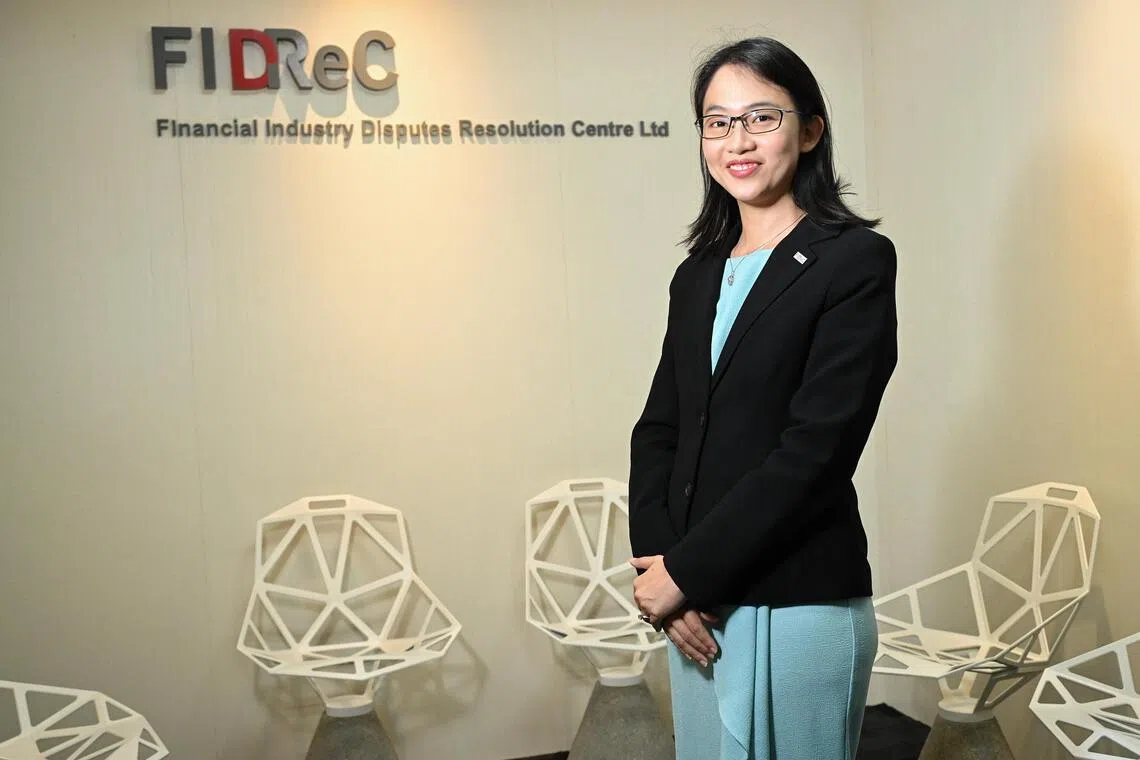
FIDReC chief executive Eunice Chua highlighted this observation at the Association of Financial Advisers (Singapore) (AFAS) annual conference in late July.
Market conduct disputes at FIDReC typically involve giving inappropriate financial advice, making false and misleading statements about financial products, or inadequately disclosing information needed for customers to make decisions.
FIDReC helps individuals, small businesses and charities resolve such disputes with licensed financial institutions – including banks, life insurers and advisers – through mediation or adjudication.
Speaking to The Straits Times after the event, Chua shared data ahead of FIDReC’s annual report to be released in November.
For the financial year ended June 2026, FIDReC handled a total of 432 market conduct claims. (bringing this up higher for context) Of these, 191 were against banks and finance companies, a decrease of 9.5 per cent from the previous financial year.
While banks and finance companies continue to make up the biggest share – 44.2 per cent – of all market conduct claims, that proportion is dropping.
The decline could signal that banks are making headway in handling market conduct issues.
Chua said that anecdotally, FIDReC has observed banks continuing to strengthen their sales supervision and complaint-handling processes over the years.
“We do see a lot more steps – checklists, verification, callbacks – being put in place to ensure that the sale is done properly,” she added.
Association of Banks in Singapore (ABS) director Ong-Ang Ai Boon said banks have established greater oversight of the sales and advisory process, and that sales professionals have to go for regular training to maintain their professional and ethical standards.
“Trust is built over time,” she noted, adding that banks earn this trust by being transparent about fees and product features, taking accountability for mistakes and treating customers fairly.
Banks have also taken customers’ feedback and complaints into consideration to improve on their product and servicing standards.
Dispute resolution outcomes at FIDReC provide one such source of customer insights, which Chua has observed banks applying to serve customers better.
She cited an example from two years ago of FIDReC highlighting case studies on premium financing – the practice of taking out a loan to buy a life insurance policy.
Those incidents made banks realise their clients might not understand how overall returns could be affected when they use premium financing to service financial products.
In response to FIDReC’s findings, many banks now present expected loan interest rates alongside a product’s projected returns. This gives customers a clearer idea of their projected returns net of interest, Chua said.
At the industry level, banks come together through ABS to share best practices, discuss emerging risks and explore ways to raise standards for dealing with customers honestly and fairly.
ABS also conducts mystery shopping exercises, which are typically carried out over an 18-month period.
Ong-Ang pointed out that these exercises provide an independent assessment of how frontline staff are interacting with customers.
“The findings help banks identify areas for improvement, reinforce good practices, and strengthen training, supervision and controls,” she added.
Life insurers and financial advisers
While banks are successfully reducing consumer disputes, life insurers and financial advisers are seeing a jump in market conduct claims.
Chua noted that among the 432 claims handled in the latest financial year, 147 involved life insurers – an increase of 36.1 per cent from the previous financial year.
Separately, financial advisers and insurance brokers were the subject of 85 market conduct claims, up 30.8 per cent year on year.
Chan Wai Kit, executive director of the Life Insurance Association Singapore (LIA Singapore), pointed out that it is important to distinguish between a claim and a subsequent finding of misconduct by FIDReC.
“A lodged claim may ultimately be substantiated or unsubstantiated,” he noted, adding that while claim volumes warrant close attention, they should not, on their own, be taken as evidence of the prevalence of misconduct.
He shared that the life insurance industry actively works to minimise potential disputes.
Where there is any evidence of wrongdoing, he emphasised, the industry takes responsibility for treating customers fairly, and will penalise any misconduct or misleading sales tactics.
Furthermore, the industry tracks consumer experiences through annual mystery shopping exercises, dispute outcomes at FIDReC and the Insurance Trust Indicator Studies, which is commissioned by the Insurance Culture and Conduct Steering Committee (ICCSC).
The ICCSC is a joint industry committee comprising the Monetary Authority of Singapore (MAS), trade associations like LIA, distribution and intermediary associations like AFAS, and senior insurance executives.
Chan noted that the insights from these exercises and studies allow insurers to identify emerging concerns early and take proactive steps to improve on their training, operational processes and product disclosures to build public trust.
Like life insurers, financial advisers saw a rise in market conduct claims.
However, Chua noted that a growing number of claims against financial advisers specifically relate to investment-linked policies (ILPs), driven largely by the product’s complexity.
AFAS’ honorary secretary Graham Choo explained that ILPs may look like simple life insurance products, but unlike traditional insurance, they can lose money if their underlying investments perform poorly.
He added that the fees for ILPs “may not be quite straightforward” because they are structured differently from those of regular unit trusts. While ILP clients pay for both insurance coverage and investments, unit trust customers pay only investment-related fees.
Choo emphasised that advisers who market ILPs must make a greater effort to explain investment risks and fees so clients fully understand what drives their policy’s value.
On a wider note, financial advisory firms seek to forge long-term partnerships with clients.
AFAS’ vice-president Salim M. Amin said these firms start by building credibility through ensuring that their client-facing advisers are equipped with relevant product-related knowledge and strong ethical principles.
Advisers then have to maintain the client relationship by providing good after-sales support and by being there for customers during critical life events.
Financial advisory is a lifelong journey between financial advisers and their clients, and not a one-time sale, Salim said.
Optional advice for complex investment products
This long-term guidance will become even more crucial as upcoming regulatory changes shift more responsibility to retail investors, making professional advice optional for complex investment products.
Under the impending shift, most retail investors will soon no longer be required to seek guidance before buying complex products, such as structured notes, derivatives and, following the regulatory changes, ILPs.
Investors already do not need to seek financial advice when they purchase non-complex products like stocks, exchange-traded funds, real estate investment trusts and fixed income instruments.
That, however, is not stopping investors from seeking advice if they prefer to.
FIDReC’s Chua noted that investors can choose to stay with a financial representative they trust.
She cautioned that self-directed investors who decide to buy complex products on their own may find it more difficult to claim on the grounds of misrepresentation, mis-selling or inadequate disclosure of material information in the event of a dispute.
To strike a balance between giving investors more autonomy and providing an adequate level of consumer protection, investor safeguards will be strengthened concurrently through enhanced “Product Highlights Sheets” and pre-transaction alerts.
Complex products will feature a red label on their Product Highlights Sheet – as opposed to the standard yellow heading band for non-complex products – which will clearly present key product features, risks and expense ratios.
In addition, investors will receive a digital pre-transaction alert warning them that a product is complex, alongside a reminder to read documents, complete relevant learning modules, or seek advice.
Chua said: “This kind of warning makes it extremely clear that a product is complex. It outlines the specific risks and features, details who the product is suitable for, and asks questions like, ‘Can you afford to lose up to 100 per cent of your investment?’ and ‘How many years can you hold it for?’”
This evolution in the financial landscape comes as the MAS shifts towards a disclosure-based regime, where investors are presented with the necessary information for them to make informed decisions.
“As Singapore matures and as more people invest and purchase financial products, it’s appropriate for people to be aware of their responsibilities,” Chua said.

