


SINGAPORE – Digital banks in Singapore are intensifying the battle for consumers’ wallet share, launching new credit cards within days of each other and leaning on their ecosystems to drive spending and customer acquisition.
Trust Bank rolled out what it described as the first stockback credit card in Singapore on Aug 13, with the flexibility to choose between stock rewards, unlimited cashback and bonus cashback, while GXS Bank launched its new cashback card on Aug 17, tapping the Grab and Singtel ecosystems.
The flurry of launches points to a broader shift: Digital banks are no longer content with just competing for customers’ deposits, investments and loans – they want to be the primary card customers reach for when they spend.
Analysts view the new credit card offerings as part of the digital banks’ broader strategy to expand their retail banking franchises – a path commonly pursued by banks with retail operations in Singapore – with rewards representing a necessary customer-acquisition cost.
The strategies reflect the digital banks’ efforts to leverage their respective ecosystems to target specific customer segments, said Tamma Febrian, director of financial institutions group at Fitch Ratings Singapore.
Trust Bank chief executive Dwaipayan Sadhu noted that investing is gaining traction in Singapore, particularly among younger investors. However, many remain on the sidelines, yet to make their first investment.
A Trust study, which surveyed 1,050 Singapore residents aged 18 to 40 in May and June 2026, found that around half were not investing primarily because of a lack of confidence and not knowing where to start.
Sadhu told The Straits Times: “The habit of micro investing with daily spend will help customers gain confidence in investing over time.”
On the Trust Freedom card, customers earn stockback rewards on every dollar spent.
Once their accumulated rewards reach $10, the amount is automatically invested in their selected US stock or exchange-traded fund (ETF). They can choose from a curated list of 50 stocks and ETFs, and change their selection in the Trust Bank app any time before the next investment transaction.
Trust is planning to introduce air miles by October. Customers can then opt for cashback, stockback or air miles.
The bank has seen more than a 100 per cent increase in total credit card sign-ups since the Freedom card was launched.
Trust cards, which include the Trust Link credit card designed for earning rewards within the NTUC and Linkpoints ecosystem, are being used more than 25 times a month. This shows that Trust is an everyday card, said Sadhu.
Trust has remained profitable for four consecutive months since achieving net profitability in March. It also acquired more than one million users by early 2025, making it the fourth-largest retail bank in Singapore by customer numbers.
GXS Bank group head of retail Jenn Ong said most Singaporeans already use Grab or Singtel in their daily lives, and the GXS credit card is designed to bring them greater value.
For instance, frequent Grab users can earn up to 10 per cent back in GrabCoins on any spend on the platform.
“The additional value they receive encourages further usage and deeper engagement with the services they already use, and value on Grab and Singtel,” Ong said, adding that the combined reach of Grab and Singtel in Singapore is more than 4.5 million customers.
Cashback also came up as a preferred form of reward among ecosystem customers when they are asked what they valued in a credit card, she said.
She added that tapping the Grab and Singtel ecosystems keeps customer acquisition costs close to zero. For example, the bank can offer tailored sign-up perks like $8 off Grab rides or 25 per cent off new subscriptions on selected Gomo 5G+ plans for six months.
Ong said there has been strong sign-ups for the GXS credit card since its launch, with one-third of sign-ups originating from the Grab app. More than three in four cardholders have also linked their card directly to their Grab app.
“We are seeing the card become part of our customers’ everyday spending within our ecosystem. About 90 per cent of GXS credit-card holders have made a payment on Grab and/or Singtel using their card,” she added.
This is not the first time digital banks have tapped their ecosystems to capture more customer spend.
Two years ago, MariBank rolled out the Mari credit card, leveraging Sea’s wider digital ecosystem, including e-commerce platform Shopee. Among benefits, card holders earn 1.5 per cent in Shopee Coins on eligible Shopee spending, giving customers an incentive to use the card for purchases on the platform while reinforcing the link between Sea’s financial and e-commerce businesses.
MariBank head of consumer business Huo Haiyan said the bank stays committed to keeping its value proposition simple and clear despite increased competition.
It is also extending its current promotions – 1.5 per cent Shopee coins, 1.5 per cent cashback on overseas spend and promotional foreign exchange rates in seven countries – to the end of 2027.
“Our momentum isn’t driven by reacting to competitor tactics, but by staying committed to what modern consumers actually want: frictionless simplicity, instant rewards and zero hidden costs,” Huo said.
GL Insight director Zennon Kapron said becoming a customer’s main bank is the ultimate prize, with a card helping to embed the bank into customers’ daily spending habits.
“A savings account produces one login a month. A card produces 30 transactions, which is where the data and the habit come from,” he said.
Tengfu Li, vice-president for ratings at Moody’s Ratings, said that beyond diversifying revenue through interchange fees and interest on outstanding balances, cards can deepen customer relationships and support cross-selling.
“The non-cash rewards – such as GXS’ GrabCoins, MariBank’s Shopee Coins and Trust’s StockBack – can also boost engagement and reinforce customer habits within their respective ecosystems,” said Li.
Febrian, however, said he does not expect these launches to materially change or heighten competitive dynamics in the sector over the foreseeable future.
“Overall, we do not view the rewards being offered as materially different from those already available from incumbent banks,” he added.
Amid the battle for wallet share, digital banks are also managing the long-term sustainability of these rewards.
MariBank cut its standard Mari credit card cashback rate from 1.7 per cent to 1.5 per cent in January for local Singapore dollar spending.
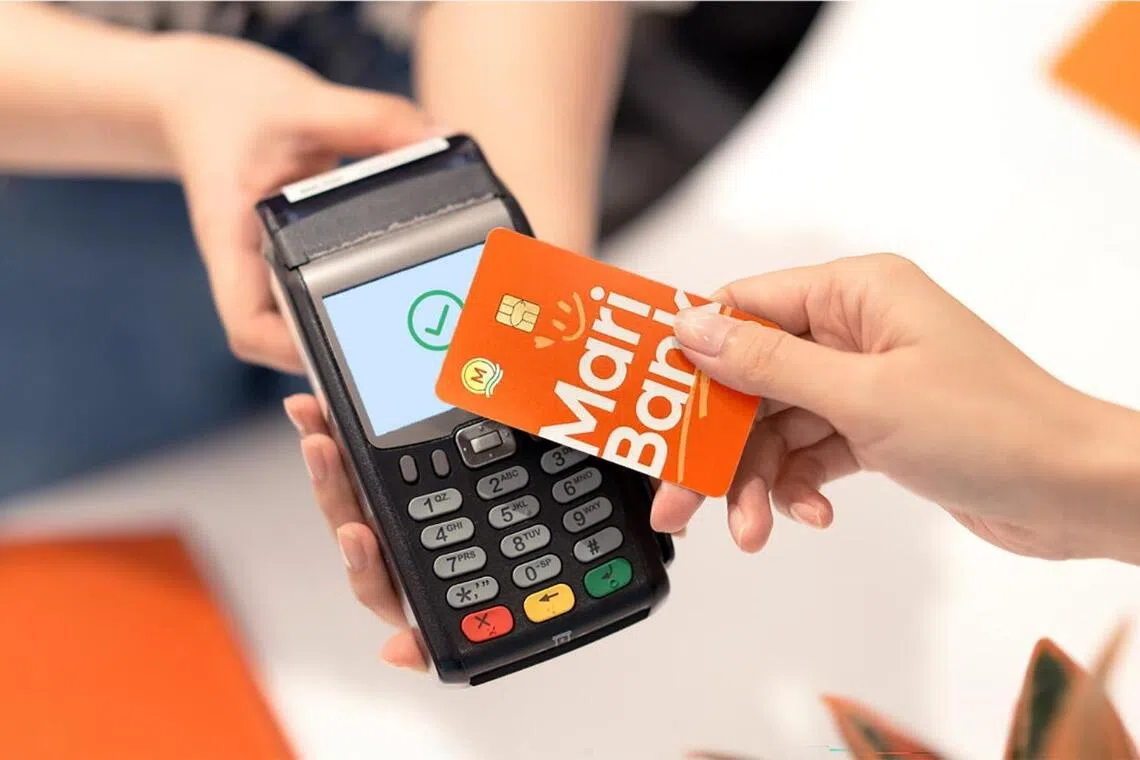
Some 90 per cent of new MariBank credit card customers in 2026 remain active six months after opening an account.
PHOTO: MARIBANK
Huo said that the bank’s credit card proposition has since evolved and the current structure is more sustainable while continuing to offer broad-based value to customers.
“For MariBank, it is not about having the most complicated rewards proposition, it is about giving customers value where they value it most, in a way we can sustain over the long term,” she said.
For example, following customer feedback that they value cashback on overseas spend, the bank simplified its proposition to offer a flat 1.5 per cent cashback on overseas spend, from the previous 1.5 per cent cashback with a 3 per cent foreign exchange fee. Since January 2026, the foreign exchange fee was removed.
Customers appear to be engaged. Some 90 per cent of new credit card customers this year remain active six months after opening an account.
Meanwhile, Trust has gone further and published the date its introductory rate expires.
Trust’s introductory 3 per cent stockback rate on eligible local and overseas spending is available until Dec 31. From Jan 1, the rate will fall to 2 per cent for local eligible spend and 0.5 per cent for foreign eligible spend.
Sadhu said: “We have always been very transparent, and it has already been announced what the rates are going to be long term. It’s clearly mentioned that it’s a promotional rate for the first four months of launch.”
Asked if he was concerned about a fall in usage after Dec 31, he said the 2 per cent stockback rate will continue to be an attractive proposition for the Freedom card.
The zero foreign transaction fees and the flexibility to choose among reward programmes are also distinct propositions to keep customers engaged, he added.

