


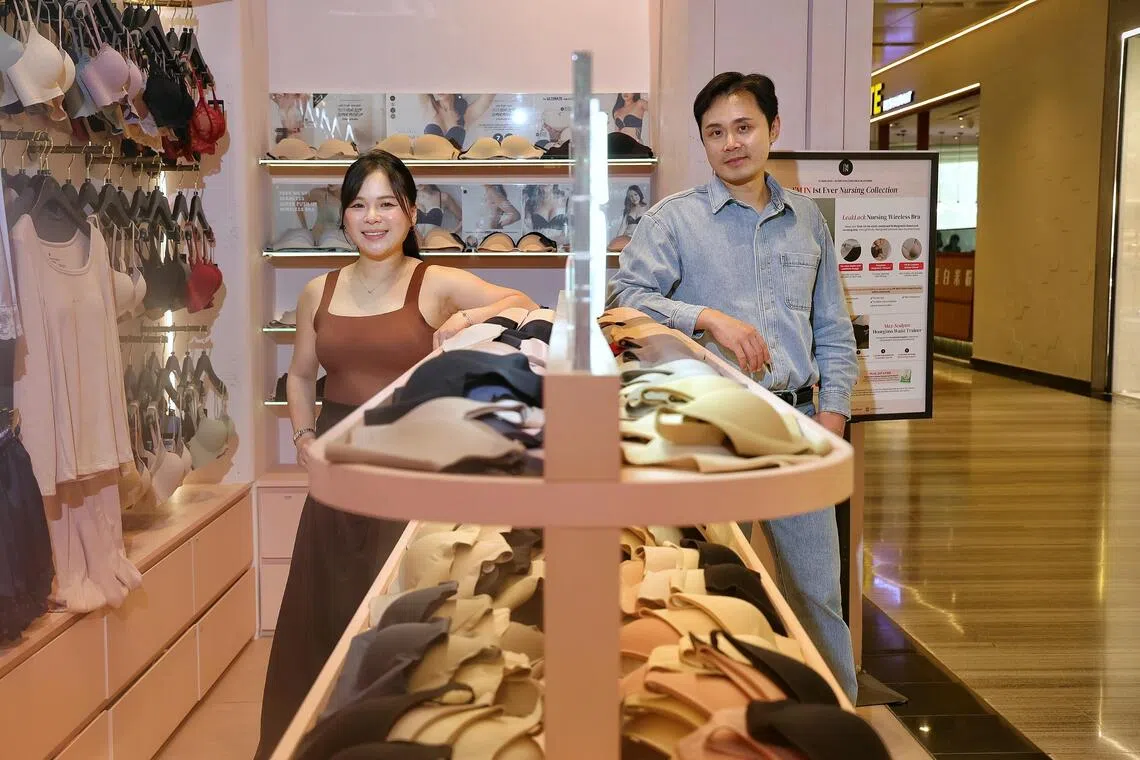
SINGAPORE – Entrepreneurship has long run in Kingsley Peh’s blood. He and his wife Elfaine Tan, whom he met when they were both 13, started their first business together at 15, selling second-hand clothing online and at neighbourhood market stalls.
“School was closed during the SARS (severe acute respiratory syndrome) outbreak, and instead of simply sitting around, we decided to try selling second-hand clothes at a neighbourhood market,” said Peh, 37.
“We had very little capital and no business experience, but we were curious to see whether we could sell something and make money on our own,” he said, adding that the experience gave them their first taste of entrepreneurship.
When they were 20, Tan started Singapore’s first online “tryvertising” platform, The Sample Store, with Peh. The platform allowed customers to order free beauty samples and try them before buying, and earn more samples by posting reviews. It was eventually acquired by Singapore Post in 2013.
In 2015, the couple went on to launch lingerie brand I’m In.
Tan had suffered the discomfort and pain of underwired bras and was convinced that women would want more comfortable, wireless support.
The duo poured $100,000 into raw material research and development, fabric chemistry, and custom steel mould engineering for wireless bras.
Today, they have scaled I’m In from an online store to five physical stores in Singapore and regional distribution in Indonesia, Malaysia, the Philippines and Brunei.
Peh has a diploma in infocommunications, and Tan has a diploma in biomedical informatics and engineering, both from Temasek Polytechnic. They have a six-year-old son and a baby girl on the way.
What do you invest in and why?
Our biggest investment has consistently been back into I’m In. Whenever the business does well, our instinct has usually been to reinvest in products, people, technology and expansion. It probably isn’t the most diversified approach, but it keeps us very committed.
There’s nowhere to hide either. The results are brutally honest. If we make good decisions, we see it. If we make bad ones, we learn very quickly.
What’s your biggest or most valuable asset right now?
Tangibly, it would be I’m In. But increasingly, I think the more valuable asset is actually intangible: the people behind it. Products can be copied and strategies can change, but having a strong team that learns, adapts and grows together is very difficult to replicate.
What’s your approach when it comes to growing your money?
I think of it a little like a slow cooker. I’m less interested in chasing 10 different opportunities and more interested in building one good system that compounds over time, with good people, good products and good fundamentals. It may not always be exciting, but I like the idea of quietly building something that becomes stronger year after year.
Do you invest in any other tangible assets such as art, crystals or Pokemon cards?
Not seriously. I’m more of a casual collector. For me, the story or idea behind something matters more than its rarity or resale value. I can enjoy a PopMart figurine simply because I like the character or the story behind it. Not everything I buy needs to become an investment.
What was your first exposure to investing?
Probably buying stock for our little market stall. We didn’t have much money then. When we made some, we treated ourselves to a good meal and put almost everything else back into buying more stock. Looking back, that was probably my first lesson in reinvestment and compounding, although we definitely didn’t use those words at the time.
What has been your best financial decision?
When we were 25, we sold The Sample Store, a business we had spent about five years building, to SingPost for $1.2 million. There was a strategic fit. We had built something innovative and agile, while SingPost had a much larger distribution network and infrastructure. The acquisition took roughly a year of discussions and negotiations to complete.
At that age, going through an acquisition taught me much more than the dollar value of the deal. I learnt how businesses are valued, how deals are structured and negotiated, and how two companies can create value by bringing different strengths together. It also taught me something I still believe today: When you’re young, time is one of your greatest forms of capital. You can afford to try, fail, learn and rebuild.
Moneywise, what were your growing-up years like?
I grew up in a simple household. My dad was an SBS bus driver, and my mum was a housewife, so being prudent with money was something we learnt very early. We also saw the anxiety that comes when a family has to make ends meet. I don’t look back at that negatively, though. Starting from a more modest place made every bit of progress feel meaningful and it shaped how I think about money today.
What was your childhood dream?
I wanted to be a computer scientist. Somewhere along the way, I became an entrepreneur instead, although with how much time I spend thinking about AI now, perhaps I’ve somehow gone full circle.
What was your first job?
My first full-time job was technically CEO of our first start-up, The Sample Store, though “CEO” makes it sound much more glamorous than it was. In reality, it stood for “Chief Everything Officer”. Sales, marketing, packing, operations, customer service – whatever needed to be done that day.
Where’s home for you?
We live in a terraced house in the central area of Singapore.
What do you drive?
We currently drive a Porsche Macan EV and a Mercedes-Benz CLA.
What was your most frivolous or guilty-pleasure purchase?
Probably paying a ridiculous amount for front-row tickets to a K-pop concert. Flying business class for a short flight purely because I desperately wanted a few hours of sleep comes pretty close.
What does work-life balance mean to you?
I prefer the idea of work-life harmony rather than perfect balance. There are seasons when work genuinely takes 80 per cent of my energy and life gets the other 20 per cent. And there are other periods when family, friends and travel take 80 per cent, and work sits quietly in the remaining 20 per cent.
I don’t think my life naturally divides itself into a neat 50:50 every day. For me, what matters is recognising which season I’m in and being fully present in it.
What would you do if you suddenly had a windfall of millions?
I’d probably put a significant part of it into finding and developing great people for I’m In. The longer I build a business, the more convinced I am that the quality of the people around you determines how far the company can go. So I’d invest in increasing our talent density – with people who have both strong capabilities and the right attitude.
If you suddenly had only $100 to your name, what would you do?
I’d give it to my kids, then I’d start again. I’ve built from very little before, so I’d trust my ability to figure it out once more.

