


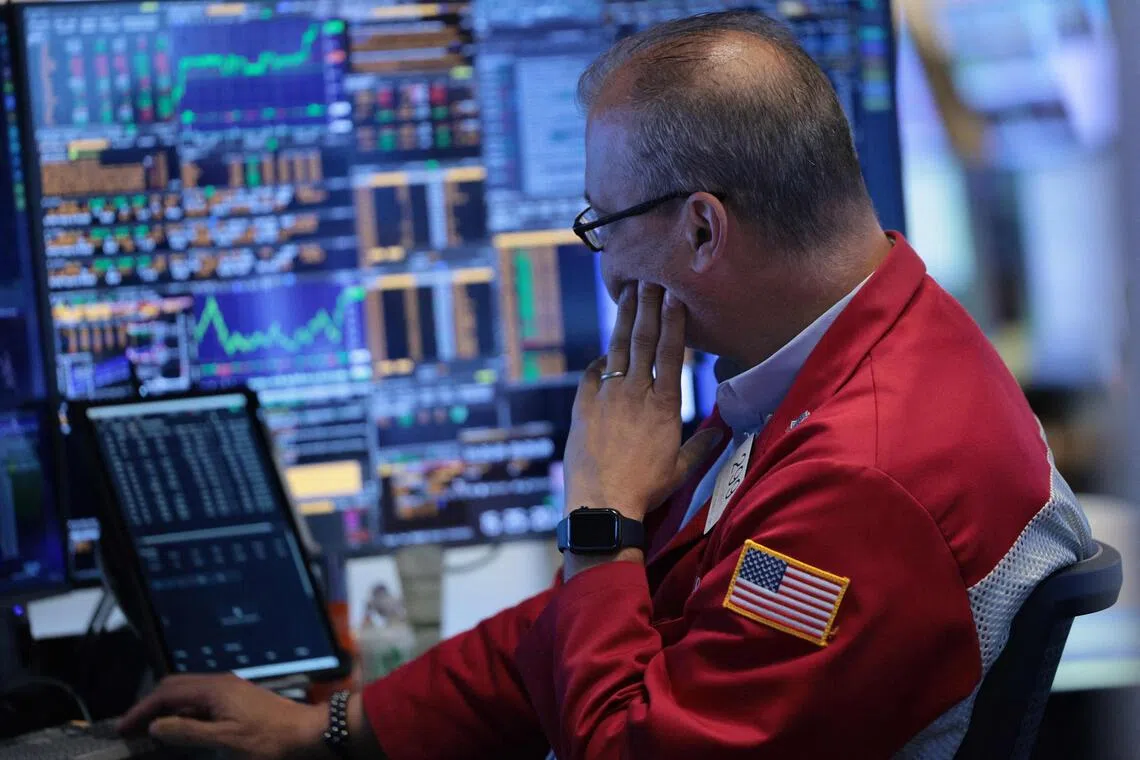
NEW YORK – Wall Street dipped on Sept 4 as a robust jobs report raised the probability that the US Federal Reserve will increase its key interest rate at this month’s monetary policy meeting.
All three major US indexes closed lower amid a broad selloff ahead of the three-day holiday weekend.
For the week, the indexes were essentially unchanged.
The Labour Department’s August employment report showed the US economy added 162,000 jobs in August, nearly three times the 56,000 consensus, while the department revised June and July payrolls upward by a total of 55,000 jobs. Labour market participation increased while the unemployment rate held firm at 4.1 per cent.
While a stronger-than-expected jobs report would generally be good economic news, markets are interpreting it as a sign the data-dependent Fed will implement a rate hike at the conclusion of this month’s policy meeting to curb war-related energy price pressures from morphing into broader, more systemic inflation.
“The labour market had a nice snapback last month, and it’s hard not to think an improving labour market is not a positive development for the economy,” said Ryan Detrick, chief market strategist at Carson Group in Omaha, Nebraska. “On the flip side, the odds of a Fed hike increased a little bit as the economy continues to run a little on the hot side.”
“We’ll get a lot more clarity on inflation next week at the consumer and producer levels,” Detrick added, referring to the Labour Department’s consumer and producer price indexes.
Financial markets are pricing in a 58.4 per cent likelihood of a 25-basis-point rate hike at the conclusion of the Fed’s September meeting, up from 49.4 per cent on Sept 4, according to CME’s FedWatch tool.
The Dow Jones Industrial Average fell 272.51 points, or 0.51 per cent, to 53,413.60, the S&P 500 lost 29.30 points, or 0.38 per cent, to 7,718.41 and the Nasdaq Composite lost 77.07 points, or 0.29 per cent, to 26,506.99.
Among the 11 major S&P 500 sectors, consumer discretionary stocks were down the most, while industrials, and tech showed modest gains.
Semiconductors were clear outperformers, gaining 3.4 per cent, but remain down 17.8 per cent this quarter. Software and services , having gained 24 per cent over the same period, were clear laggards on the day, dropping 2.1 per cent.
Lululemon Athletica tumbled 17.4 per cent after the activewear brand cut its full-year profit and revenue forecasts.
Adobe dropped 6.7 per cent following its announcement that longtime chief excutive officer Shantanu Narayen will be succeeded by insider Anil Chakravarthy.
US credit reporting agencies lost ground after Federal Housing Finance Agency director Bill Pulte said on Sept 3 he directed Fannie Mae and Freddie Mac, created by the US Congress to support the housing market, to approve all lenders to use the credit scoring system VantageScore.
Fair Isaac lost 16.7 per cent, TransUnion dropped 5.9 per cent, while Equifax slid 6.4 per cent.
US markets will close on Sept 7 in observance of the Labour Day holiday.
Declining issues outnumbered advancers by a 1.04-to-1 ratio on the NYSE. There were 151 new highs and 167 new lows on the NYSE.
On the Nasdaq, 2,478 stocks rose and 2,256 fell as advancing issues outnumbered decliners by a 1.1-to-1 ratio.
The S&P 500 posted three new 52-week highs and six new lows while the Nasdaq Composite recorded 61 new highs and 99 new lows.
Volume on US exchanges was 13.14 billion shares, compared with the 14.89 billion average for the full session over the last 20 trading days. REUTERS

