


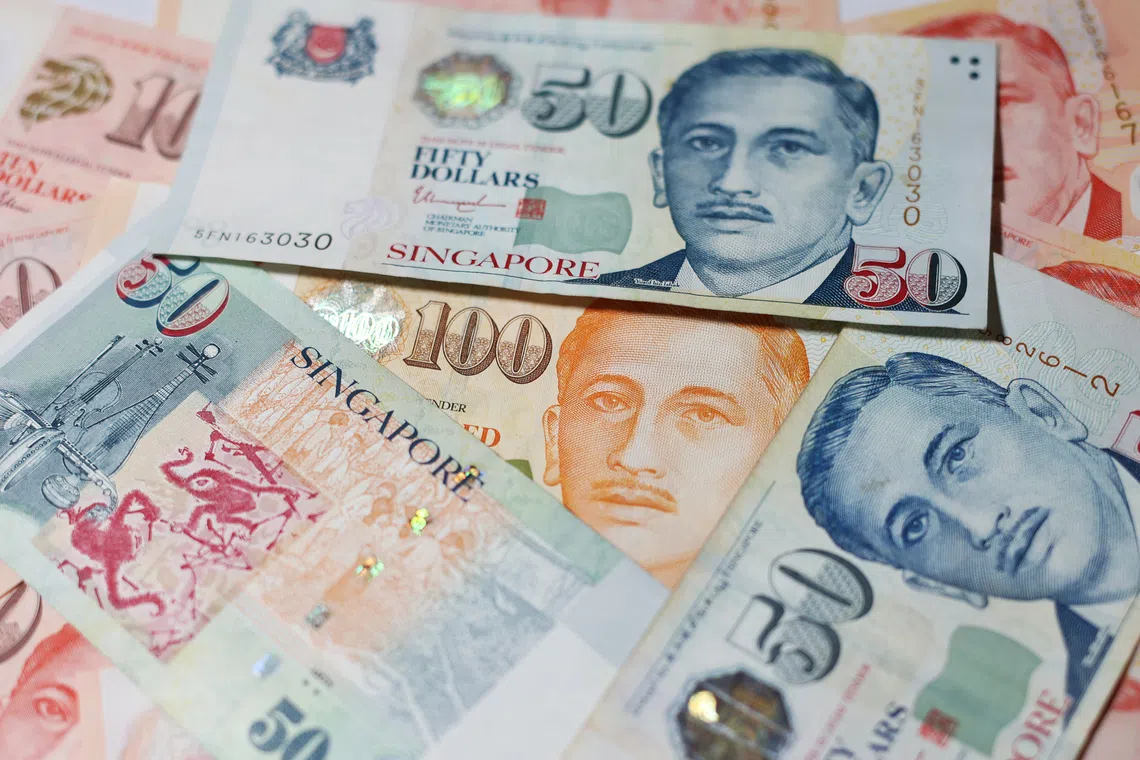
SINGAPORE – The Singapore dollar is tracking the US currency in an inverse direction more closely than any other in Asia, which analysts say positions it for stronger gains in the region if the “dollar debasement trade” gathers pace.
The currency’s 120-day correlation with the greenback has dropped to -0.94, the most inverse link since May 2024 and the most negative in Asia.
It signals that the Singapore dollar is moving in almost direct opposition to the US currency, offering investors a play on the latter’s weakness.
The dynamic aligns directly with a resurgence in the debasement trade as political and fiscal uncertainty in the US prompt investors to offload the greenback for alternative assets.
At the same time, robust economic growth and policy tightening from the Monetary Authority of Singapore are providing additional tailwinds for the local currency.
“Dollar debasement will undoubtedly be Singapore dollar positive,” said Galvin Chia, an emerging Asia strategist at Societe Generale SA.
He expects the local currency to be driven by its tight inverse link with the greenback, limited central bank intervention, a booming AI export sector, and robust volatility-adjusted returns during US dollar weakness.
That optimism is supported by the Singapore dollar’s performance, having gained 1.8 per cent this quarter to lead South-east Asia.
The MAS reinforced that trend in July by tightening monetary policy in a second straight review, increasing the rate of appreciation of the local dollar against the trade-weighted currency basket.
The decision comes amid a strong economic backdrop, after the government upgraded its growth outlook for this year to 4.5 per cent to 5.5 per cent, from 2 per cent to 4 per cent set in February.
“The Singapore dollar is one of the most stable currencies in the region and typically benefits from flight to safety flows,” according to Wee Khoon Chong, senior market strategist for Asia Pacific at BNY in Hong Kong.
“Recent market reform and the government’s targeted measures to attract foreign investment further consolidate the Singapore dollar’s standing in the region,” he added.
Singapore in August pledged to offer potentially lucrative tax exemptions to individual fund managers, such as hedge fund traders, in a bid to win business from rival asset management hubs.
These targeted measures to attract foreign capital and sound fiscal policy, further reinforce the local dollar’s outlook.
Currencies of economies with a large current account surplus and strong fiscal positions will benefit, “with the Singapore dollar in particular with its monetary policy tilted toward the appreciation of the exchange rate,” said Khoon Goh, head of Asia research at Australia & New Zealand Banking Group.
ANZ forecasts the Singapore dollar to appreciate to 1.26 per dollar by the end of the year. It traded at around 1.27 on Sept 3.
The debasement trade gathered pace in mid-August after Treasury Secretary Scott Bessent announced plans to buy back longer-maturity Treasuries, effectively limiting the potential returns from holding long-term dollar assets and prompting investors to rethink global allocations.
Against that backdrop, Singapore’s top-tier credit rating gives investors another reason to gravitate toward its currency.
“Singapore’s AAA credit ratings, underpinned by its strong fundamentals and fiscal strength, mean Singapore dollar-denominated assets are likely part of that wider set of markets that investors evaluate when they rebalance their portfolio,” said Wei Ming Cheong, a portfolio manager at Eastspring Investments. BLOOMBERG

