


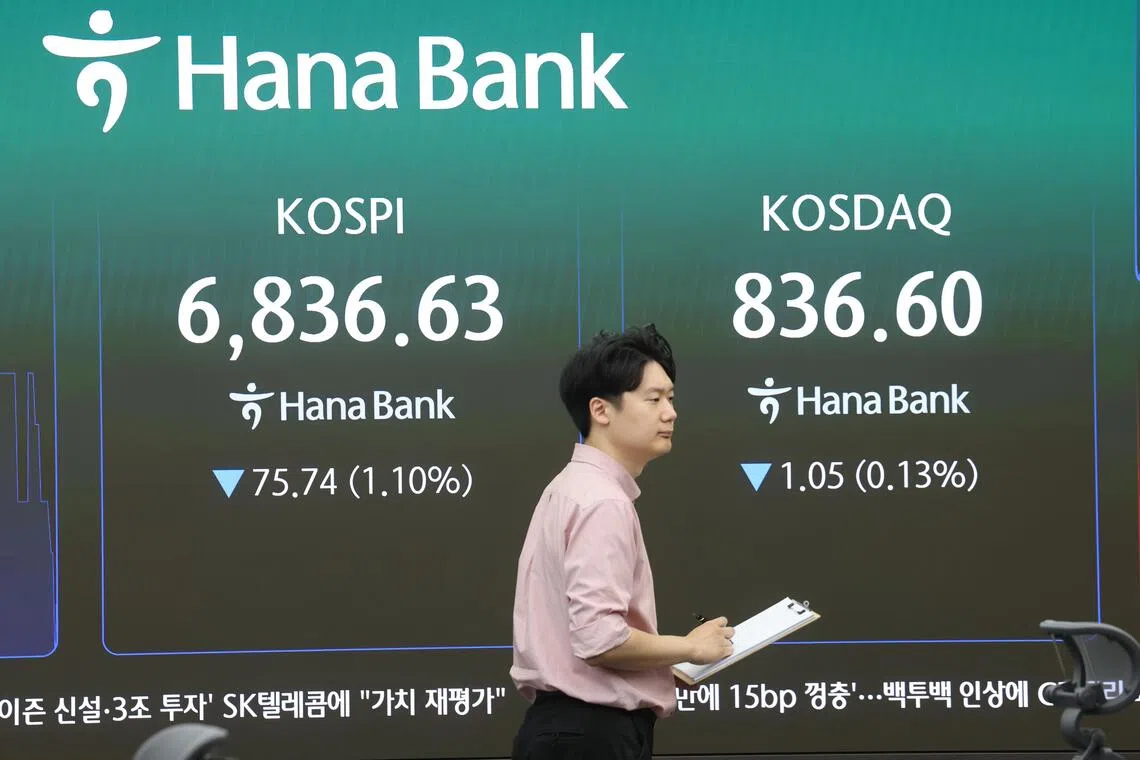
Asian stocks dropped on Aug 31 and the dollar held its gains after hawkish comments from Federal Reserve chairman Kevin Warsh strengthened bets on an interest-rate hike in September. Oil climbed as Middle East tensions intensified.
MSCI’s Asia Pacific equities gauge fell as much as 1 per cent before paring its decline to 0.6 per cent, with technology shares leading losses.
The Kospi Index – a barometer for artificial intelligence investments – dropped 1.6 per cent, with chipmakers Samsung Electronics and SK Hynix among the decliners. US stock-index futures also retreated.
The dollar traded in a narrow range against major peers after posting its biggest gain in about a month on Aug 28 following Warsh’s remarks.
Elsewhere, Brent crude climbed 1.4 per cent to US$89.30 a barrel after the US military on Aug 30 struck Iranian rocket launchers that were preparing to send mines into the Strait of Hormuz, ending weeks of relative calm.
The moves showed a cautious start to the week after Warsh vowed in his Jackson Hole speech on Aug 28 to bring inflation back to target, prompting traders to lift the probability of a September rate hike to 60 per cent.
Adding to the pressure, escalating Middle East tensions drove oil higher, raising the risk of another bout of price pressures.
“Asian market will be in a defensive mode to start the week on Aug 31,” said Nick Twidale, chief market analyst at AT Global Markets.
“The combination of a sharp escalation in Fed rate hike expectations after Kevin Warsh’s speech on Aug 28 and renewed US strikes in the Strait of Hormuz will have investors on full alert.”
The attack by the US was the first military action against Iran in more than a month, as President Donald Trump has switched to a campaign to drive Iran to the negotiating table by squeezing its economy.
In other corners of the market, gold steadied around US$4,460 an ounce after last week’s selloff. Higher interest rates tend to diminish the appeal of the non-yielding metal.
Futures on the S&P 500 Index lost 0.2 per cent and those on the Nasdaq 100 Index retreated 0.3 per cent after the underlying gauges closed lower on Aug 28 and as tensions rose in the Middle East.
The yen hovered around 160 per dollar after hitting its weakest level in a month. Traders will be alert to stronger rhetoric from Japanese officials after the currency weakened on Aug 28 after the dollar surged, erasing more than half of its intervention-fuelled gains.
The recent intervention has “curbed yen depreciation pressures to some degree, signaling that a move well above 160 is unlikely to be tolerated,” Barclays strategists including Lemon Zhang wrote in a note to clients. “However, fundamental factors continue to weigh on the JPY, including a still-wide US-Japan yield differential, fiscal pressures and continuing Japanese investors’ purchases of overseas assets.”
Meanwhile, traders have piled into bets that a quarter-point rate hike in September is more likely than not, and will tighten policy at least once more over the coming year, according to swaps data compiled by Bloomberg.
In his first major speech since taking the helm of the central bank, Warsh warned inflation isn’t meaningfully slowing and said policymakers must be confident it is, otherwise the Fed has “work to do”.
He said financial conditions aren’t currently restrictive and described rates as the Fed’s “predominant tool” for achieving its mandate, while stopping short of signaling support for a hike in September.
“The market took a hawkish message away from Fed Chair Warsh at his Jackson Hole speech,” Marc Chandler, chief market strategist at Bannockburn Capital Markets, wrote in a note.
“Even if the market has overreacted to Warsh’s comments, the upside dollar correction has only just begun.”
Some of the main moves in markets:
Stocks
-
S&P 500 futures fell 0.3 per cent as of 8.45am Singapore time
-
Hang Seng futures fell 0.2 per cent
-
Nikkei 225 futures (OSE) fell 1.7 per cent
-
Japan’s Topix fell 0.7 per cent
-
Australia’s S&P/ASX 200 was little changed
-
Euro Stoxx 50 futures fell 0.4 per cent
Currencies
-
The Bloomberg Dollar Spot Index was little changed
-
The euro was little changed at US$1.1591
-
The Japanese yen was little changed at 160.04 per dollar
-
The offshore yuan was little changed at 6.7287 per dollar
-
The Australian dollar was little changed at US$0.7162
Cryptocurrencies
-
Bitcoin fell 0.8 per cent to US$77,998.37
-
Ether fell 2.4 per cent to US$2,431.63
Bonds
-
The yield on 10-year Treasuries was little changed at 4.71 per cent
-
Japan’s 10-year yield advanced 1.5 basis points to 2.935 per cent
-
Australia’s 10-year yield was little changed at 5.10 per cent
Commodities
-
West Texas Intermediate crude rose 1.1 per cent to US$84.33 a barrel
-
Spot gold rose 0.2 per cent to US$4,464.33 an ounce. BLOOMBERG
Source : https://www.straitstimes.com/business/asian-stocks-drop-on-hawkish-warsh-tone-oil-gains

