


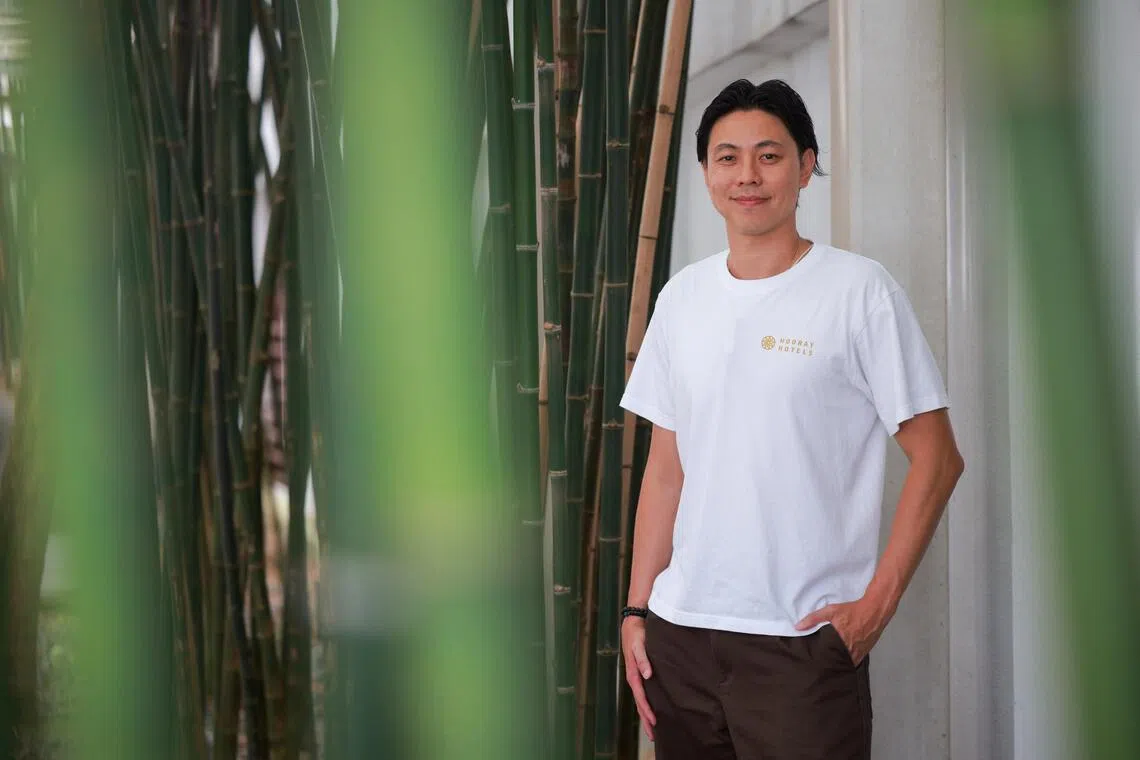
SINGAPORE – At 40, Ray Hoe left Singapore with his wife and two children to pursue his dream of becoming a hotelier in Japan.
It was a high-stakes bet on a country where he had neither the language nor the business connections.
Armed with what he describes as a healthy dose of naivety and a can-do spirit, he took an equity term loan, remortgaged his Singapore property and made the leap.
“It wasn’t because we were unhappy in Singapore. I simply wanted to see if I could build something meaningful overseas, as I’ve always been drawn to taking the road less travelled,” Hoe, 41, tells The Straits Times.
His unconventional second act is a sharp departure from his earlier career.
Hoe started out in international property marketing at JLL in 2012 before spending about eight years with his father, a property developer in Johor, Malaysia. He subsequently worked as a mortgage broker back in Singapore.
In 2025, the University of British Columbia finance graduate founded Hooray Hotels, a boutique hospitality company focused on introducing international travellers to lesser-known parts of Japan.
Its first property is a 10-room ryokan in Toyama, a coastal city in central Japan known for its seafood and views of the Tateyama Mountain Range.
The plan was to build a family business in which his children could gain hands-on experience.
A year on, the journey has proved far more challenging than imagined.
Just as the 77-year-old ryokan secured its hotel licence and was preparing to open in September, Hoe’s business visa application was rejected, forcing him to leave Japan.
His wife, 34, and their two children are back in Singapore, travelling to Japan during the school holidays to help out at the ryokan.
Meanwhile, Hoe shuttles between the two countries, using Japan’s 90-day visa-free arrangement for Singaporeans.
Q What do you invest in and why?
A My three biggest investments today are my home in Singapore, Hooray and cash.
Before Hooray, I was heavily invested in equities and cryptocurrency, particularly Bitcoin and Bitcoin mining companies.
Now, most of my capital and attention go into Hooray, where launching a new business made me appreciate liquidity much more.
Q What’s your biggest or most valuable asset right now?
A Financially, my most valuable asset is my home in Singapore. But the asset I’m most invested in – financially and emotionally – is Hooray Hotels.
Q What’s your approach when it comes to growing your money?
A If I’ve done my homework and believe in something, I’m prepared to take a meaningful position rather than diversify for the sake of diversification.
That’s what I did with Bitcoin in 2020 and, in some ways, it’s what I’m doing again with Hooray today.
But as I get older, my thinking has changed. I am not looking for Hooray to give me a 2x or 3x return. I’m trying to build a brand and business that can compound in value over time.
Ultimately, I want money to give me options and hopefully build something that I can eventually pass on to my children.
Q Do you invest in any other tangible assets such as art, crystals or Pokemon cards?
A Not really. Real estate is the main tangible asset class I am comfortable with and have invested meaningfully in. Even Hooray has an underlying property asset.
Q What was your first exposure to investing?
A My first exposure was cryptocurrency, and it was actually a bad one. Around 2013, I put about $1,500 into OneCoin and lost everything. It taught me that being excited about something isn’t the same as understanding what you’re investing in.
Q What has been your biggest financial mistake?
A I’ve been fortunate so far, so I don’t think I have one major financial mistake that stands out.
Q What has been your best financial decision?
A Having the conviction to sell my first home in 2020 and invest the proceeds into Bitcoin and Bitcoin mining companies such as Marathon Digital (MARA) and Riot.
During Covid, governments were cutting interest rates and injecting enormous amounts of liquidity into the economy. My view was that asset prices would rise.
I invested around $800,000, starting with the purchase of Bitcoin when it was trading around $8,000 and MARA at roughly US$2-3 a share. At the peak of the bull run, my portfolio had grown to about $2.9 million.
I didn’t sell at the peak. The market fell quickly and I gradually sold as prices declined.
My average selling price for MARA was around US$40. I no longer own MARA or Bitcoin.
More importantly, that investment gave me my first meaningful pot of capital and the freedom to eventually leave my career and pursue Hooray.
Q Moneywise, what were your growing-up years like?
A I grew up quite humbly. Until my late teens, I lived with my mother and grandmother in a three-room HDB flat in Toa Payoh.
My mother worked as a draftsman, and took on multiple jobs to supplement the family income. My father worked for a property developer and eventually became a small property developer himself. He did well when I was in my early 20s.
I saw from my mother how hard you have to work to earn money, and from my father how taking calculated risks and building something yourself could change your circumstances.
A lot of how I approach business today is influenced by my dad.
Q What was your childhood dream?
A I wanted to be an architect, but my parents discouraged me from pursuing it as a career.
I eventually went into real estate, and now I’ve somehow ended up developing and restoring hotels where architecture and design are a big part of what I do.
Q What was your first job?
A My first job was at a bubble tea shop when I was a teenager. I was paid $5 an hour.
I worked part-time whenever I could, all the way through university – at the bubble tea shop, then as a waiter, dishwasher and cook.
Q When did you first realise money was important?
A Probably when I first seriously considered buying property in Singapore.
You suddenly understand the size of the down payment, what a mortgage means and how many years of work it represents.
Q What would you tell your younger self?
A Invest more in Bitcoin!
Jokes aside, I’d tell myself to spend more time studying accounting and learning how to read and understand a balance sheet.
I studied finance, but I’ve realised that as a business owner, understanding your numbers is incredibly important.
You can have great ideas, but if you don’t understand the financial health of your business, you’re flying blind.
Q Where’s home for you?
A In Singapore, I live in a freehold three-bedroom duplex penthouse in River Valley.
Japan is where I’m building Hooray and pursuing this next chapter of my life, so I’m happy to call it my second home.
Q What do you drive?
A I don’t own a car in Singapore.
Q What was your most frivolous or guilty-pleasure purchase?
A Probably staying at Hoshinoya Tokyo when I ran the Tokyo Marathon in 2018. My wife and I stayed for three nights at around $900 a night.
I wasn’t earning a lot then, so $900 a night was a lot of money to spend on a hotel. But I wanted to experience what I considered some of the best Japanese hospitality.
Q What does work-life balance mean to you?
A Right now, there isn’t much work-life balance. Building Hooray consumes most of my time, and unfortunately my family sometimes has to take a back seat.
For me, balance doesn’t mean giving everything equal time. It’s about making the time I do have with my family count.
Q What would your perfect day look like?
A Exploring a new destination with my wife, staying at a new hotel, eating somewhere new, and simply enjoying each other’s company.
I’ll inevitably also be studying the hotel – its design, service, food and little details – thinking about what I can learn for Hooray, or whether we could open a hotel there one day.
Q What would you do if you suddenly had a windfall of millions?
A I’d put a large part of it into Hooray, but not necessarily into opening more hotels. I’d invest in our people – training the team, bringing in expertise and improving our service and operations – to make the first Hooray as good as possible.
And if there’s anything left over, I’d happily pay off my mortgage.
Q If you suddenly only had $100 to your name, what would you do?
A My priority would be to rebuild a stable income and savings before thinking about investing again. I’ve taken big risks because I had a financial base that allowed me to do so. If that disappeared, I’d rebuild the base first.

