


SINGAPORE – Company directors will soon be able to tap a new training programme covering the fundamentals of governance they need to know, from their legal and fiduciary duties to handling conflicts of interest and financial literacy.
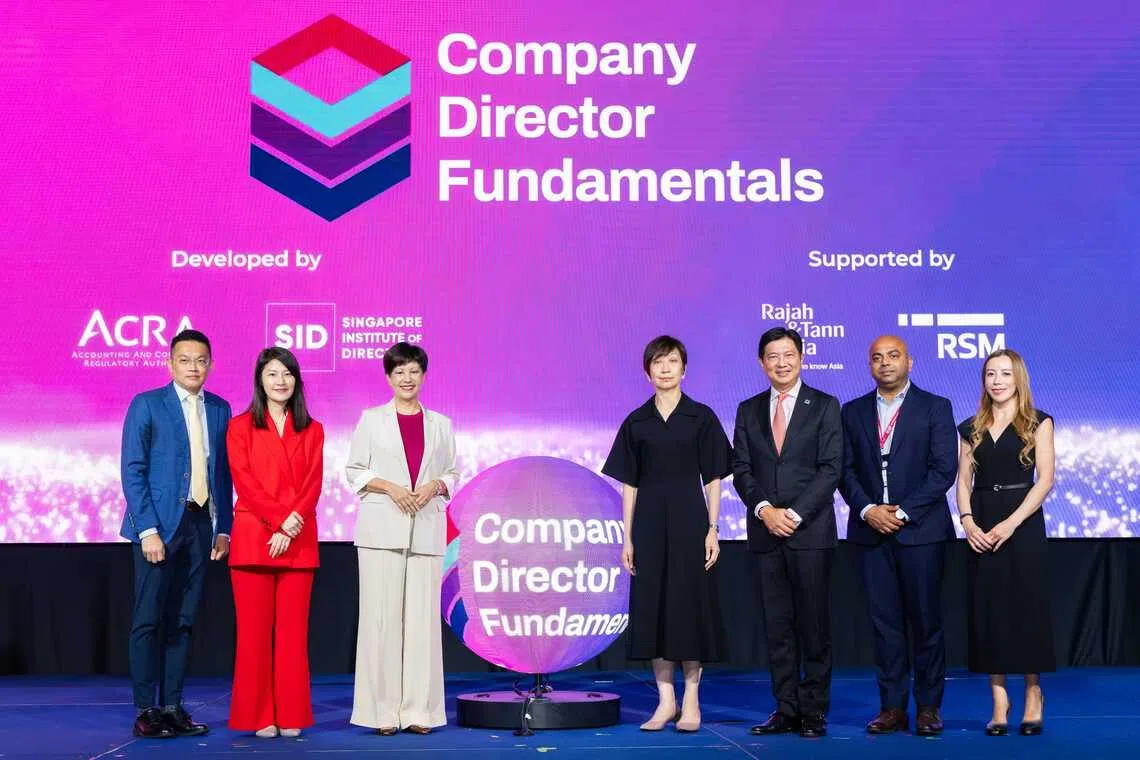
Minister in the Prime Minister’s Office and Second Minister for Finance and National Development Indranee Rajah launched the Company Director Fundamentals (CDF) programme at the SID Directors Conference 2026, organised by the Singapore Institute of Directors (SID), on Aug 28.
The programme, jointly developed by the Accounting and Corporate Regulatory Authority (ACRA) and SID, will open for registration in October 2026, with access to the modules to follow later.
It comprises 10 bite-sized modules that each take about 15 to 20 minutes to complete, including six free foundational modules and four paid modules for directors who want to deepen their capabilities.
It is aimed at current and aspiring directors, including foreign directors seeking to familiarise themselves with Singapore’s governance requirements. It is intended to strengthen directors’ baseline governance knowledge as boards face increasingly complex legal, technological and business challenges.
In her address, Indranee said boards must be prepared to recalibrate as companies operate in a more uncertain environment, but this did not mean discarding the fundamentals.
“When the world becomes more uncertain, getting the fundamentals right becomes even more important,” she said.
Indranee also stressed the role companies and directors play in maintaining Singapore’s reputation as a trusted business hub, saying national institutions alone could not sustain that reputation and directors had to take ownership of their continued development.
“Trust is not merely an abstract value to uphold. In an uncertain world, it is a competitive advantage,” she said.
She also described climate change as a core business risk and said climate reporting should be viewed as a strategic tool rather than merely an obligation, with directors setting the tone from the top.
SID chief executive Emily Poon said the programme would equip directors across companies of different ownership structures, sizes and stages of growth “with the knowledge and confidence to fulfil their responsibilities”.
“Ultimately, capable directors make better decisions, build stronger organisations, and contribute to a more resilient Singapore,” she said.
Six free CDF 101 modules cover the fundamentals of being a director, such as their legal and fiduciary duties, including the responsibility to act in the company’s best interests; handling conflicts of interest; understanding company finances; and corporate tax compliance.
The four paid CDF 201 modules delve into areas such as board and shareholder decision-making, corporate actions, the business case for environmental, social and governance considerations, and enhancing business performance.
Those who complete all 10 modules will receive a certificate of completion from ACRA and SID.
ACRA and SID are developing the programme with support from RSM Singapore and Rajah & Tann Singapore LLP, while CPF Board, the Inland Revenue Authority of Singapore and Workplace Safety and Health Council are part of a working group supporting its development and periodic review.
At a keynote address titled “Stewardship in a New Global Order”, Temasek chief executive Dilhan Pillay Sandrasegara described the operating environment as brittle, anxious, non-linear and difficult to comprehend.
He said boards needed to guide management in making decisions.
The conference also featured a panel discussion titled “Rewriting the Rules: Competing in a Fractured World”, moderated by Singtel group chief financial officer Arthur Lang.
The panellists were National University Health System chairman Tan Chong Meng, DBS chief executive Tan Su Shan and CapitaLand Integrated Commercial Trust chairman, and non-executive independent director Teo Swee Lian.
During the panel discussion, Tan Su Shan said companies needed to “put the human in the centre of everything” as they adopt artificial intelligence.
She added that people needed to go through the process of learning to use AI to become competent in it, and highlighted the importance of maintaining trust in the age of AI.
Separately, former DBS chief executive Piyush Gupta was conferred an honorary fellowship by SID at the conference for his contributions to banking leadership, institution-building and corporate governance in Singapore.
During a closing fireside chat moderated by SID governing council member and treasurer Ooi Huey Tyng, Gupta spoke about the role boards should play in companies and the importance of creating an environment for robust discussion.
“The board is the steward of the company,” Gupta said. “They cannot just be policemen.”
He said boards needed to return to their original purpose of creating value, while management had to be confident enough to highlight the issues that boards needed to focus on.
Gupta also said boards needed a culture of debate and open dialogue, and that companies could lose much of the value of collective discussion when people did not speak up.
He said one way to start such discussions was to ask provocative, left-field questions that required people to defend and debate their positions.

