


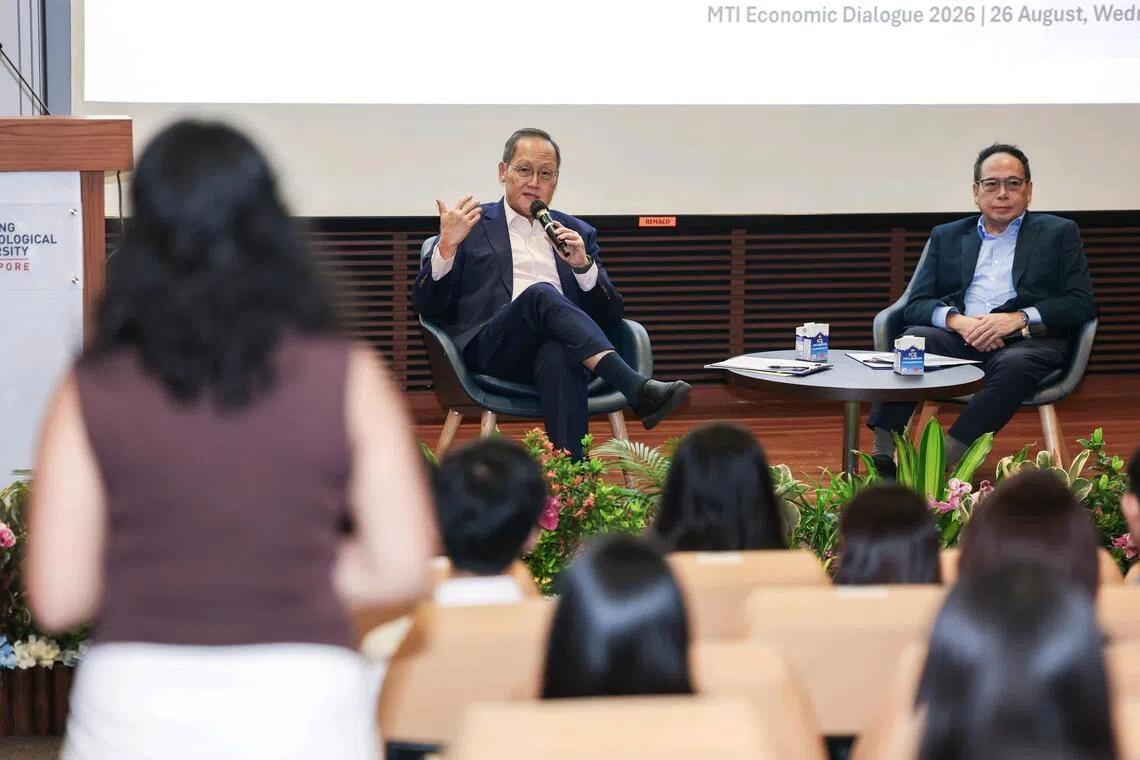
SINGAPORE – Harnessing artificial intelligence (AI) is important to the continued growth of the Singapore economy, but the technology cannot be expected to contribute to job creation as it did in the past, said Minister for Trade and Industry (Energy and Industry) Tan See Leng.
The Government recognises that AI and automation may allow firms to produce more with fewer workers, Tan said at the MTI Economic Dialogue on Aug 26.
“As such, we can no longer assume that growth will automatically create the same number, the same type, or the same range of jobs as before,” he said.
“What we will do is to make sure that all of our AI adoption, always at the core, is human-centric.”
This means building pathways into growth sectors, raising the quality of jobs in essential and resilient occupations, including skilled trades, and encouraging entrepreneurship.
Tan also pointed to plans to offer “career bridges” to workers who are more exposed to disruption from AI, automation and changing cost structures, to support them in the move to other opportunities.
He added that it was also important to ensure that gains from AI diffuse beyond leading firms.
Small and medium-sized enterprises must also be able to adopt useful solutions, with workers equipped to use AI alongside their current expertise.
“In short, we want Singapore to be valuable not just because goods, people, capital and energy pass through us, but also because important decisions are made here,” Tan said.
“These activities create, in turn, a virtuous cycle where opportunities and capabilities continue to abound for Singaporeans as well as our companies,” he added.
The event was attended by around 190 participants, most of them students from universities and junior colleges. Tan also presented the Ministry of Trade and Industry’s economist service undergraduate scholarships to six recipients.
Responding to a question from an attendee on how he views balancing the benefits and challenges of AI, Tan said he recognises the technology can be daunting for some who might be nudged to upskill.
He quipped: “I am 61. When I go for my old class gathering and I tell them about AI, they say, please, don’t act smart. My own contemporaries look at me in bewilderment.
“They say, (do) you know what you are doing? But this is the trade-off. As a government, we know that this is bitter medicine, but it’s good for you.”
At the recent National Day Rally, Prime Minister Lawrence Wong said that Singapore will not hold back on new technologies just because they are disruptive.
At the same time, the country will not leave affected workers to fend for themselves.
Citing how autonomous vehicles can ease manpower constraints in light of the growing difficulty in recruiting bus captains, he acknowledged that many taxi and private-hire drivers worry that they may be displaced by self-driving vehicles.
“So, even as we scale up autonomous vehicles, we will do so progressively. We will not let adoption run ahead of our ability to retrain and support affected drivers and help them move into new jobs,” PM Wong said.
AI agents – programs that help people carry out tasks without human guidance – can also give small businesses “capabilities that were once available only to much larger firms”, he said.
Risks that are harder to predict also enter the picture as technology becomes more powerful, requiring safeguards, PM Wong cautioned, referring to how AI companies Anthropic, OpenAI and Meta recently revealed that their AI models or agents had gone rogue and hacked other organisations during testing.
Calling these developments unsettling, he said: “Singapore will do our part. We will bring countries and companies together and build coalitions around practical safeguards.”

