


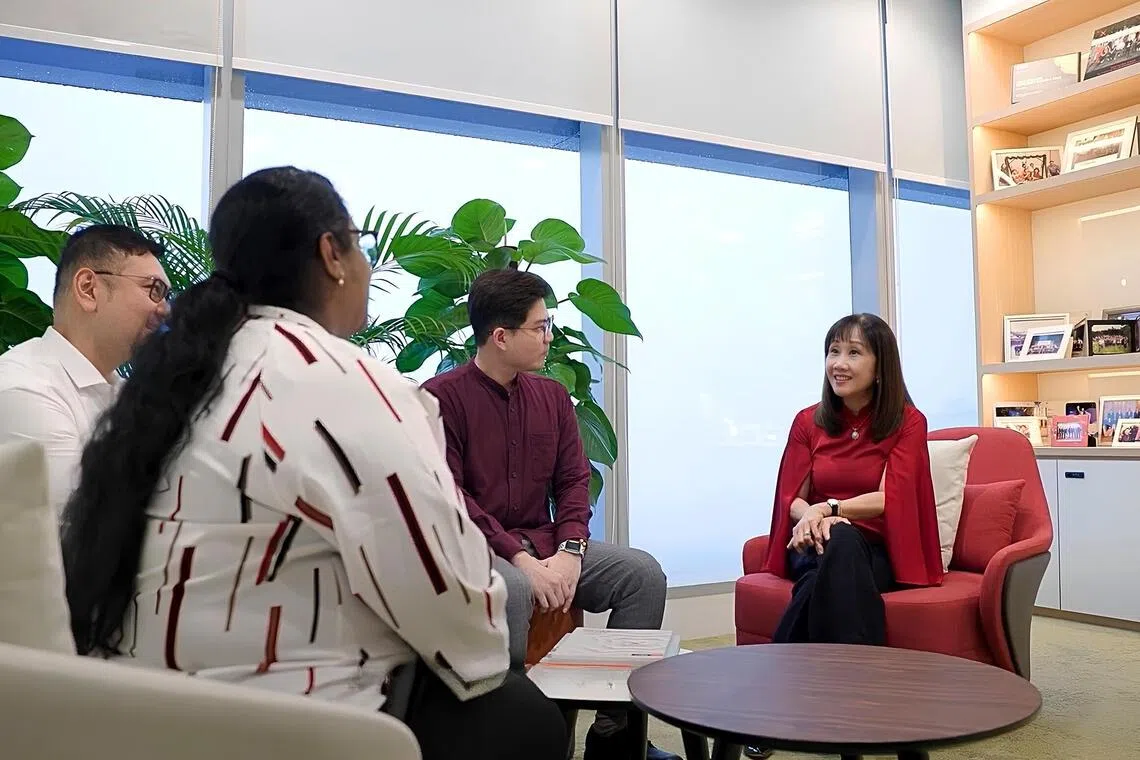
SINGAPORE – When DBS Bank human resources chief Lee Yan Hong reflects on the biggest challenges of her more than three-decade career, artificial intelligence does not make the list.
During the 2008 global financial crisis, she watched the share price of the international bank she was working for then collapse, wondering whether her team would remain intact if the business were to go under.
At DBS during the Covid-19 pandemic, she had to keep thousands of employees safe amid the unprecedented public health crisis.
AI, to her, feels more manageable. It is less of a crisis, and more of a leadership opportunity where she feels “more in control”, Lee told The Straits Times in an exclusive interview.
The challenge, she believes, is changing the narrative around artificial intelligence – from a technology that threatens jobs to one that helps people overcome their limitations.
Just like cars, which were invented to help humans overcome physical limitations and travel faster and farther, AI is an invention that can compensate for cognitive limitations, said the head of group human resources at South-east Asia’s largest bank by assets.
“I cannot read a million pages,” Lee said. “I cannot go to all the websites. I cannot summarise things so fast, and look at all the patterns and synthesise so fast, so AI helps me with that.”
“It’s a cognitive enhancer, and we want to use it to create capacity to drive growth,” she added, her voice spirited as she made the case for AI.
DBS’ current AI momentum builds on a digital transformation journey that started in 2014. Lee said the bank moved quickly to experiment with generative AI in 2023, after ChatGPT became more mainstream.
Rather than waiting for employees to adopt GenAI on their own, Lee said the bank gave them the tools, including its in-house DBS GPT and Microsoft Copilot, and encouraged broad-based use across its 19 markets.
She said what helped drive adoption was a sense of FOMO, or fear of missing out. As employees saw how colleagues were able to write in perfect English and produce better reports, more began experimenting with the tools themselves.
More than 70 per cent of DBS employees now use AI tools, Lee noted with pride. “For my team, if I take away their AI, they will kill me,” she quipped.
At DBS, more than 1.8 million prompts are generated each month across all its markets – and all that AI usage does not come cheap.
Lee said the bank has invested millions of dollars in tech, including AI subscriptions, and sees this as necessary in helping staff do their work better.
If AI can reduce the amount of “toil” employees spend on repetitive work and help them finish their tasks faster, she is happy, for they can go home earlier, recharge and return the next day with better ideas.
AI in human resources
The HR chief herself is also benefitting from AI. For example, performance evaluations for senior executives once involved gathering information from 360-degree surveys, personality assessment reports and other sources of data. The process could take her about eight hours.
Now, AI can produce a first cut in five minutes, she said. The hours saved can then be spent on careful deliberation before she meets the committee to make the final decision.
“I have seven hours to be really thoughtful,” she said, adding that AI, paradoxically, “makes hard thinking easier”.
One often-cited concern about the use of AI in HR is that applicant tracking systems can reduce resume screening to a game of numbers and keyword-stuffing.
Lee said DBS has to use AI for resume-screening for practical reasons. In India, for example, a single job posting can attract anywhere from 10,000 to 100,000 applications. Without AI, it is impossible to screen all resumes against consistent, skills-based criteria without human bias.
But she said the bank has never outsourced hiring entirely to AI. Candidates still go through psychometric and technical assessments. Interviews remain important for hiring managers to assess chemistry and fit, as well as for candidates to understand the company’s values and culture.
When it comes to candidate assessments, DBS allows the use of GenAI for writing and coding tests. But as Lee points out, AI merely raises the baseline for everyone, as people can arrive at similar answers with AI.
To stand out, candidates have to think deeper, read widely, join the dots and propose outstanding solutions. The thinking cannot be outsourced, she said.
Ramping up hiring
For young graduates, the door into DBS has widened in 2026, as it plans to take in more than 500 of them through its management associate (MA), internship and traineeship programmes. It has hired 112 MAs so far in 2026 – more than double the average annual intake in 2024 and 2025.
DBS is also focused on creating roles that will help grow the bank and keep it safe. This means more hiring is expected in areas such as AI, data, wealth management, risk management and cybersecurity.
In fact, Lee said the number of new hires in Singapore is up about 10 per cent so far in 2026, compared with the same period in 2025.
If sustained, that uptick could reverse a multi-year drop that saw new hires here fall from 1,833 in 2023 to 1,097 in 2025.
But Lee also emphasised that DBS has had low turnover. In particular, its attrition rate in Singapore is just 2.8 per cent, she said, reducing the need for many replacements.
Lee is also an advocate for internal mobility for those whose existing roles may be affected.
Call centre staff, for instance, can move into relationship management roles, serving wealth clients or small and medium-sized enterprises, after acquiring the necessary licences.
For staff who do not want a front-office role or the pressure of meeting sales and profit-and-loss targets, there are also opportunities to move into adjacent support and operational roles in the growing wealth management business, Lee said.
That, to her, is the broader point of workforce transformation: using AI to help the bank grow while bringing its existing workforce along with it.
That emphasis on career resilience was reinforced on Aug 24 with the launch of DBS’ new career advisory service. More than 100 members of the bank’s 500-strong HR team were trained as career advisers, enabling them to guide their colleagues while expanding their job scope.
The bank also signed a memorandum of understanding with the Institute of Banking and Finance to jointly build AI capabilities, support workers’ transitions into redesigned roles and strengthen the pipeline of young talent for the financial sector.
For Lee, a crucial part of preparing the workforce for AI is removing the fear surrounding it.
She herself was “super irritated” by jargon such as prompt engineering, which can make AI sound intimidating to the uninitiated.
It is just about asking questions, she said – the better the questions, the better the answers from AI.
“Fear is not a strategy,” she added. “If you don’t do anything, you will miss this industrial revolution.”
Her message to workers is simple: Don’t ask what AI will do to you.
Instead, ask: “What is AI doing for me?”

