


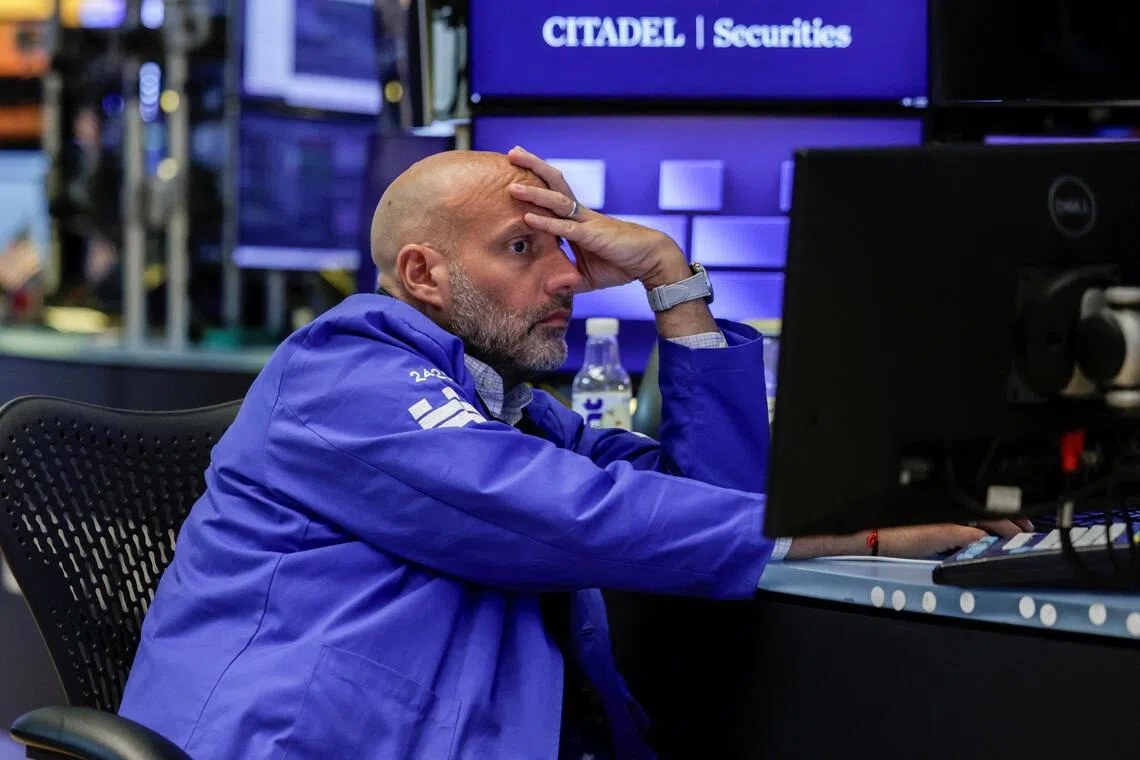
NEW YORK – The three main US equity indexes closed lower on Aug 20 as rising Treasury yields dented risk appetite while disappointing results from retail bellwether Walmart soured investors on the consumer sector and rallying oil prices fanned inflation worries.
Walmart shares tumbled 9.2 per cent after the world’s largest traditional retailer missed Wall Street expectations for quarterly comparable sales as rising gasoline prices had shoppers reining in spending.
The report dragged down the S&P 500 consumer staples and consumer discretionary sectors, which were among the weakest of the benchmark’s 11 major industry indexes.
Rival retailers such as Costco, Dollar Tree and Albertsons followed Walmart lower with losses between 1 per cent and 2.6 per cent.
The increase in US crude oil above US$87 compounded concerns about the health of the US consumer, according to Mona Mahajan, head of investment strategy at Edward Jones.
She noted that investors were already anxious after recent weaker-than-expected retail sales and labour market data for July.
“There is some question about how resilient the consumer can be with ongoing elevated gas prices and inflationary pressures,” Mahajan said.
The strategist also highlighted pressure from rising bond yields on equities.
Wall Street indexes had risen on Aug 19 after the US Treasury Department said it would spend more than double the expected amount on buying back bonds in a bid to slow a recent surge in yields.
On Aug 20, however, stocks declined as yields advanced again.
Yields on the 30-year and 10-year bonds pared gains briefly after US Treasury Secretary Scott Bessent said he may again increase the volume of Treasury bonds the government will repurchase.
But yields resumed their upward trend.
“There are a couple of headwinds that the markets woke up to today,” said Mahajan. “One was a resumption in the increase in bond yields across the curve that came despite yesterday’s Treasury move… it reversed very quickly, within 24 hours.”
The Dow Jones Industrial Average fell 703.84 points, or 1.32 per cent, to 52,759.21, the S&P 500 lost 66.82 points, or 0.87 per cent, to 7,641.16 and the Nasdaq Composite lost 263.92 points, or 1 per cent, to 26,067.17.
The S&P ended about 2 per cent below its most recent record close, reached last week, while the Nasdaq was more than 3 per cent below its June 2 record finish.
Consumer staples fell 1.93 per cent and was the biggest percentage loser among the S&P 500‘s major sectors, followed by healthcare , which fell 1.93 per cent.
The S&P 500 consumer discretionary sector sank 1.8 per cent with megacap Amazon among its biggest index-point drags.
Big percentage decliners in the sector included Royal Caribbean Group and Carnival Corp, which lost more than 4 per cent each as they are sensitive to fuel prices.
The S&P 500 energy index rose 0.4 per cent as oil gained for the fifth consecutive session due to stalled US-Iran peace talks and Middle East supply disruptions.
Real estate was the only other sector gainer, adding 0.15 per cent.
Meanwhile, cryptocurrency-related companies such as Strategy and exchange operator Coinbase Global rallied more than 7 per cent a day after US President Donald Trump called on Congress to pass a crypto Bill.
Healthcare’s biggest decliner was biotech company Moderna, which finished down 23.5 per cent after it surged nearly 177 per cent on Aug 19.
Deere shares closed up 6.9 per cent after a full-year net income forecast raise from the world’s largest farm-equipment manufacturer.
Shares in Coty sank 9.2 per cent after the CoverGirl cosmetics brand owner forecast current-quarter earnings below expectations and withheld its annual outlook, while Advance Auto Parts tumbled 24.5 per cent after issuing a weaker annual sales forecast.
Declining issues outnumbered advancers by a 1.94-to-1 ratio on the NYSE, where there were 156 new highs and 132 new lows.
On the Nasdaq, 1,672 stocks rose and 3,217 fell as declining issues outnumbered advancers by a 1.92-to-1 ratio.
The S&P 500 posted 16 new 52-week highs and 3 new lows while the Nasdaq Composite recorded 67 new highs and 104 new lows.
On US exchanges about 9.61 billion shares changed hands compared with the 16.64 billion average for the last 20 sessions. REUTERS

