Thirteen years in with the same employer, and Yuslina Abdul Aziz still talks about work as though she’s just started a new job.
Since joining the Ministry of Home Affairs (MHA) after graduating from university in 2013, she has worked in communications, policy and international relations at the Central Narcotics Bureau (CNB) and the MHA Headquarters.
This is all thanks to the ministry’s Civilian Generalist track. Every new posting has brought new responsibilities and a different perspective, making every few years feel like the start of a new job.
Her family thinks she is in the same role as 13 years ago, unaware that she has rotated across multiple domains of work since then.
“I’ve tried explaining but they don’t get how it’s possible that you get to take on different job roles within the same organisation every few years,” the 36-year-old adds, with a laugh.
For Yuslina, that is the fun of it.
MHA consists of the MHA Headquarters (HQ), seven departments and three statutory boards – known collectively as the Home Team. She began her career in the Communications Division at the CNB, one of the Home Team departments under MHA.
Today, she is an assistant director at the International Organisations and Security Directorate in the Home Affairs ministry’s International Cooperation and Partnerships Division.
Each posting has broadened her understanding of the Home Team, while giving her the chance to develop new skills and take on new responsibilities.
She reflects on the questions she once had as a newly minted graduate – and what she has learnt throughout her career.
1. Is an MHA/Home Team career only for those in uniform?
Not at all, though it’s easy to see why people may think so. I think the public perception of MHA and the Home Team is shaped by its uniformed presence and rightly so, because our uniformed officers do such good work in keeping Singapore safe and secure.
After graduating, I saw a Singapore Police Force recruitment advertisement and it made me think seriously about how I wanted to contribute to Singapore. I saw an opportunity to apply the perspectives I gained through my background in sociology in support of the Home Team’s work, contributing in a way that is both meaningful and aligned with my strengths.
As I was doing my research, I found out more about the MHA Civilian Generalist career path. It surprised me to learn how much of MHA’s work is carried out by civilian officers. I wanted to be a part of this, and build my career at such an accessible and interesting workplace.
The Generalist track definitely appealed to me because it offered the flexibility and freedom for me to try different roles early in my career. I would say it suits those who want to give back to society in every unique way.
2. Can any degree lead to an MHA Civilian Generalist career?
For sure. My colleagues come from a range of backgrounds, from psychology to engineering. What matters is not whether your degree sounds like an obvious fit, but how you think, write, analyse and communicate.
I did wonder at first what a sociology graduate like myself could bring to law enforcement and national security but my studies trained me to think about how people and communities behave, how institutions shape behaviour, and how policies can have unintended consequences on different groups of people.
That has been relevant in almost every posting for me.
A good example was when I was working on policies related to the private security industry, which involved engaging a diverse group of stakeholders from front-line officers and security agencies to industry associations and unions; each bringing different perspectives to the table.
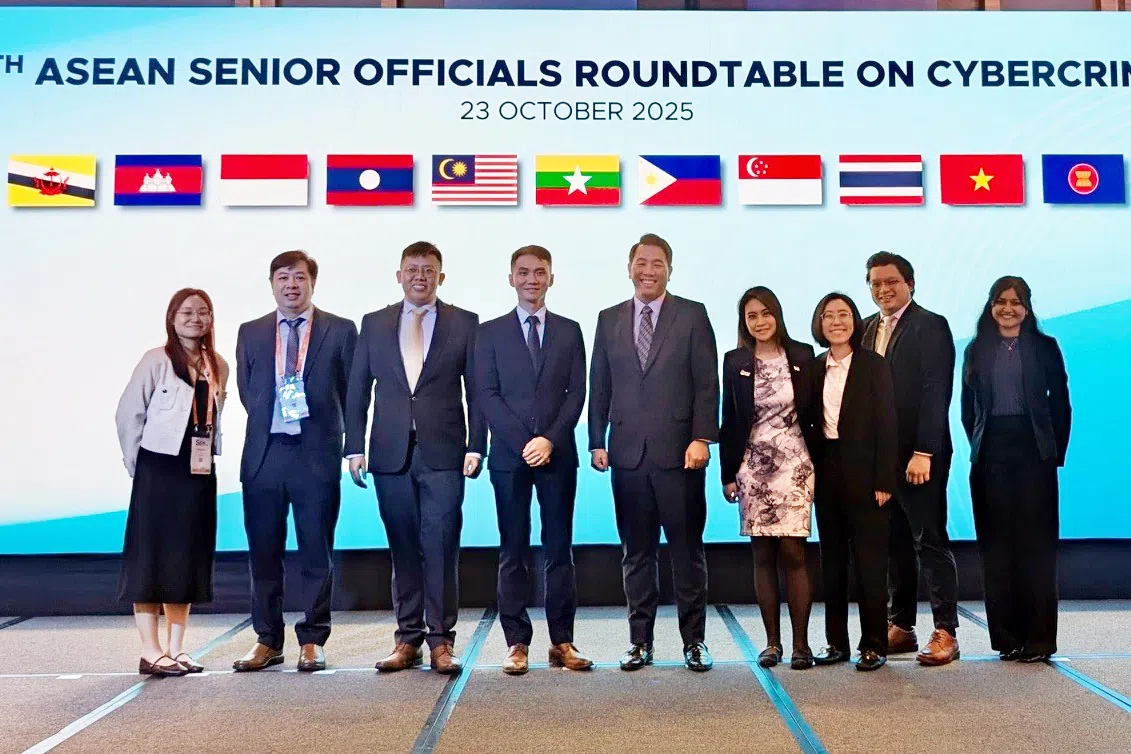
In her current posting with MHA’s International Cooperation and Partnerships Division, Yuslina (third from right) works with various agencies and overseas counterparts on global issues, including financial crime.
PHOTO: MINISTRY OF HOME AFFAIRS
Studying sociology has taught me how to look beyond a single viewpoint and understand how policies can have different implications for the various stakeholders. Most importantly, I learnt how to balance their differing needs and priorities.
Different degrees train you to approach problems in different ways – whether that is understanding people, analysing systems, working with data or breaking down complex issues. What matters is being able to apply those skills to the work.
3. What do you get to see across your rotations in the Home Team as an MHA Civilian Generalist?
In the security policy directorate with the Joint Operations Group at the MHA HQ, I had worked closely with the private security industry and union, and got to meet security officers and companies. This gave me a better understanding of what’s happening on the ground.
In my current role, I work on matters relating to financial crime, so a substantial part of my work takes place in an inter-agency setting. It has been a great experience learning from coworkers with different career backgrounds, such as legal and finance, and seeing things beyond just my ministry’s perspective.
Each rotation has enabled me to hone new skill sets, and deal with different challenges and perspectives, so I have never felt like I was stagnating. In contrast, I actually find a renewed sense of purpose with each rotation.
And because the culture at MHA and the Home Team is really strong and consistent from agency to agency, there is no culture shock. Yes, you change agencies but you still feel comfortable. So it feels like a fresh new job each time – without the awkwardness of being completely new to the organisation.
That variety is also why – even after more than 10 years with MHA – I can say I’ve never had a boring day.
4. How are MHA Civilian Generalist officers guided on their career track?
During career or appraisal chats, I talk to my supervisors about my aspirations, what I want to try next and whether I should stay longer in a role to develop myself further. These conversations also help me understand where my current strengths and skill sets may fit.

(From right) Yuslina with Gillian Ong, her first director at the Central Narcotics Bureau and a mentor she still turns to for career advice today.
PHOTO: MINISTRY OF HOME AFFAIRS
For example, I have always wanted to try international relations work, so my current role felt like a good mix of the skill sets I had developed from both my communications and policy postings.
My former supervisors are still my friends today because they are not just bosses – they are mentors, not just at work but in life.
My very first director, Gillian Ong, who hired me when I was in CNB’s Communications Division, is still someone I keep in touch with today. I would also go back to my previous bosses for advice whenever I am thinking about whether it’s time to try a different domain or take on a different posting.
MHA also provides that structure through regular career conversations, where officers can discuss their interests, development needs and possible next postings with their supervisors.
Many of them have gone through different rotations themselves, so they are in a good place to advise me. That is one of the things I appreciate about being an MHA Civilian Generalist. The rotations give you room to explore, but you are not figuring it all out alone.
5. What was an unexpected experience you’ve had in the Home Team?
Being involved in organising a staff appreciation event in 2022 taught me a lot about how morale and culture are built in an organisation.
I was a member of MHA HQ’s staff well-being committee and volunteered to organise the annual staff appreciation event. Being on the committee also gave me a chance to meet other MHA officers I wouldn’t otherwise have known in my day-to-day work.
Because this is probably the main event of the year that most MHA HQ officers look forward to, it’s quite a big deal. Each division takes pride in dressing up according to the event theme which changes from year to year. Our senior management takes part as well.
It was a good reminder that meaningful work can come in many forms – and being able to contribute to a better workplace culture is quite a privilege.
What does a career look like for an MHA Civilian Generalist?
You get to work behind the scenes with uniformed and specialist colleagues on the policies, systems and support that help keep Singapore safe.
But what makes the track different is the breadth of exposure it provides officers with.
Officers can move across different parts of the Ministry of Home Affairs (MHA) – from the MHA Headquarters to Home Team agencies, such as the Singapore Police Force, Singapore Civil Defence Force, Immigration & Checkpoints Authority, Central Narcotics Bureau and Singapore Prison Service.
Through these rotations, they take on work across areas, such as communications, policy and operations, research, strategic planning, international relations and seven other domains, without having to don a uniform.
Each posting comes with new responsibilities and challenges, giving officers a broader understanding of how the Home Team works.
Over time, you can also deepen your experience in areas that match your strengths and interests. The track may appeal to those who want purposeful work across diverse areas, without being confined to a single domain.
Find out more about MHA’s Civilian Generalist track here.