


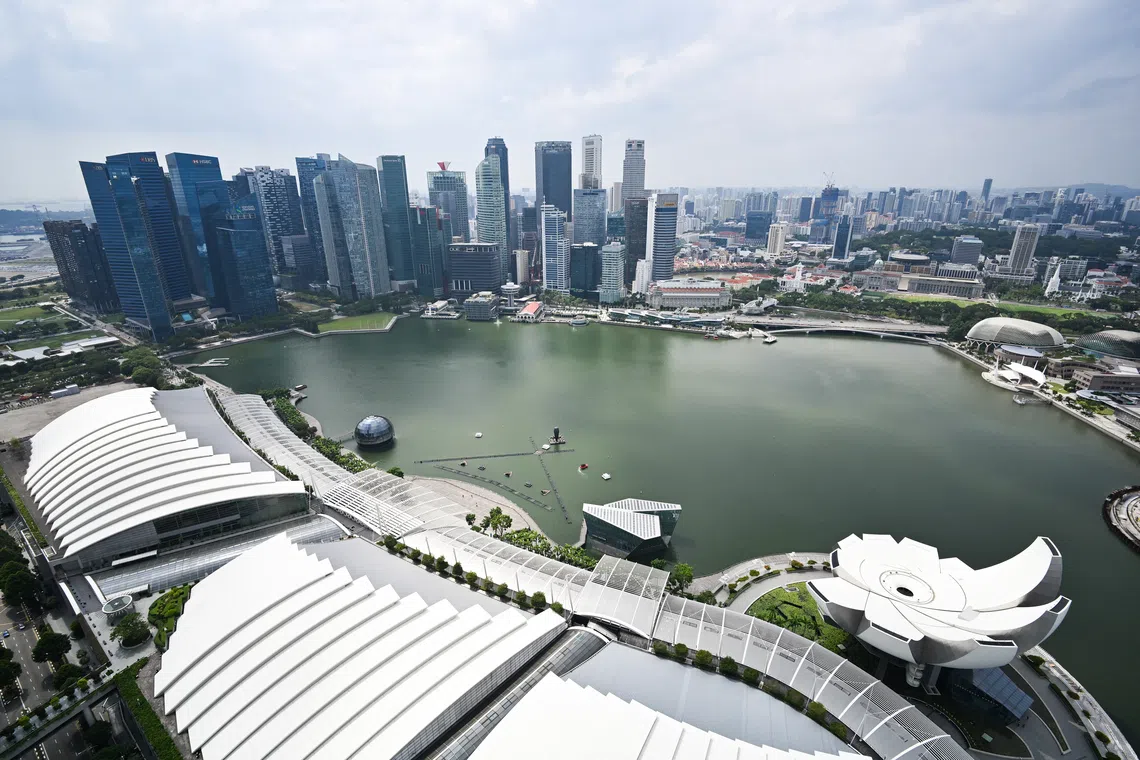
SINGAPORE – Singapore’s bid to become the region’s leading asset management hub could receive a much-needed boost from measures announced by the Monetary Authority of Singapore (MAS) on Aug 19, as the Republic and Hong Kong compete to attract the industry’s top talent.
Although further details of the measures – including a new foreign work pass track, tax exemption for profit-related returns and a hedge fund investment programme – will remain under wraps until Budget 2027, industry observers said the timing was crucial in signalling the Republic’s ambitions.
As competition with Hong Kong intensifies, Singapore must move quickly to remain competitive in attracting asset managers and industry talent, they added.
“Timing matters, perhaps more than people realise,” said Suhaimi Zainal-Abidin, deputy chairman of the Singapore branch of the Alternative Investment Management Association (AIMA). “Every month of silence means you potentially lose a firm that may decide to place its next 20 hires elsewhere.”
He noted that Singapore’s asset management sector had been lagging behind Hong Kong, which is seeing faster growth in assets under management (AUM).
Hong Kong’s AUM grew 20 per cent to hit a record high of HK$42.2 trillion (S$68.7 trillion) in 2025, driven by a rise in net fund inflows of about 300 per cent.
In comparison, Singapore’s AUM hit $6.7 trillion in 2025, up around 10 per cent year on year, with net inflows growing 29 per cent.
AIMA, which serves as the primary industry representative for investment managers, said publicly in July that Singapore-based managers were already moving staff to Hong Kong. It cited individual taxation as “the single most important factor for internationally mobile professionals.”
Meanwhile, Hong Kong is already moving to pass legislation that would expand tax exemptions for carried interest, a share of fund profits paid to investment managers when they meet performance targets.
Such rewards, also known as hurdle rates, are generally regarded as income and are taxable if they are derived in Singapore.
AIMA, which serves as the primary industry representative for investment managers, said in July that some Singapore-based fund managers have already been relocating staff to Hong Kong because of its more attractive personal income tax rates.
Meanwhile, other wealth hubs have already implemented measures to attract fund managers. Most notably, Dubai and the rest of the United Arab Emirates do not levy a personal income tax, or personal capital gains tax for individual investors, making the Middle East country an attractive destination for globally mobile investment talent, noted Lim Maan Huey, asset and wealth management leader at PwC Singapore.
Lim said MAS’ proposed tax reforms would bring Singapore in line with competing financial centres and encourage both existing and new fund managers to continue investing in teams and operations here.
The reforms would also strengthen Singapore’s appeal, and build on its political stability, robust regulatory framework, strong rule of law, deep capital markets and access to investment opportunities across the region, she added.
She noted that those who are likely to benefit the most from MAS’ proposed tax exemption are senior investment professionals and fund management businesses whose compensation are closely tied to investment performance.
Performance-linked profit-sharing arrangements are a recognised feature of the asset management industry, and they are valued because they help align the interests of fund managers and investment professionals with those of investors by linking rewards to investment performance, said Kai-Niklas Schneider, co-chair of the Singapore Funds Industry Group and partner at law firm Clifford Chance.
Developing the talent pool
Taken together, the reforms reflect a holistic set of measures that support important aspects of the ecosystem, including talent, investment activity and industry growth, analysts said.
They also reflect the depth of engagement between regulator and industry, which is a notable strength of Singapore’s funds and asset management ecosystem, said Schneider.
But analysts noted that the proposed initiatives would need some refinement in order to work effectively.
For instance, the proposed tax exemption and new foreign work pass track under the Overseas Networks and Expertise (ONE) Pass framework largely target senior professionals and do not address the difficulties firms face in hiring younger talent through the Employment Pass scheme, said Mr Zainal-Abidin, who is also chief executive of Singapore-based hedge fund Quantedge Capital.
“You cannot build a senior Singaporean bench in 15 years without a junior- and mid-level pipeline today.”
More could also be done to support younger managers in their early years, particularly in the areas of licensing, talent, and access to service providers such as prime brokers, said James Ong, group head of asset management at CGS International Securities.
He noted that new fund managers in Singapore often have to wait longer than their Hong Kong counterparts to secure essential trading and financing services from major banks and brokers, adding to their costs during the critical early stages of growth.
‘Marginal’ contest with Hong Kong
Ultimately, though, competition between Singapore and Hong Kong for asset managers will be decided at the margins, said UOB Kay Hian’s director of wealth management Kenneth Goh.
He noted that major considerations such as the rule of law, currency and proximity to clients are already well established, leaving measures such as tax exemptions and new visa rules to tip the balance for managers who see little difference between the two financial centres.
The two markets are also competing on slightly different strengths, with Singapore broadly seen as a neutral base for investors, said Ong.
Unlike Hong Kong, which some investors associate closely with China, Singapore is seen as a more neutral base for funds seeking capital from around the world.
This neutrality can make it easier for managers to appeal to investors from different markets, as perceptions of where a fund is based can influence investors’ willingness to put money into it, he added.
Tussle for IPOs
Singapore’s tussle with Hong Kong for asset managers also mirrors the competition between the two financial centres for another coveted prize – company listings – as both stock exchanges see a revival in initial public offering (IPO) activity.
Following reforms introduced by MAS, the Singapore Exchange (SGX) has moved forward from years of scarce listings and a wave of delistings. In 2025, it recorded 16 IPOs, while eight listings have been launched so far in 2026, raising about $1.4 billion.
In comparison, Hong Kong hosted 85 listings in the first half of 2026, raising HK$209.9 billion (S$34 billion), up from 42 new listings raising HK$107.1 billion in the year before – its strongest first-half result in five years.
While it may seem like a stark difference in performance, analysts noted that the numbers alone do not necessarily mean that Singapore is lagging behind Hong Kong on the IPO front.
UOB Kay Hian’s Goh noted that the bulk of the listings in Hong Kong were by Chinese issuers, and SGX does not enjoy the same advantage of having a robust Mainland pipeline.
He added that the new measures to strengthen Singapore’s asset management industry could also benefit SGX indirectly if fund managers based here channel more capital into locally listed assets.

