


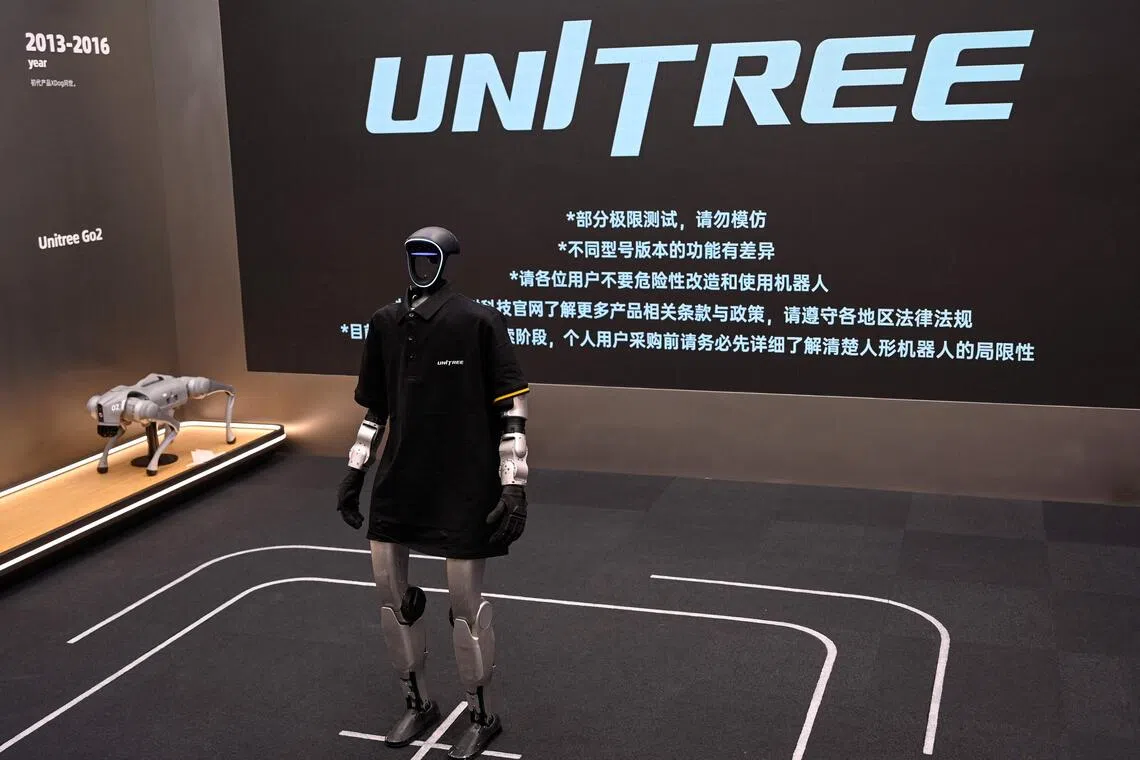
SHANGHAI/BEIJING – Shares in Unitree, China’s best-known humanoid robot maker, soared nearly sixfold in its Shanghai trading debut, in a landmark moment for the country’s robotics sector, which has become a key battleground in the Sino-US tech war.
While Unitree, which competes with Hyundai Motor Group-owned Boston Dynamics and Tesla, is not the first Chinese humanoid robot maker to list, its listing is expected to set the tone for a slew of other rivals preparing to come to market.
The stock was changing hands at 900 yuan on the tech-focused STAR Market in early trade, compared with its IPO price of 150.8 yuan. It pared some gains after having opened at the day’s high of 1,100 yuan.
The world’s biggest humanoid-robot maker by sales, which raised roughly US$900 million (S$1.1 billion) in its initial public offering last week, has drawn global attention for its robots that run, dance and perform martial arts.
It is also, unlike most of its peers, profitable even if few of its robots are used in commercial applications.
Investors are also drawn to Unitree’s perceived state support as China seeks to gain the upper hand in tech over the United States and pushes development of the sector.
Its founder Wang Xingxing had a coveted front-row seat at a summit with tech business leaders hosted by Chinese President Xi Jinping early last year, and the start-up also has backing from some of China’s most influential tech firms including Tencent, Alibaba and DeepSeek.
“It is a top-tier player, and its uniqueness commands premiums,” said Yan Kai, a venture capitalist and partner at Ivy Capital in Shanghai.
“Its price is dictated by political and economic considerations, rather than valuation models.”
The debut coincides with the opening of the World Robot Conference in Beijing, where hundreds of mostly Chinese companies will be launching new products and demonstrating advancements that the government is betting will make up for the labour shortfall caused by China’s demographic crisis.
Some 10 per cent of the Unitree shares were sold in the IPO, and Wang continues to own around a fifth of the company.
The debut has catapulted his personal wealth to more than US$12 billion on paper. Reuters

