


SINGAPORE – Sim Swee Kee, 23, is a second-year banking and finance student at Republic Polytechnic (RP) pursuing a business diploma.
He began his investing journey in the Singapore market “as soon as I could, at the age of 18”, with his earnings from giving part-time tuition.
“I already knew the benefits of compounding interest but didn’t have much money to invest at that point. While serving National Service, I was getting a regular allowance and, using dollar-cost averaging, I just kept growing my investments.”
Today he allocates about 90 per cent of his portfolio to local bank, telecom and airline stocks.
“A lot of people call me ‘old’,” Sim quipped, referring to his preference for low-risk, high-dividend stocks that are typically more popular with older investors.
“I generally avoid US stocks because I don’t fully understand the market dynamics over there, so I’m a bit hesitant to invest,” he added.
Like Sim, 19-year-old university undergraduate Chloe Wong started investing as soon as she turned 18.
She spoke to The Straits Times on the sidelines of the OCBC GENesis event in July, a programme held for children of the bank’s affluent clients.
“I talk to my mum about investing quite frequently. My mum listens to podcasts about investing in the car, so I tune in as well,” Wong said.

Chloe Wong, 19, said her mother encouraged her to open an investment account the moment she turned 18.
PHOTO: OCBC
She added that her mother encouraged her to open an investment account the moment she turned 18, setting aside money so she could familiarise herself with the investment platform and learn to make informed decisions.
Sim and Wong are part of a growing trend of financially savvy youth who are starting their investment journeys early.
Mr Joey Choy, a principal investment specialist at Phillip Securities, said in the past, people only began thinking seriously about investing after entering the workforce and accumulating substantial savings.
Today, however, investors are entering the market at a younger age, with some starting at 18 and in their early 20s, he added.
These observations are backed by a survey by Trust Bank, The Everyday Investor Report, released on August 13.
The online survey of 1,050 Singapore residents aged 18 to 40 was conducted from May to June 2026.
Respondents were split equally into two groups based on their life stages: young adults aged 18 to 24 who are studying or have just started work; and working adults aged 25 to 40 who are more established in their careers but have heavier financial commitments.
The survey found that investing is becoming more mainstream, with 51 per cent of all respondents actively investing today.
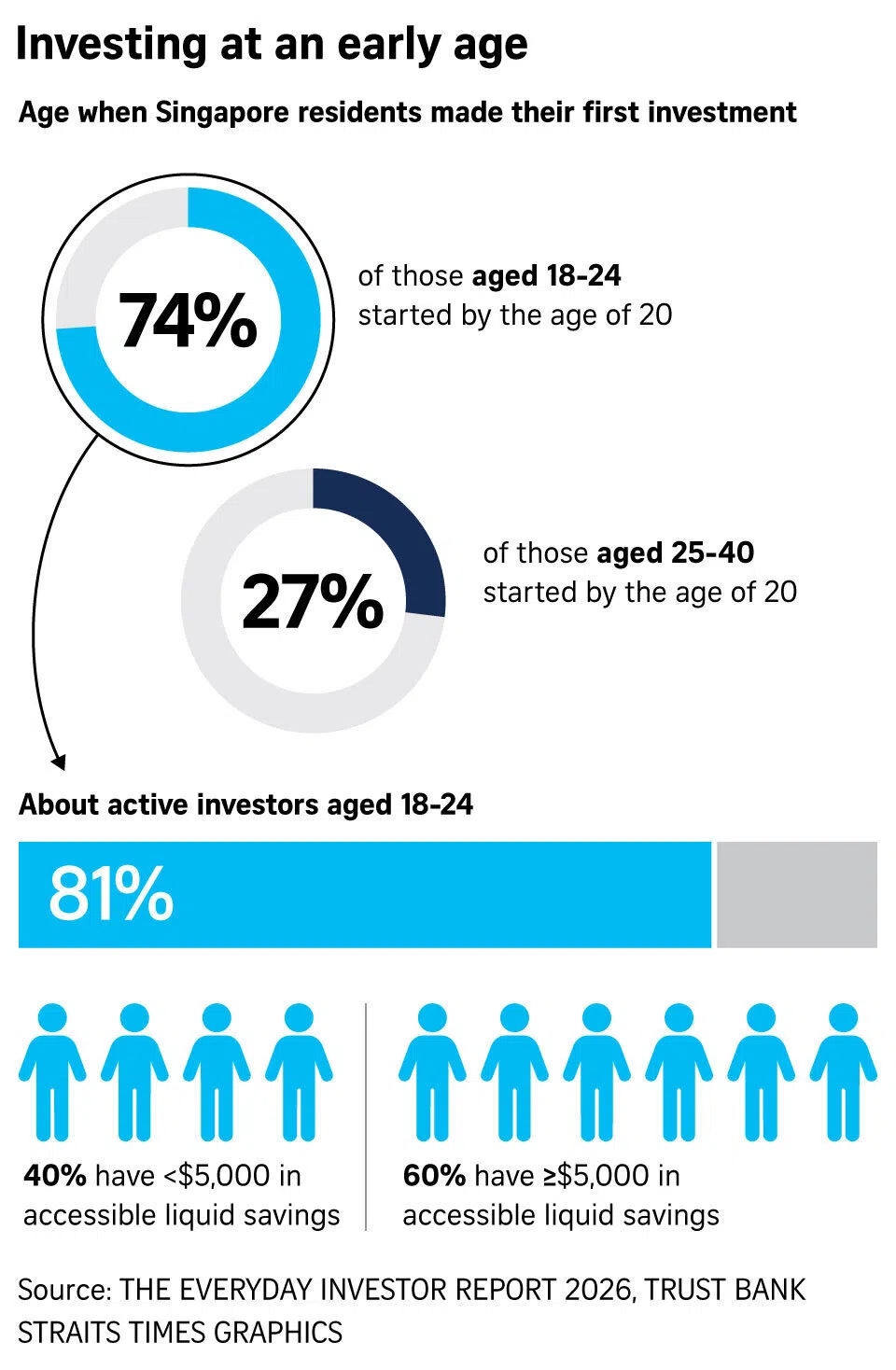
Investors are starting earlier, with 74 per cent of active investors aged 18 to 24 making their first investment by age 20.
In contrast, only 27 per cent of active investors in the older age group had started investing by the time they were 20.
The survey also found that young adults are not waiting until they have accumulated wealth or savings to invest. Instead, they are starting with small amounts and consistently investing a little over time.
While 40 per cent of active investors aged 18 to 24 have less than $5,000 in liquid savings, 81 per cent invest at least 5 per cent of their allowance or income.
Choy said that by starting early, young individuals benefit from a longer runway to learn and compound their capital, even if they begin with smaller amounts.
Jamie Lee, head of DBS digiWealth, said investors can start small and invest regularly by adopting a disciplined, dollar-cost averaging approach.
This strategy essentially involves investing a fixed amount of money at regular intervals, say every month, regardless of whether stock prices go up or down.
Lee shared that the DBS digiWealth platform recorded a 53 per cent increase in regular savings plan transactions in June 2026, compared to a year ago.
As an example, investors can start investing with $100 in DBS digiPortfolio, which offers a variety of ready-made portfolios to meet different financial goals.
Lee said half of the digiPortfolio investors are below 40, indicating “rising consciousness among younger investors to invest for the long term via this approach”.
Well-informed youths
Today’s youth are more informed because they can access information on social media, YouTube and online investment platforms, Choy observed.
He added that local tertiary education institutions have stepped up their investor education efforts.
“Young investors are already learning about stocks while in polytechnic or university,” he said.
Sim shared that he learnt the fundamentals of financial markets, sustainable finance and financial technologies through his classes at RP.
This knowledge gave him the foundation to better understand market movements. He also makes it a habit to read the news daily to understand how current events affect the stock market.
“I do not follow financial influencers. I read the news, do my own research and make my own decisions,” he said.
To build up his financial literacy, he also attended workshops at his polytechnic, which were organised together with CGS International Securities Singapore.
There, he picked up basic investing concepts and gained a better understanding of how financial markets work. The sessions also reinforced his belief in the importance of starting early with his investments.
“During these financial literacy workshops, there are different kinds of investors: mature investors and novice investors,” Sim noted. “I can learn from investors who have a lot of years of experience in this field, but I can also teach those who have no experience at all – I can introduce them to investing.”
Wong, however, looks to her mother as her primary go-to for investment advice.
“My mum told me that investing should only be used with money that you are not afraid to lose. She also told me that if I do not sell my investments, it is not a real profit yet. I am just making a paper gain.”
Investing is not for me
There are some young investors who remain hesitant to enter the market.
The Trust survey found that 33 per cent of respondents have never invested. Common reasons cited include fear of losing money, not knowing enough to feel confident, and not knowing where to start.
For Chen Ee Hui, the market is simply too stressful. The 19-year-old spoke to ST on the sidelines of the UOB PriviGen event in July, a programme held for the children of the bank’s affluent clients.
“Investing is not for me,” she said, adding that she is the sort of person who would constantly monitor her portfolio even if she knows she should not.

Chen Ee Hui (Left), 19, finds the stock market too stressful and prefers to “invest in” limited edition handbags.
PHOTO: UOB
Instead, Chen, who loves shopping, prefers to invest in limited-edition handbags like Hermes Birkins.
“In Singapore, you have to wait for a month, and sometimes they don’t even have stock.
“I might as well go somewhere that I can easily get them, to Milan and buy a Hermes Birkin bag,” she shared.
“I can buy the bag, enjoy it for a while and then sell it and buy another one for myself, while making a profit from the sale of the first bag,” she said.
“There are always new ones coming out. And I do like bags.”

