


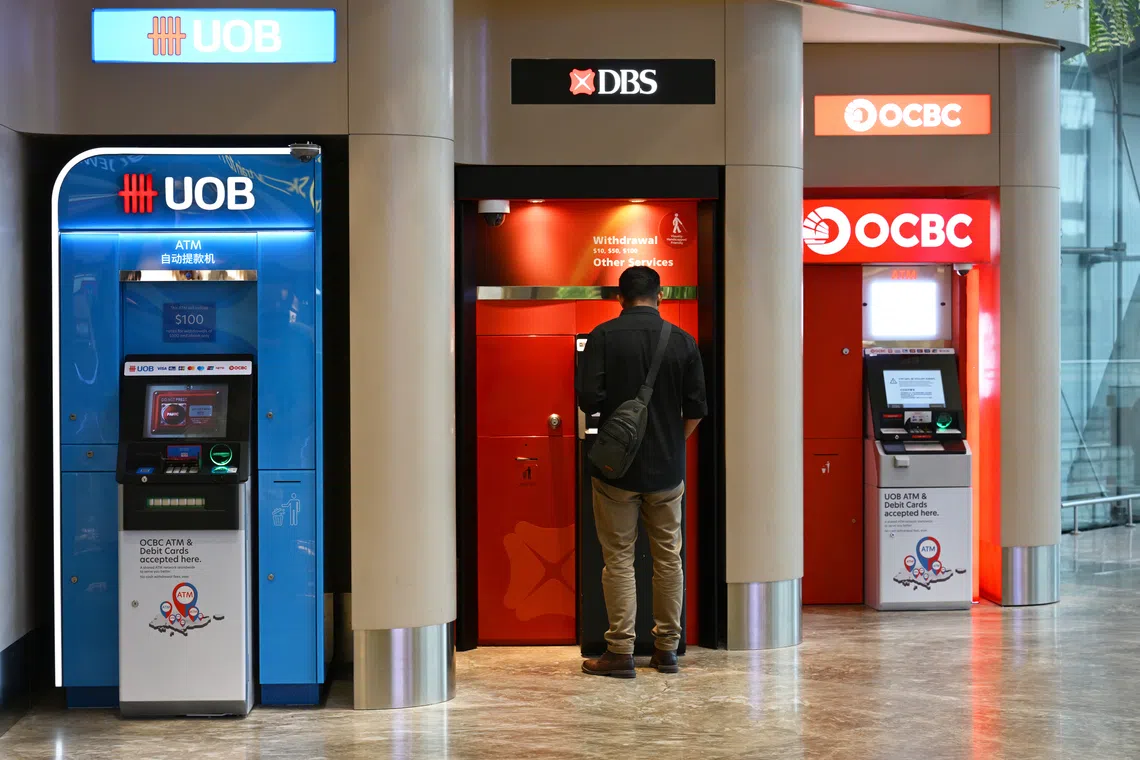
SINGAPORE – DBS and OCBC shares have hit fresh highs but could climb further, while asset quality concerns at UOB could affect near-term profitability, analysts said.
This comes after the three Singapore banks reported second-quarter profit growth, with wealth management and other fee income offsetting pressure on lending margins.
Saxo chief investment strategist Charu Chanana said Singapore banks are no longer simply a proxy for interest rates. They are becoming regional wealth platforms – and that may prove to be the more durable investment story, she said.
DBS shares rose to a fresh peak of $77.97 on Aug 11 before closing at $76.99 – 0.86 per cent higher.
OCBC, too, reached a new high of $31.56, before paring gains to $31.36, or 3.50 per cent higher.
Both banks raised their targets.
UOB’s shares, however, fell 2.63 per cent to $42.16.
The bank last week flagged a large non-performing asset linked to a real estate account in Greater China, kept its 2026 guidance largely unchanged and cut its fee-income growth target.
Upbeat on DBS and OCBC
Analysts were upbeat about DBS’s strong second-quarter earnings and its raised targets for the year.
The bank expects total income for 2026 to exceed 2025 levels, upgrading its previous flat-growth forecast, among other targets.
RHB raised its price target for DBS to $81.20 from $75.70 on Aug 7, while maintaining its “buy” call on the stock.
RHB and CGSI expect DBS to pay higher dividends at the end of 2027, funded by unutilised excess capital of $2.6 billion from its $3 billion share buyback programme.
Macquarie head of ASEAN equity research Jayden Vantarakis on Aug 6 raised DBS’s price target to $80.74 from $70.86.
CGSI, however, downgraded DBS to “hold” from a “buy” on Aug 6, while keeping its price target unchanged at $77.10, as the stock’s strong gains so far this year have reduced its upside potential.
Analysts are positive on OCBC, too.
RHB kept its “buy” rating on OCBC while raising its price target to $32.85 from $29.80 after the bank reported a record quarter and upgraded its guidance.
OCBC raised its 2026 financial targets, including total income growth, from its previous stable-to-growing outlook.
Chanana of Saxo said that OCBC arguably delivered the best current balance of earnings momentum, diversification and operating efficiency among the Singapore banks.
Fee income, wealth, trading and insurance all contributed to its strong second-quarter earnings. “Its earnings growth was broad rather than reliant on one source. That diversification is particularly valuable as net interest margins (NIMs) fall because OCBC has more earnings engines available to absorb the pressure,” she said.
Macquarie maintained an “outperform” rating with a price target of $27.76, as second-quarter loan growth and income from insurance and trading exceeded the research house’s estimates.
CGSI reiterated its “hold” call while lifting its price target to $29.80 from $28.40, assuming a higher return on equity from OCBC’s integration of its wealth and insurance businesses.
But CGSI sees limited room for net interest income to grow in the second half of the year, as lower asset yields continue to weigh on margins.
OCBC also noted slowing investment activity in July, which could translate into softer non-interest income growth in the second half, said CGSI.
Mixed outlook on UOB
Citi Research downgraded UOB to “sell” from “neutral” on Aug 11, with a target price of $38. Analyst Tan Yong Hong noted that NIM expectations should be tempered as fixed-rate assets reprice at lower rates.
It comes as OCBC Group Research downgraded the stock to “hold” from “buy” on Aug 6, even as it raised its fair-value estimate to $42.35 from $41. The downgrade reflected limited upside in UOB shares, with OCBC head of equity research Carmen Lee saying “the share price is now trading close to our valuation”.
CGSI maintained its “hold” call on UOB at a $42.60 target price, citing asset quality concerns that have resurfaced.
“We believe elevated credit costs will continue to drag UOB’s near-term profitability,” said CGSI analyst Tay Wee Kuang.
UOB’s new non-performing assets hit $902 million in the second quarter, up 90 per cent year on year due to one real estate account in Greater China. UOB said adequate provisions have been pre-emptively set aside to buffer against this exposure.
In the third quarter of 2025, UOB had also reported a surge in allowances for credit and other losses to $1.36 billion – including $615 million in pre-emptive general provisions – causing net profit to plunge 72 per cent year on year to $443 million.
Total credit costs normalised in the fourth quarter, falling to 19 basis points from the previous quarter’s 134 basis points. Total allowances halved on lower specific allowances.
Not all analysts are bearish on UOB.
RHB noted positively that UOB is comfortable with its coverage and expects non-performing assets to trend lower from here.
It upgraded its rating on UOB to “buy” and lifted the price target to $46.60 from $41.30 as the valuation gap versus peers is “too wide and should narrow”.
Vantarakis said that while UOB’s 8-basis-point quarter-on-quarter NIM decline was the largest among peers, he is maintaining an “outperform” rating at a price target of $45.16.
UOB’s wealth fee income rose 29 per cent year on year, driving overall fee growth of 5 per cent year on year. Other income from asset disposals – namely Novena Square and 230 Orchard Road – boosted total revenues, he noted.
Saxo’s Chanana said that while UOB lags its peers on several metrics, it could still attract value-oriented investors seeking ASEAN growth optionality and who are willing to accept weaker current profitability and higher execution risk while waiting for the regional franchise to deliver.
“UOB offers the strongest direct ASEAN expansion story and is moving towards a more capital-light distribution model,” she said. A prime example is UOB’s Aug 5 announcement that it would sell its asset management business to Allianz Global Investors for $555 million.

