


SALT LAKE CITY, Utah – Home to mountains, deserts and the largest saltwater lake in the western hemisphere, the US state of Utah has increasingly attracted foreign investment, but flows from Asia account for only a sliver of the pie.
Outreach to the region has helped, said Utah Governor Spencer Cox, pointing to the landlocked state’s trade missions to Japan and South Korea, and the launch of a direct flight from its capital of Salt Lake City to Seoul in June 2025.
“We did a trade mission to Japan and Korea almost two years ago and had tremendous success with bringing Utah companies to invest in Asia and vice versa,” Cox said.
“With our Asian friends, it really started in tourism because they started visiting. We had that link to Asia.
“Where we are seeing investment right now is in life sciences, aerospace, defence and energy. Those sectors have been a real positive for us.”
It comes as Utah’s trove of critical minerals, with applications ranging from defence to artificial intelligence, has drawn attention.
The state’s reserves of critical minerals are one of the most diverse in the US, and lawmakers earlier in 2026 established a long-term drive to meet 20 per cent to 25 per cent of domestic demand.
Cox had a pitch for Singapore investors who have typically favoured other American states, such as Texas. “We’re the Texas of the Mountain West. You get the same type of low regulation, but you also get a lot more attention,” he told The Straits Times during a press tour organised by the US State Department’s Foreign Press Centre.
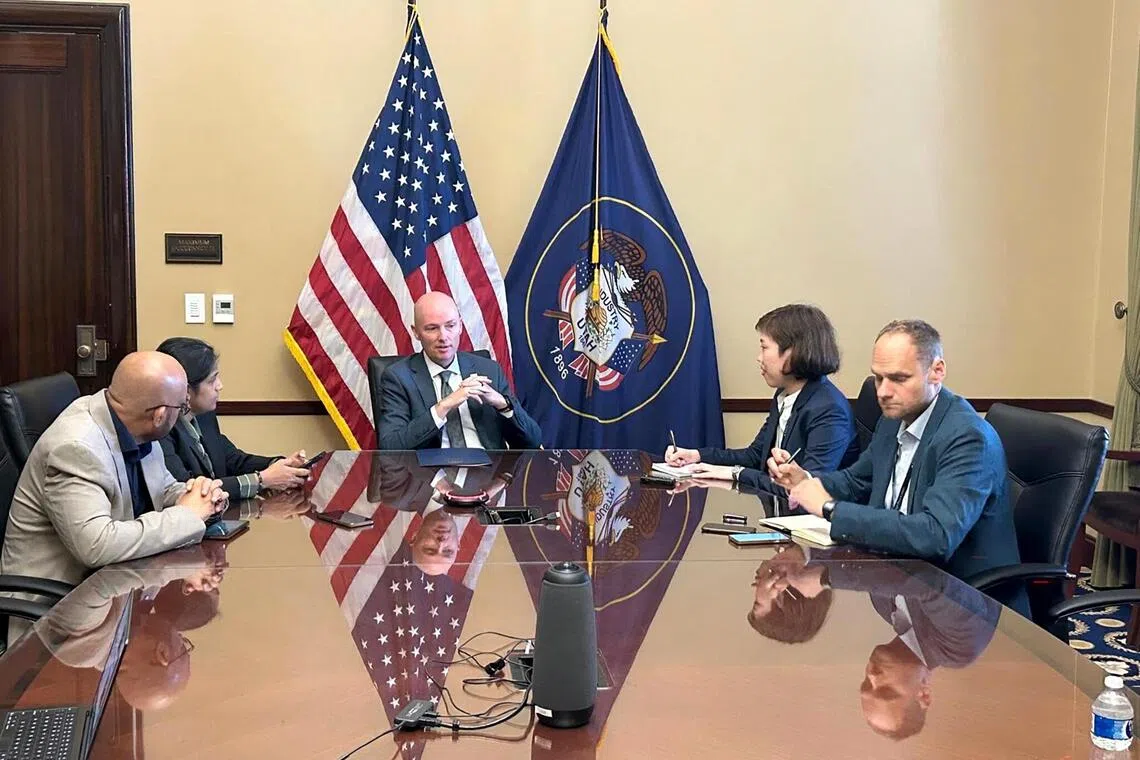
Utah Governor Spencer Cox (centre) said Singapore businesses will face low regulation offered by the US state, but get more attention from officials.
PHOTO: US DEPARTMENT OF STATE
The state offers businesses incentives such as tax credits for firms that perform and create high-paying jobs.
Close to 60 Singapore companies currently operate in Texas. They are among over 250 Singapore firms present across 45 states in the US, in sectors including logistics, real estate and professional services.
Enterprise Singapore (EnterpriseSG), which helps businesses expand overseas, opened a US office in Texas earlier in 2026 to work alongside its offices in New York, Los Angeles and San Francisco.
Its director for the Americas Lim Seow Hui told ST that it continues to see “steady interest from Singapore companies looking to establish and deepen their in-market presence in the US”.
She added: “Opportunities are increasingly emerging beyond traditional gateways such as New York and San Francisco.”
Foreign investment push
Foreign direct investment (FDI) in the US has grown by more than a trillion US dollars since 2020 to US$5.86 trillion (S$7.5 trillion) in 2025, according to the US Bureau of Economic Analysis.
The manufacturing industry saw the largest increase in FDI, led by companies producing electrical equipment and components.
Jonathan Samford, president of Global Business Alliance, which supports foreign investors, said US President Donald Trump has been clear about wanting more investment on US soil.
“The welcome extends well beyond Washington. In our latest national survey, 75 per cent of American voters viewed international companies favourably, up from 62 per cent two years ago, and that support runs across both parties,” he said.
A recent report by fDi Intelligence, a subsidiary of the Financial Times, found that Texas, New York and California secured more FDI projects than other US states did, based on deal announcements made from 2020 to 2025.
Utah drew US$4.9 billion in FDI and was placed 32nd in terms of FDI capital expenditure over the period. It recorded US$40.3 billion in investments from other parts of the US.
Still, the report noted: “The state attracted its second-highest capital expenditure pledges in 2025 since records began.
“Japanese investors have been the most active, thanks to Sekisui House’s multiple residential projects. This reflects strong inward migration of new residents from other parts of the US since the Covid-19 pandemic.”
The other top foreign investors in Utah were the United Kingdom, France, Canada and Australia.
There was no indication of the investment that can be attributed to Singapore, although industry sources said the Asian region accounts for a minority of investors in Utah.
Growing critical industries
Rio Tinto, one of the largest foreign companies operating in Utah, produces the critical minerals of copper and tellurium at its massive Kennecott mine near the capital.
Copper is essential for building data centres, power grid infrastructure and electric vehicles, while tellurium, recovered as a by-product of copper refining, is critical in the production of advanced thin-film solar panels.
A spokesperson for the British-Australian firm said the open-pit mine is “strategically important not only for Rio Tinto, but (also) for the United States’ broader efforts to build secure domestic supply chains”.
“Kennecott hosts a world-class copper orebody, a skilled local workforce, strong industrial infrastructure, and a community that understands the importance of responsible mining,” the spokesperson added.
The firm is exploring an expansion of its mine, which will produce some 1.5 million additional tonnes of copper.
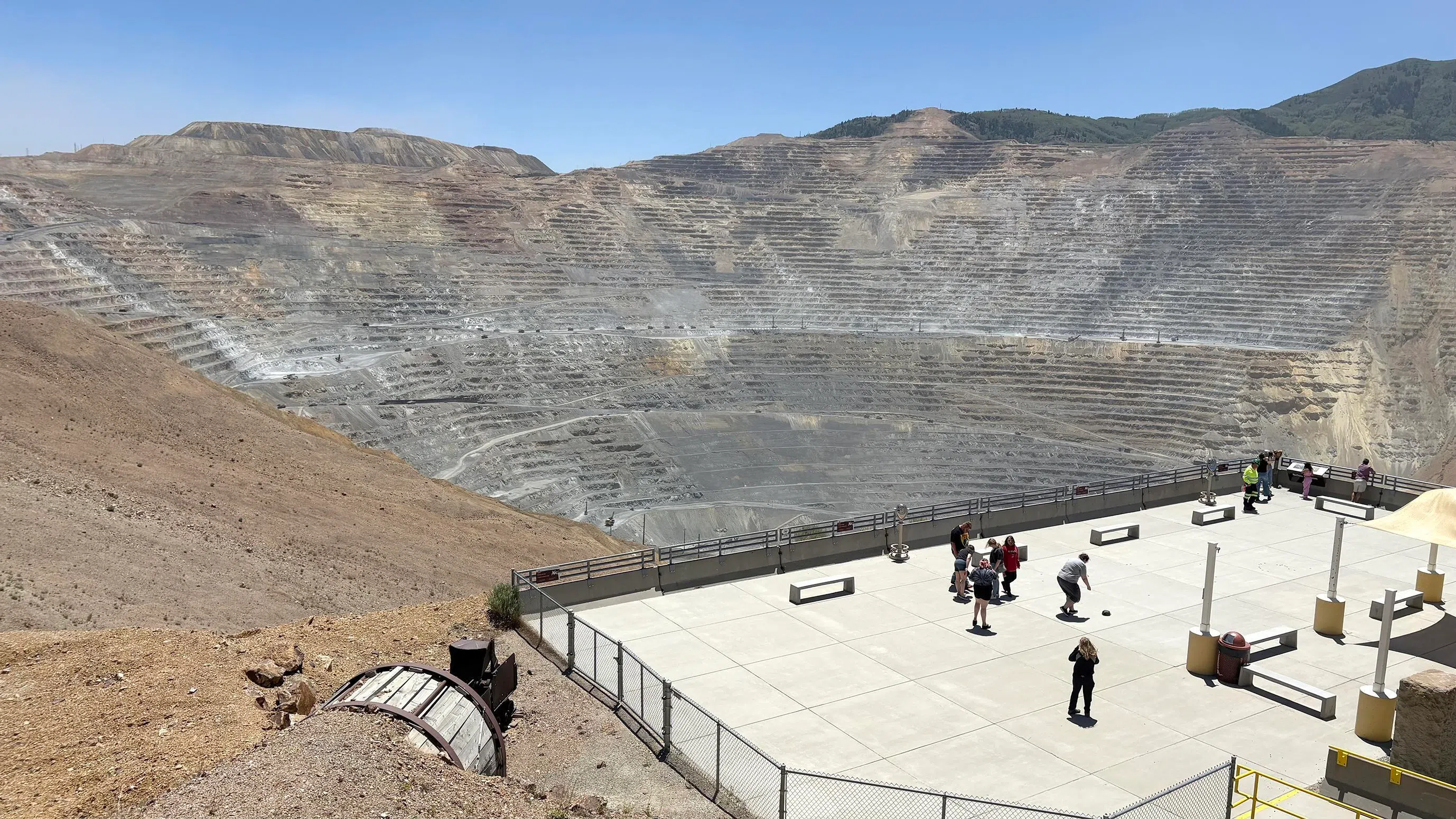
Rio Tinto is considering an expansion of its Kennecott mine located just outside Salt Lake City in Utah.
ST PHOTO: ANNABELLE LIANG
Brian Somers, president of the Utah Mining Association, said it is working with existing mining facilities, including Kennecott, to step up critical mineral production, instead of spending years developing new operations in the state.
“We can’t do things the way we’ve done in the past. Unfortunately, China really does have us over a barrel with a lot of these mineral supply chains, so we’ve got to accelerate the time to market,” he said.
Austrian manufacturer Doppelmayr is set to nearly double the size of its Utah production facility in September as part of a US$60 million expansion in the state.
The company builds ropeway systems deployed around the world, including the Singapore Cable Car’s Sentosa line.
Doppelmayr USA chief executive Keith Johns said the firm benefited from more people venturing outdoors in the US and around the world after the pandemic.
Even so, demand for the firm’s products has been affected by tariffs imposed by the Trump administration. It sources components such as haul ropes – steel cables used to move chair lifts and cabins up and down mountains – from outside the US as it cannot find local manufacturers.
Johns said: “Tariffs that are imposed on those. Someone has got to pay them.
“Some of our customers have delayed investments and some have said, we are going forward with it, but tariffs have definitely had an impact.”
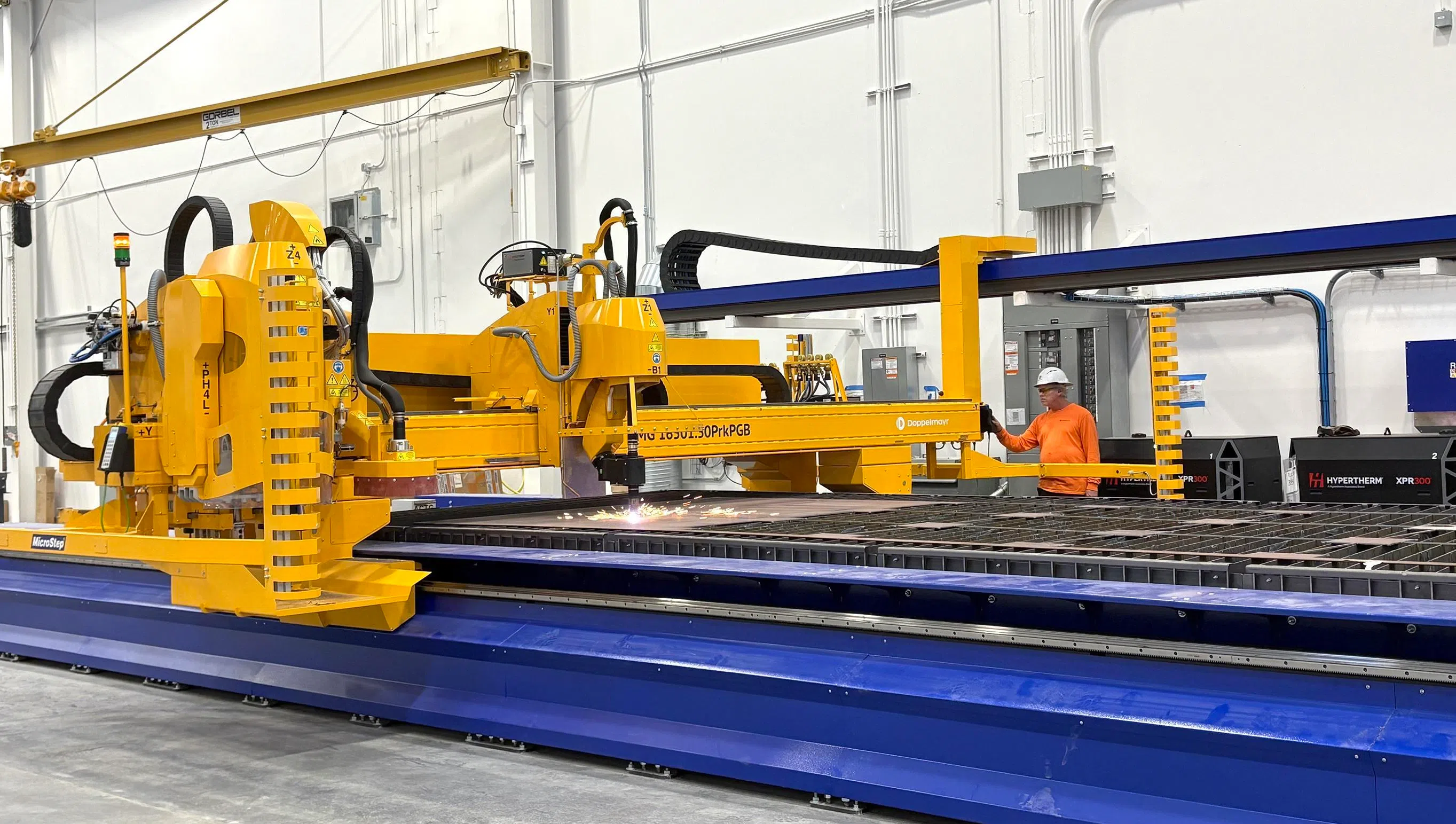
Doppelmayr’s new manufacturing facility in Utah, which is nearly double the size of its current facility, will be operational in September.
ST PHOTO: ANNABELLE LIANG
What lies ahead
There are hopes that investment in Utah could grow.
Washington-based BGR Analytics in a 2024 index ranked Utah as the top state for Asian investment, considering metrics including economic profile, business climate and strength of workforce.
The state of 3.5 million people is also seeing the fastest growth in its working-age population among US states, which can help to drive economic growth, recent data released by the US Census Bureau showed. The number of 25- to 64-year-olds in Utah jumped by 10.8 per cent between April 1, 2020 and July 1, 2025.
Over the years, officials have also made progress in shedding Utah’s reputation as a “flyover state”, a term often used to describe territories passed over by travellers.
Its ski resorts, drawing swathes of visitors during winter, transform into popular mountain biking trails and concert venues in the summer months.
Cox’s administration in May also launched a “Utah Elevated” plan to drive economic development through 2035, which includes targeting foreign and domestic investments. Among other priorities, it will tap Utah’s position as host of the 2034 Winter Olympics to drive infrastructure investments.
David Carlebach, chief operating officer and managing director for World Trade Center Utah, which works with the state to attract investment, said: “The biggest challenge in my role is simply getting the word out internationally about what was once the best kept secret in America.
“We have been a small- and now medium-sized state in the interior of America, and not enough people abroad have heard the ‘why Utah’ story.”
Cox hinted at more official engagements with Singapore in the months ahead.
“We would encourage our friends in Singapore to come and visit us, and we need to go visit our friends in Singapore, so that they know that there are other options out there,” he said.

