


SINGAPORE – Desmond Pang learnt one of his earliest lessons about money while helping out at his father’s coffee shop as a child.
“I remember vividly that a cup of kopi cost 60 cents back then. And at the end of the day, the money drawer would be filled with piles of coins,” he said.
“From that experience, I realised that money, no matter how small the amount, can turn into something significant through consistent accumulation.”
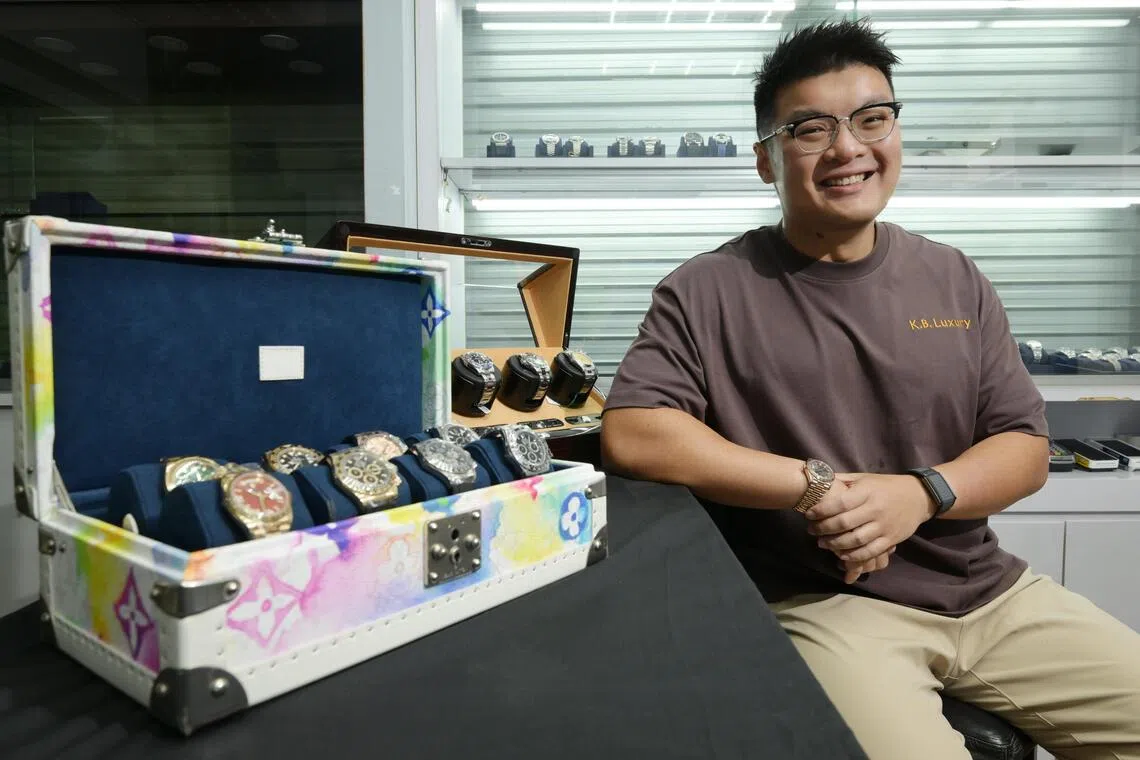
Pang, 33, is the owner of K.B. Luxury Watch and Jewellery in Jurong, which specialises in pre-owned luxury watches.
His father had bought over the watch business in 2014, and Pang soon joined the shop while studying banking and finance at the Singapore Institute of Management. Two years later, he left school to focus on the business full-time.
Starting with more affordable Rolex models, which were easier to buy and sell, Pang gradually expanded into higher-end brands such as Audemars Piguet, Patek Philippe and Richard Mille.
Over the past 12 years, he has grown the business’ inventory value from about $400,000 to around $2.5 million.
Even after closing six-figure deals, the lesson from a 60-cent cup of kopi still guides him, Pang said.
“I don’t believe in overnight success; it comes from consistent growth and building over time…
“The nature of my business means I am rarely in a comfortable position during deals – sellers always want the highest price when I buy, and buyers always want the lowest price when I sell,” he said.
“Even when a deal is not at my ideal price, I try to make the most of the opportunity rather than let it slip away, because consistent accumulation will always pay off.”
Pang has two children, including a newborn. His 35-year-old wife is an engineer at ST Engineering.
Do you invest in anything? If yes, what do you invest in and why?
When I was younger, I dabbled in stocks, forex trading and even cryptocurrency. But I realised that the time and effort required to research and analyse the markets far outweighed the returns I was getting.
Now, I entrust a portion of my cash to fund managers. It gives me peace of mind, and the returns have actually been better.
As a business owner, though, most of my earnings are reinvested into the business, as the watch industry is heavily dependent on capital and inventory.
What’s your biggest or most valuable asset right now?
My watch inventory is my most valuable asset right now, worth over $2.5 million.
What’s your approach when it comes to growing your money?
Be patient. Life is full of shortcuts that sound too good to be true. If the amount of effort or capital required seems disproportionately small to the returns being promised, I walk away.
A few years ago, there was a scheme in Singapore offering watches at a 20 per cent discount through pre-orders. Initially, people were sceptical.
But after the first few buyers received their watches and flipped them for a profit, many rushed to place bulk pre-orders.
Soon after, the organisers disappeared and the scheme collapsed. Many people I know personally never got their money back.
Do you invest in any tangible assets such as art, crystals or Pokemon cards?
Not really in those categories, but luxury watches are tangible assets too, and this is where my focus and capital remain.
What was your first exposure to investing and what was your first investment?
My first investment was in forex, and it did not go well. I quickly realised I did not understand the underlying mechanics and was simply trading based on gut feeling. It taught me a hard lesson: Never jump the gun, and make only informed financial decisions.
What has been your biggest financial mistake?
Trading forex. Looking back, it felt more like gambling than investing.
What has been your best financial decision?
Reinvesting my earnings into my business instead of spending them on a lavish lifestyle. Everyone has an area of expertise, and this is mine. Reinvesting allows me to deploy my capital where I understand the risks best and continue growing the business.
What was your childhood dream?
I wanted to be a firefighter, but as I grew older, my interests changed, and I decided to enter my current line of work instead.
What was your first job?
My first job was selling headphones at tech gadget store Treoo after completing my A levels. It taught me how to deal with customers and pitch products.
I even had the opportunity to pitch to major retailers such as EpiCentre, which gave me an early understanding of how businesses operate and how to communicate professionally.
As a child, what did you save up for? Have your saving habits changed as an adult?
As a child, I was very interested in technology and always wanted the latest mobile phones. However, I learnt from a young age to spend within my means. Because of that, I never saved for one big splurge. Instead, I focused on saving consistently over time.
That habit has stayed with me into adulthood. I always make sure I live within my means so my financial decisions never compromise my family’s quality of life.
What was your most memorable encounter with money? When did you first realise money is important?
I was in primary school when I accompanied my older cousin to buy a second-hand motorbike.
He had spent a long time saving for it, and the deal was done entirely in cash. It was the first time I had seen that much money in one place. Soon after buying it, the bike broke down. Having spent all his savings on the purchase, he had no money left for repairs. My uncle refused to bail him out, and my cousin eventually had to sell the bike at a loss.
That experience taught me that buying something is only part of the cost. You also have to plan for the maintenance and unexpected expenses that come with owning it. Without that foresight, a dream purchase can quickly become a financial burden.
What would you tell your younger self?
I would tell my younger self that there are more important things in life than chasing the next dollar.
When I started the business, I sacrificed my health. I slept irregularly, binge ate and neglected my well-being. At my heaviest, I weighed 135kg and developed serious health complications.
Everything changed when my wife and I were expecting our first child. I realised I needed to be healthy and present for my family, so I made my health a priority.
Looking back, I wish I had found a better work-life balance earlier. Health and family are the ultimate forms of wealth.
Business success means very little if you are not healthy enough to enjoy it with the people you love.
Where’s home for you?
I live in a four-room Build-To-Order flat in the Kallang area. I was fortunate to get it on my first try, and I am very happy with the location because it is convenient for my regular running routine.
What do you drive?
A Volkswagen Golf GTI Mk7.5.
What does work-life balance mean to you?
Being able to take care of myself and my family, and being home when my children go to sleep at night, while still running the business.
How have your spending habits changed since you first started working?
I stopped spending on depreciating assets such as cars and instead focused on things that directly improve my life and my family’s well-being.
This includes investing in fitness equipment, personal coaching and regular health check-ups so we can stay healthy together.
What would your perfect day look like?
I’d wake up at 6am feeling refreshed, go for a run and a gym session, then take my son to school before heading to work. My ideal workday would involve closing several purchase and sales deals before leaving the shop at 8pm.
I’d be home by 8.30pm to spend time with my children, unwind and end the day with my family.
What would you do if you suddenly had a windfall of millions?
The first thing I would do is buy more expensive watches for the business. Then I would renovate the shop. If there was still money left, I might buy a bigger house.
If you suddenly had only $100 to your name, what would you do?
Have a nice meal, take a shower and start over.

