


SINGAPORE – Rising business costs have become a bigger concern for companies in Singapore amid global uncertainty caused by the conflict in the Middle East.
But the Government is moving to ease regulatory burdens for small and medium-sized enterprises (SMEs), as more firms expect lower profits in 2026.
A Singapore Chinese Chamber of Commerce and Industry (SCCCI) survey of 540 local businesses found that 80 per cent of respondents were concerned about rising business costs, up from 65 per cent a year earlier.
Market uncertainty, weaker demand and supply chain disruptions were also among the top challenges cited, amid global uncertainty stemming from the Iran war.
Businesses were also concerned about the availability of suitable manpower, as well as the need to transform and pivot towards new growth areas.
Against that backdrop, 78 per cent of respondents expect to remain profitable in 2026, although 56 per cent expect lower profits than in 2025.
To cope with the challenging environment, businesses said they were absorbing higher costs to maintain customer relationships, passing on some cost increases to customers and cutting costs, as well as diversifying into new markets.
The poll, which was conducted from May to July, also found that businesses are taking tentative steps towards adopting artificial intelligence.
Some 45 per cent of respondents said they were experimenting with off-the-shelf AI tools as a first step towards broader integration. The biggest hurdles were uncertainty over how to adopt AI comprehensively rather than in a piecemeal way, a lack of in-house expertise and the cost of implementation.
On internationalisation, Malaysia was the top overseas market of interest, followed by Indonesia, China, Vietnam and Thailand.
Businesses also said they were looking to South-east Asia to tap the region’s growth potential, strengthen sourcing and procurement of goods and materials, and expand their manufacturing and production capabilities.
At the annual Small and Medium Enterprises and Infocomm Commerce Conference on Aug 5, SCCCI president Kho Choon Keng announced the formation of an international advisory panel.
“Through the (panel), SCCCI seeks to provide our members and Singapore businesses with strategic guidance and distinctive insights on geopolitical, economic and market developments, while fostering new partnerships and cross-border collaboration involving businesses in Singapore, South-east Asia, China and beyond,” Kho said.
Speaking at the event held at Suntec Singapore Convention and Exhibition Centre, Minister for National Development Chee Hong Tat said the Government would improve regulatory efficiency and reduce compliance burdens, particularly for SMEs.
Chee announced two upcoming measures to streamline approvals for businesses, as part of the work of the Inter-Ministerial Committee on Pro-Enterprise Rules Review, which was launched in 2024 and is chaired by Deputy Prime Minister Gan Kim Yong.
Medical clinic operators in commercial buildings currently need approval from both the Ministry of Health (MOH) and the Urban Redevelopment Authority (URA), unless the building’s total clinic space does not exceed 1,000 sq m.
Chee said that these operators will not need to submit a change-of-use application to URA if they have obtained MOH’s prior approval and the building’s total clinic space does not exceed 3,000 sq m or 20 per cent of its total commercial gross floor area, whichever is lower.
Meanwhile, businesses within the Changi Airport development will not need to seek separate approval from URA when switching between commercial uses, such as converting a shop into a restaurant.
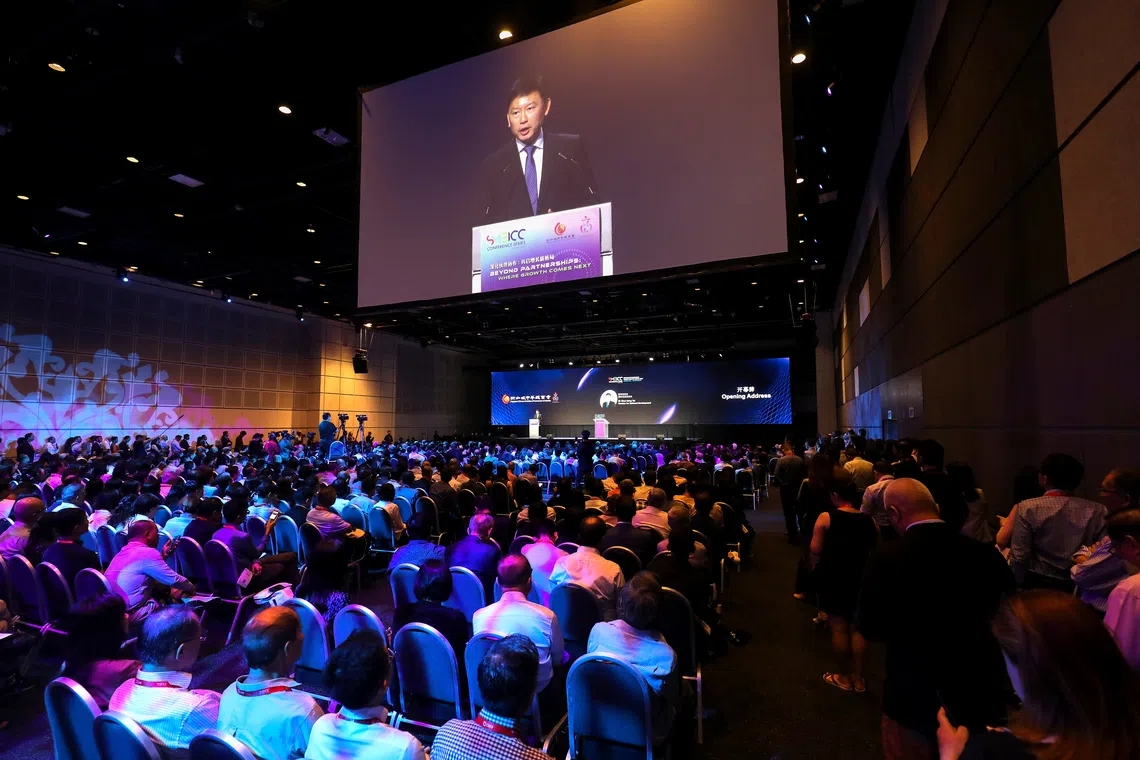
Minister for National Development Chee Hong Tat also said the Government wants to encourage “a pro-business approach” across agencies by streamlining administrative processes to save time, money and manpower.
PHOTO: LIANHE ZAOBAO
URA will instead authorise such uses upfront within approved commercial units, as well as childcare centres and community building uses, subject to conditions including prior approval from the Civil Aviation Authority of Singapore.
URA will provide more details later in 2026 when it implements both changes.
Chee said: “This means that an applicant in either situation can save $500 and two weeks of waiting time for each application.
“Both these measures will reduce the double handling… It’s a lose-lose situation if we have too many of these unnecessary red tape in the system.”
Beyond these specific measures, Chee said the Government wants to encourage “a pro-business approach” across agencies by streamlining administrative processes to save time, money and manpower.
He added that the Government would continue working with businesses to tackle challenges posed by AI, climate change and technological change.
For example, government agencies will continue to work with labour unions and government partners – including trade associations like the SCCCI – to businesses in Singapore to help them build digital capabilities, access AI tools and upskill their workforce.
Businesses also need to carefully assess their vulnerability to climate risks and consider measures to ensure business continuity under more extreme climate conditions.
Chee said: “As more investors use climate-related disclosures to understand companies’ environmental strategies and to inform their investment decisions, businesses also have to build their capabilities in areas such as sustainability solutions and reporting.
“We welcome more businesses to tap the Sustainability Reporting Grant by Enterprise Singapore and the Economic Devlopment Board to strengthen your sustainability capabilities and to better position your company for a low-carbon economy.”
He also encouraged SMEs to tap SME Centres, which provide a wide range of support, including business advisory, to facilitate the adoption and implementation of AI solutions.
“At a time when the global environment is increasingly uncertain and challenging, businesses, including our SME community, need to look beyond established playbooks to plan their strategies,” he said.
“Companies need to consider how they can operate more efficiently, collaborate more effectively and adapt more quickly to a constantly shifting landscape, to continue to achieve sustained growth.”

