


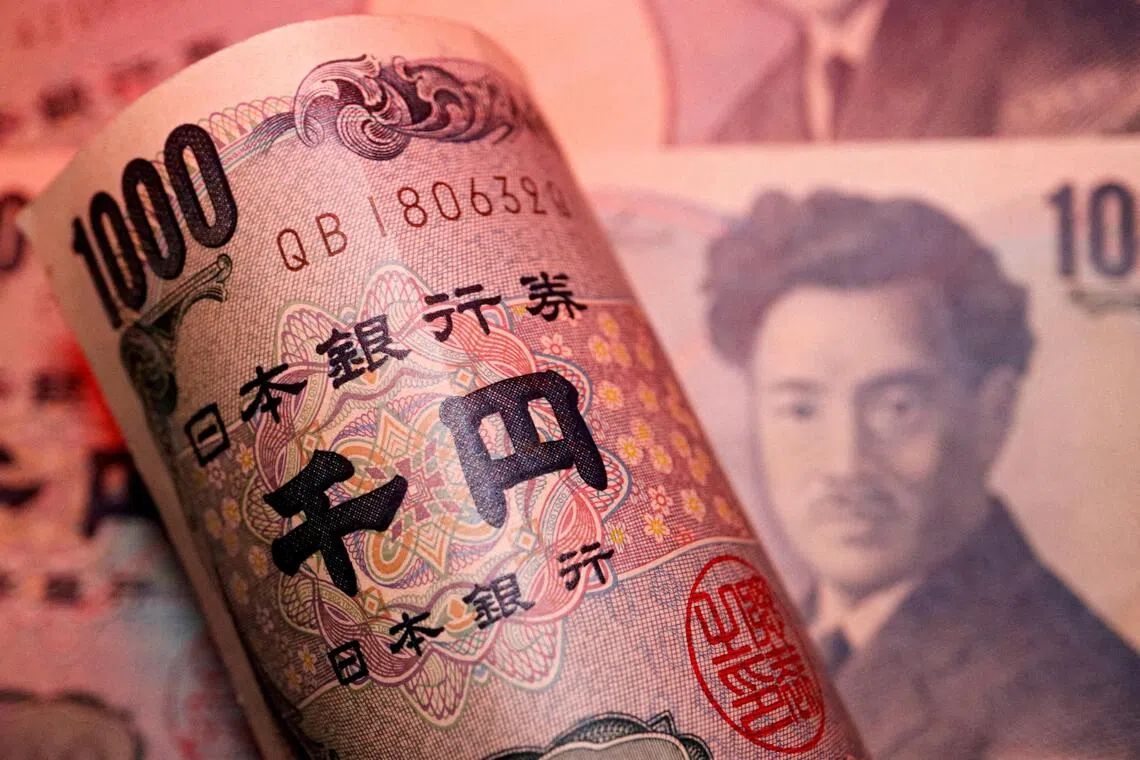
TOKYO – The yen’s weakness has become a growing issue for Japan’s policymakers, given its role in driving up import prices and household living costs. It’s also become a worry for the US.
Japanese authorities spent almost US$74 billion (S$94.9 billion) in late April to support the currency following two months of steep declines. The resulting rebound was short-lived, however, and by July 23 the yen had slid further to its weakest against the dollar since 1986.
This prompted one of the most dramatic interventions in global currency markets in decades – a joint Japan-US effort to bolster the yen, accompanied by a joint warning that the two nations wouldn’t hesitate to move again to defend its value if required.
Why is the yen weak?
Several factors are weighing on the yen. Chief among them is the gap between Japan’s ultra-low interest rates and those in the US and other major economies, which has encouraged investors to borrow cheaply in yen and invest in higher-yielding assets overseas. The resulting capital outflows have put persistent pressure on the Japanese currency. While the BOJ raised its benchmark interest rate in June to the highest in 31 years, the rate remains low by international standards.
Adding to the headwinds are investor concerns about Japan’s fiscal outlook. The country’s heavy debt burden – which exceeds 200 per cent of gross domestic product, the highest among major economies – and persistent budget deficits have raised concerns that Japan’s government is spending beyond its means. That can erode confidence in Japanese assets and the yen.
The US-Israel war with Iran has also added pressure on the yen. Japan imports almost all of its energy, with the majority of its oil imports coming from the Middle East, making it highly exposed to disruptions in the region. Higher oil prices mean Japan must pay more for energy imports – in US dollars – boosting demand for foreign currency at the expense of the yen.
Mounting global inflation stemming from the Middle East conflict has also shifted expectations around the trajectory of US interest rates, from cuts to hikes, making US dollar-denominated assets even more attractive, further undermining the local currency.
So what if the yen falls?
The yen’s slide over the past decade or so has helped to transform Japan into an affordable travel destination for millions of foreign tourists while boosting the profits of the nation’s biggest exporters.
But in an economy heavily dependent on imported energy and raw materials, the feeble yen has also driven up costs, fueling inflation for households and squeezing the profitability of domestically focused businesses. The resulting cost-of-living crunch contributed to the downfall of two prime ministers before current leader Sanae Takaichi took office.
There is growing concern that domestic inflation is becoming more entrenched. Japanese officials see mounting evidence that companies are passing higher costs on to customers more quickly than in the past.
Why is yen weakness a problem for the US too?
US President Donald Trump has repeatedly criticized Japan’s weak currency, arguing that it gives Japanese manufacturers an unfair trade advantage. This issue has featured in trade negotiations between the two nations. In March 2025, he took a more confrontational stance, suggesting tariffs on Japanese goods as a response.
The US move to help support the yen in late July signalled a shift in tone from Washington, with Trump saying the currency-market intervention was a sign of friendship with Tokyo.
For the US, a weak yen isn’t just a negative in terms of trade. Japan is also the largest foreign holder of US Treasuries, that is, government bonds. Japanese selling of Treasuries to generate funds to bolster the beleaguered yen risks pushing down US bond prices and increasing borrowing costs that are already under pressure due to a burst of inflation linked to the Iran war.
What has Japan’s government done to prop up the yen?
Japan has used a handful of options to slow the yen’s decline, with direct intervention being the most immediate tool deployed. This is when authorities buy or sell the currency in the foreign exchange market to influence its value. Such operations signal that officials will not tolerate excessive currency moves and can deter speculators from pushing a currency into free fall or triggering a rapid surge.
Japan has intervened heavily in currency markets over the years to influence the yen. Historically, authorities have typically sought to weaken the yen, but more recent efforts have been aimed at strengthening it. Before this year’s successive interventions, the last such operations came in 2024, when the government spent almost US$100 billion buying yen to prop up the currency. All four interventions that year occurred when the exchange rate was around 160 yen per US dollar, cementing that level as an informal line in the sand for when policymakers will intervene.
Authorities don’t always need to actually buy or sell yen to influence trading. Sometimes before – or instead of – direct intervention, senior officials resort to verbal intervention, warning speculators that excessive trading will not be tolerated. Comments by the finance minister or the ministry’s top currency official can quickly move markets. Officials typically use a carefully calibrated set of expressions to ratchet up their warnings and show how close they are to intervening. References to “taking bold action” suggest intervention is close.
How does Japan intervene in its currency?
Japan is party to international pacts that stipulate that exchange rates should generally be determined by markets. At the same time, the Group of 20 members acknowledge that excessive or disorderly currency moves can threaten economic and financial stability, giving governments scope to intervene when volatility spikes.
In Japan, the Finance Ministry decides when to intervene and the BOJ carries out the operation through a small number of commercial banks. Those banks either buy yen and sell dollars to strengthen the local currency, or the reverse to weaken it. The scale of the transactions depends on how much impact the ministry seeks and how quickly the market reacts.
The dollars used to buy yen typically come from Japan’s foreign exchange reserves in the form of cash or US Treasury holdings. Japan appeared to sell some of its Treasuries when it intervened to prop up the yen in 2024, and there are indications authorities drew on their holdings of foreign securities, including US Treasuries, during their intervention in April this year.
To keep traders guessing, officials often decline to confirm intervention immediately. Instead, the Finance Ministry discloses the amount spent on intervention at the end of each month. Cultivating doubt and fear of losses in the market is part of the government’s strategy, making comments from officials especially powerful.
How effective is currency intervention?
When Japan intervenes in currency markets, the immediate impact is typically sharp. Past episodes show the yen strengthening by around 2 yen against the US dollar within seconds and by 4 to 5 yen within hours. However, the impact is often only temporary unless the economic fundamentals driving the trend are also addressed.
Foreign reserves are intended to protect the economy during major financial shocks or unexpected events, not to prop up the currency indefinitely. Although intervention can buy time until market dynamics change, unilateral intervention is unlikely to reverse a broader market trend.
The limits of intervention were on display when authorities intervened on April 30, and potentially in the days that followed. While the effect was immediate and pronounced – with the yen strengthening sharply against the dollar – the rally soon faded. On July 23, the yen hit a 40-year low of 163.99.
The currency’s rebound in late July came with help from the US, a potential game changer for dealing with yen bears. The joint intervention was likely larger than those undertaken in 1998 and 2011, when US contributions didn’t surpass the US$1 billion mark. Japan alone was estimated to have spent US$53 billion on July 30 – a likely single-day record – before spending an estimated US$34 billion the following day.
Can authorities keep intervening to prop up the yen?
The question is not whether the government can keep intervening but if and when it makes sense to do so. The finance ministry’s foreign reserves – at US$1.09 trillion as of the end of June – gives it ample financial firepower. Japanese Finance Minister Satsuki Katayama has flagged that Japan would also utilise a US Federal Reserve facility that provides central banks with dollars using Treasury holdings as collateral.
There are other considerations policymakers must also weigh up. Sharp moves caused by direct intervention can create headaches for businesses trying to price goods, make payments and hedge against exchange rate fluctuations. They can also inflict huge losses on traders betting that the currency will keep moving in the previous direction.
For the government, intervention also carries political and diplomatic risks. It can draw criticism over currency manipulation, although that tends to be more likely when intervention is aimed at weakening the yen, a direction that can help exporters with trade. That charge is harder to argue when the government acts to support the yen.
Can Japan boost the yen in other ways?
Beyond direct intervention, Japan could try to combat the weak yen by addressing broader monetary and economic fundamentals. In theory, tightening monetary policy should help by narrowing the interest-rate differential with the US, making yen-denominated assets more attractive.
In practice, however, the difference in policy rates between the two nations has already shrunk to less than half of what it was just before the BOJ ended its negative interest-rate regime in March 2024 – yet the yen has continued to retreat.
Other measures could involve encouraging companies to repatriate capital and invest more at home. Greater domestic investment could increase demand for yen-denominated assets, while stronger economic growth could make Japan more attractive to foreign investors over time. Takaichi released a strategy plan in June aimed at bolstering private-sector investment in key industries such as artificial intelligence, semiconductors, defense and shipbuilding as part of a broader effort to boost Japan’s growth rate.
Finance Minister Katayama recently urged Japan’s large pension funds, including the Government Pension Investment Fund, to increase investment in domestic assets and floated the idea of adding government bonds to a tax-free investment programme for individuals. Takaichi also flagged the importance of encouraging households and the GPIF to increase their investment in Japanese financial assets. The remarks briefly supported the yen, and some strategists say they suggest that Tokyo may be exploring new ways to influence the currency.
Fiscal reforms, such as curbing government spending and reducing the country’s massive national debt, could also support the yen over the longer term by increasing confidence in Japan’s public finances and improving the appeal of Japanese assets.
However, most of these measures would likely take time to bear fruit. BLOOMBERG

