


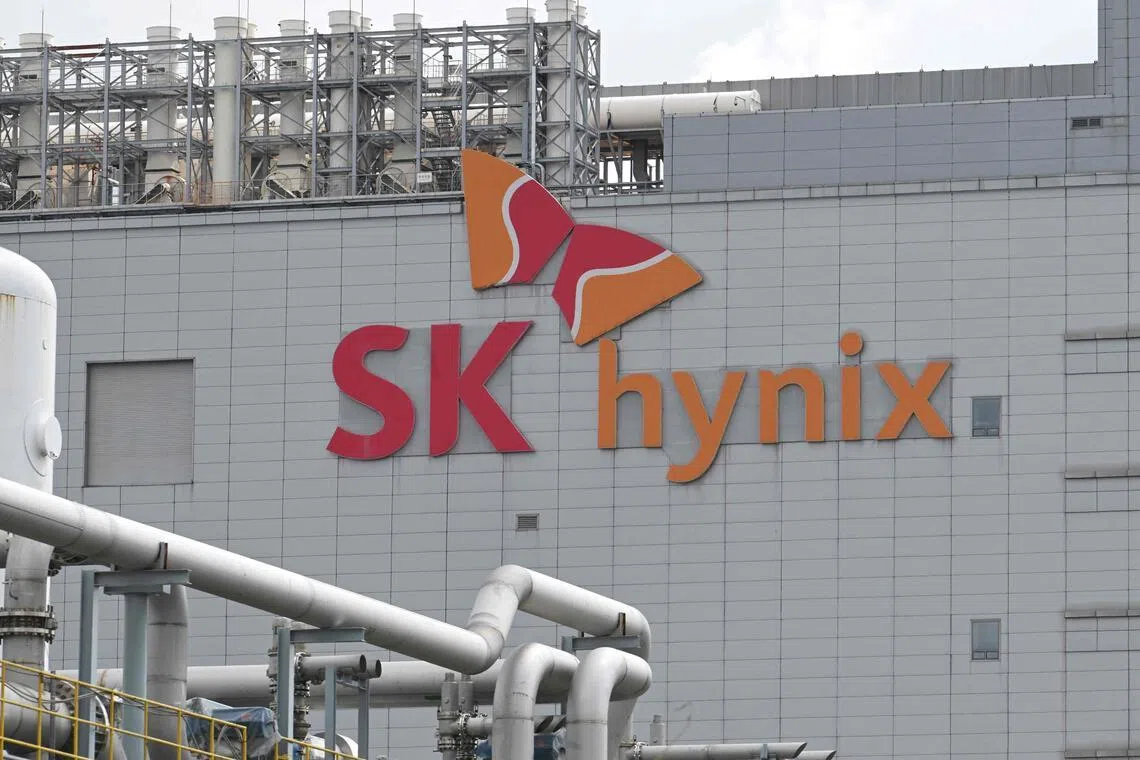
SK Hynix earmarked at least US$31 billion (S$40 billion) in capital spending in 2026 after reporting a six-fold surge in quarterly profit, a record amount of spending to safeguard its lead over Samsung Electronics and ride a multiyear boom in AI spending.
SK Hynix, which briefly became South Korea’s largest company in 2026 before shedding US$600 billion in just over a month, expects its capital investments to rise around 50 per cent to at least 45 trillion won (S$40 billion).
It posted margins of more than 80 per cent for the June quarter – a high watermark – because of the endemic memory shortages that have helped raise prices it charges customers like Apple and Nintendo.
Yet the South Korean company’s shares fell 10 per cent in Seoul on July 29, reflecting both the sky-high expectations that surround the AI industry’s linchpins – and growing concerns that big tech firms such as Meta Platforms are building more data centres that they will need.
SK Hynix executives brushed aside those fears on July 29, telling investors they are signing long-term contracts with no end in sight to explosive demand.
They echoed SK Group Chairman Chey Tae-won’s view that demand will fall short of supply till at least 2030. It is even now preparing to deliver the next-generation of high-bandwidth memory, known as HBM4E – in bulk to top customer Nvidia in 2027.
And bit growth, or unit shipments of memory capacity, should accelerate in the second half, executives said.
“Investor expectations might have gotten a bit excessive,” said Jason Lemire, chief investment officer at Bold Wealth Partners.
“The results need to be put into perspective, though. These are amazing numbers. The company is firing on all cylinders, and faces so much demand pressure that it decided to radically increase its capex numbers.”
Despite consistently strong numbers, SK Hynix’s shares have headed south since June after doubts grew about whether global AI spending will justify the chip sector’s lofty valuations.
Tech companies’ rising debt levels are also weighing on investors’ minds. The growing amounts of leverage tied to players like SK Hynix in particular has also turbo-charged volatility across South Korea’s bourse, wiping out roughly 45 per cent of the company’s value in about a month.
Investors worry that soaring chip costs may trigger a broader economic slowdown, pushing prices of electronics higher and spurring manufacturers to cut production of devices like PCs and smartphones.
Brokerages including Mirae Asset Securities have trimmed their second-quarter profit estimates for SK Hynix in recent weeks, citing moderated growth in average selling prices of chips.
Chipmakers have pushed back, saying that demand is expected to outstrip supply for the long term.
They point to customers such as cloud service providers ratcheting up orders for memory, lifting both volumes and margins.
SK Hynix Chief Executive Officer Kwak Noh-Jung told Bloomberg earlier in July that the severe memory chip shortages that are roiling the computer, car and device makers would likely persist beyond 2030.
SK Hynix’s net income surged a bigger-than-expected 1,242 per cent on one-time investment gains in the June quarter, shoring up the company’s financial strength. Operating profit rose 557 per cent, but still fell short of elevated projections. Revenue also came below the average analyst estimate.
“Demand is strong, and the AI memory story hasn’t broken, but expectations had simply moved ahead of what even another record quarter could deliver,” said Josh Gilbert, Etoro’s lead analyst for APAC and the Middle East. “Its second quarter is a lesson in just how high the bar now sits for anything tied to AI.”
SK Hynix, along with Samsung and Micron Technology, dominates global memory supply. The trio has increasingly shifted production in recent years toward high-bandwidth memory used in Nvidia’s AI accelerators, tightening supplies of conventional memory.
Attention now is on SK Hynix’s pricing ability.
SK Hynix won multiyear contracts with around 10 customers, it said. And last week, parent SK Group signed a pact with Nvidia on a partnership spanning deals worth more than US$500 billion.
The figure includes money that Nvidia will spend buying memory chips, as well as purchases of supercomputers, Nvidia CEO Jensen Huang told Bloomberg Television.
The less-than-expected operating profit was mainly because of somewhat weaker product mix, said Sanjeev Rana, head of research at CLSA Securities Korea.
“2027 is still going to be a year we will see memory supply being very tight. After such a big correction recently it’s a good buying opportunity.” BLOOMBERG
Source : https://www.straitstimes.com/business/sk-hynix-hikes-spending-to-40-billion-to-ride-ai-boom

