


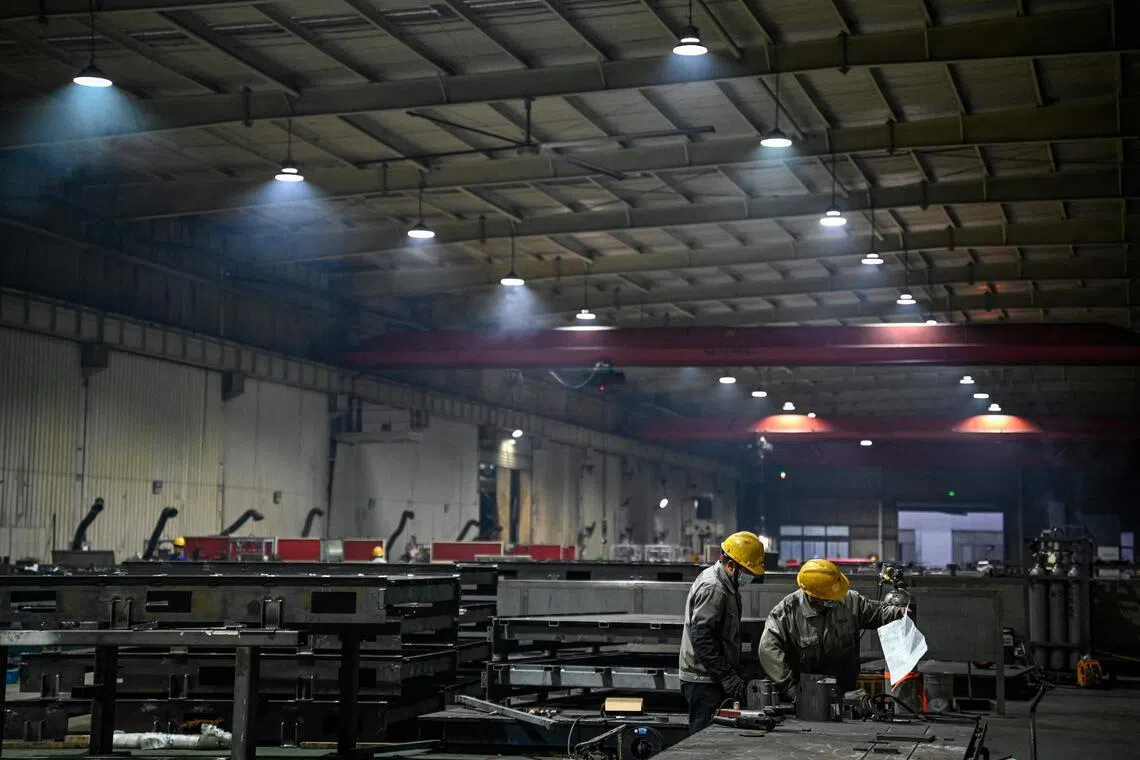
BEIJING – China’s regional growth data underscored the uneven nature of the country’s economic transition in the first half of 2026, as provinces at the forefront of Beijing’s push into high-tech sectors pulled ahead of those reliant on traditional industries.
The divergence reflects a broader shift towards a two-speed economy, with booming factories and exports supporting growth while weak housing and consumer spending continue to weigh on domestic demand, complicating policymakers’ efforts to tackle the economy’s “strong supply and weak demand” imbalance.
Among China’s major provincial-level economies, southern Guangdong, eastern Zhejiang, Shanghai, Anhui and Shandong were the notable exceptions to the nationwide slowdown, accelerating their growth rates even as gross domestic product growth eased to 4.7 per cent in the first half from 5 per cent in 2025.
All five are heavily exposed to advanced manufacturing, semiconductors, AI-related industries and high-value exports.
Fifteen of China’s 31 provincial-level economies outpaced the national growth rate of 4.7 per cent in the first half, while 16 lagged behind, data released by local statistics bureaus showed.
New economic drivers propel growth in Eastern provinces
Zhejiang, a manufacturing powerhouse, led growth with a 5.7 per cent expansion, followed by Shandong and Anhui provinces and the financial hub Shanghai at 5.6 per cent, supported by semiconductors, electric vehicles, robotics and artificial intelligence.
Provinces with greater exposure to property and traditional industries, including Hunan, Jilin, Shanxi and Liaoning, were among the weakest performers in the first half, underscoring the difficulties facing regions that have yet to develop strong high-tech manufacturing engines.
Growth in the first half slowed to 2.7 per cent in Hunan, 2.4 per cent in Jilin, 2.1 per cent in Shanxi and 2.5 per cent in Liaoning.
“The diverging growth rates reflect provinces’ differing reliance on old and new economic drivers, with regions more exposed to traditional sectors generally expanding more slowly than those with stronger new-economy industries,” said Zhaopeng Xing, ANZ’s senior China strategist.
Only six provinces accelerated from their 2025 growth pace, including Guangdong, Zhejiang, Shanghai and Anhui, highlighting the growing importance of high-tech manufacturing as a driver of regional growth.
Anhui overtook Hunan to rejoin China’s top 10 provincial economies, with first-half GDP rising to 2.74 trillion yuan (S$525.5 billion).
Its ascent has been powered by electric vehicles and electronics. Industrial output of high-tech manufacturing surged 44.6 per cent, while auto manufacturing rose 29 per cent. Output of new-energy vehicles and industrial robots rose 20.6 per cent and 16.2 per cent, respectively.
Anhui’s exports soared 37.6 per cent, with high-tech exports up 78.3 per cent and car exports more than doubling. Those gains helped offset a 33.7 per cent decline in property investment and weak consumer demand, with retail sales rising only 1.6 per cent.
Xi tells big provinces to lead tech push
In March, Chinese President Xi Jinping urged China’s major provinces to move beyond simply driving growth and take the lead in innovation, industrial upgrading and the development of “new productive forces”, calling them critical to maintaining national economic stability.
Shanghai’s resilience came from integrated circuits, AI and finance, while Beijing relied more heavily on services.
Consumption and investment remained weak across much of the country. Among the top 10 richest regions, only four saw goods retail sales growth exceed 2 per cent.
Shanghai’s retail sales rose just 0.7 per cent in the first six months, while Beijing’s fell 2.2 per cent.
Fixed-asset investment declined in at least 18 provincial economies in the first half. By contrast, Shanghai’s investment rose 6.8 per cent and Beijing’s 3 per cent.
Economists expect local governments to accelerate already-budgeted investment projects in the remainder of the year to hit a national economic growth target between 4.5 per cent and 5 per cent.
However, Xing of ANZ said GDP rankings alone no longer tell the full story, as local governments are increasingly assessed on debt resolution, social welfare and environmental goals.
“GDP is no longer the sole baton guiding local governments.” REUTERS

