


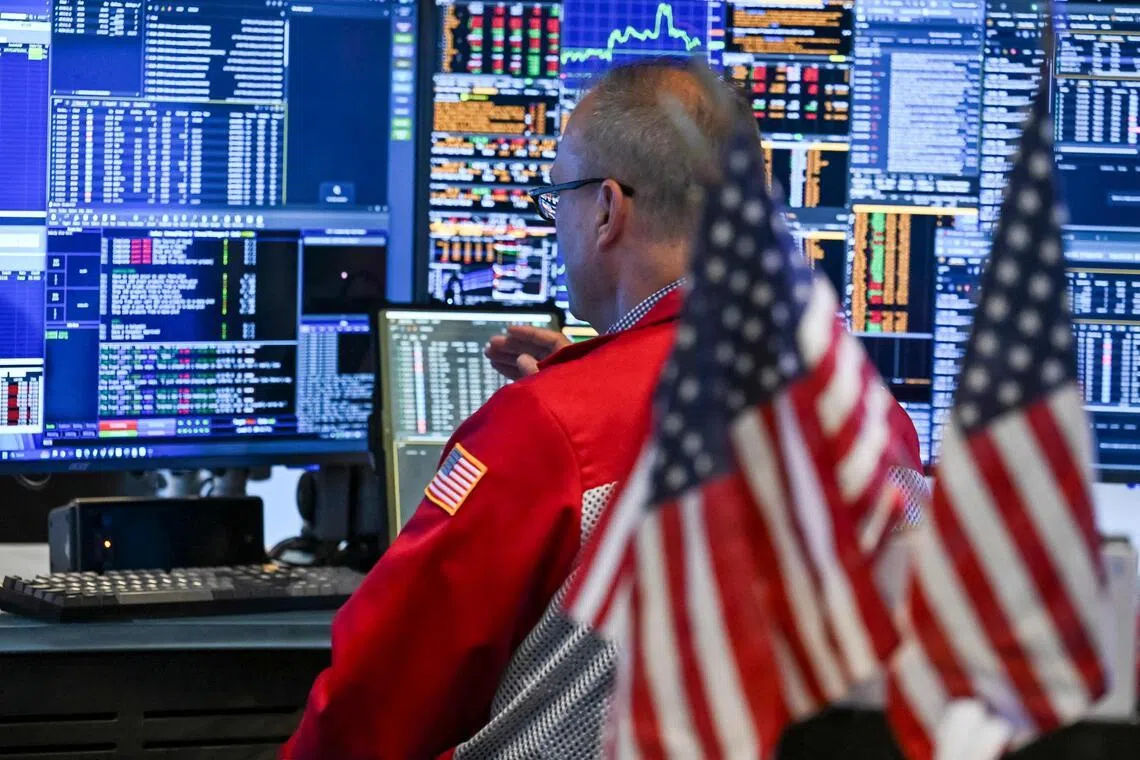
SINGAPORE – Global indexes fell on July 24 after technology giants like Alphabet and Tesla reported their earnings.
The S&P 500 fell 1.2 per cent, while the Nasdaq declined 2.2 per cent by that afternoon.
Dow Jones also fell by nearly 1 per cent.
Alphabet, the parent of Google, reported strong second-quarter earnings, with revenue up 24 per cent year on year.
Its shares sank 7 per cent despite its results on investor concerns over the company’s aggressive increase in its capital expenditure for artificial intelligence.
Meanwhile, Tesla’s adjusted earnings per share missed analyst estimates despite revenue jumping 26 per cent.
Its profit miss was also partially because of pricing discounts and heavy capital spending on artificial intelligence.
This miss caused its stock to fall as much as 14 per cent.
The Straits Times Index (STI) slipped during the day’s trading on July 24, but recovered to close at 5,588.34, up 0.12 per cent.
Market confidence has been shaken by the continued intensifying tensions in the Middle East, with Yemen’s Houthis attacking a Saudi tanker as the US launched more strikes against Iran.
Brent crude oil also started trading above US$100 a barrel, up 14 per cent over the week and crossing the US$100 mark for the first time since May.
Analysts also project that prices could surpass US$120 a barrel by the final quarter of 2026 if the maritime shipping corridors remain blocked.
The Strait of Hormuz, a vital global shipping channel for oil and gas, has been effectively blocked since the Iran-US conflict broke out in February.
Energy company to go public
Closer to home, EGP Energy Corporation, an electrical infrastructure solutions and services provider, announced its initial public offering (IPO) on July 21.
It seeks to raise about $30.6 million in gross proceeds ahead of its planned listing on the Singapore Exchange (SGX) mainboard.
The company follows other mainboard listings, such as private specialist healthcare group Foundation Healthcare, flexible workspace provider JustCo, and UI Boustead real estate investment trust (REIT).
EGP Energy’s IPO comprises 18.8 million offering shares priced at $0.51 each.
Of these, 17.8 million shares will be offered through an international placement to institutional and other investors in Singapore, as well as selected institutional and other investors outside the US.
The remaining 1 million shares will be offered to the public in Singapore.
The IPO will close at noon on July 27, with trading of EGP Energy’s shares on the SGX expected to start on July 29.
Shareholders grill Singapore Airlines
Singapore Airlines (SIA) executives faced a grilling from shareholders over its stake in Air India at its annual general meeting on July 24.
A shareholder asked about the Indian airline’s restructuring and whether there was a maximum risk limit SIA was willing to take.
SIA CEO Goh Choon Phong said progress has been made in the right direction and the issues Air India faces are external, such as the closed airspace over Pakistan.
Responding to whether SIA would invest more in Air India, Goh replied that “whatever investment we put in will have a robust business case associated with it, and it will be within our means”.
SIA chairman Peter Seah added that SIA’s investment in Air India, jointly made with Indian investor Tata Sons, gets “discussed in every board meeting”.
“I can assure you that this subject receives full attention from the whole board, so it’s not delegated to management,” he said.
Another shareholder said that India is building a high-speed rail network, which might take some of the airline’s business.
Goh said that around the world, countries that have high-speed rail also have domestic flight operations.
He added: “The potential is about connecting India to the rest of the world, for which I would say there is still a huge (shortfall) of capacity, so the opportunity is not merely domestic; it is also the international markets.”
A shareholder also asked if SIA plans to list on Nasdaq following the launch of the SGX Global Listing Board, a joint cross-border framework by Singapore Exchange and Nasdaq enabling streamlined dual listings.
Seah said “never say never” but that at the moment, SIA has no plans to do so.
Yeo Hiap Seng appoints a new CEO
Food and beverage company Yeo Hiap Seng, or Yeo’s, announced that its chief executive Ong Yuh Hwang is stepping down.
Ong will hand over the reins to Adrian Ho, who is Nestle’s vice-president and regional manager for Asia, Oceania and Africa. Ho will take over the position on Sept 1.
Ho, 54, has more than 30 years of experience in the fast-moving consumer goods industry and has held leadership roles across Europe and Asia.
Ong joined Yeo’s as chief operating officer in 2022. He was previously CEO of Suntory Garuda Beverage Indonesia for two years and has held positions in Procter & Gamble.
Yeo’s cut 9 per cent of its Singapore headcount in March after deciding to move its canning operations to Malaysia.
The company said centralising production at its facilities in Johor and Selangor would improve the overall manufacturing efficiency across its network.
The Senoko facility in Singapore will continue to serve as the group’s headquarters, cross-border logistics hub and a smaller-scale manufacturing centre, the company added.
Yeo’s closed flat at $0.58 on July 24.
Metro’s countdown begins
Metro announced that it will close its department stores at Paragon and Causeway Point when their leases expire, after a strategic review of the group’s retail business.
It also said it is evaluating a range of other retail formats, including smaller-format stores, multi-speciality concept stores, curated retail experiences and pop-up store initiatives.
The company said it is in discussions with its existing and other landlords to roll out the new concept stores.
It also intends to progressively transition from the current large-format department store model to a more flexible one, to cater to changing consumer preferences.
This follows the shuttering of other department stores, such as Isetan in Nex, which shut in April.
Mary Chia not out of the woods
Catalist-listed beauty group Mary Chia Holdings said it has paid over $300,000 owed to Fullink Capital.
However, the insolvency proceedings brought against the company by the lender remain ongoing. A dispute between the two companies arose after Fullink issued a statutory demand dated March 17 seeking over $900,000 from Mary Chia.
Mary Chia said that it will continue working with its legal advisers and take appropriate steps to protect the interests of the company and its stakeholders.
It has delayed its annual financial reporting and applied to the Accounting and Corporate Regulatory Authority for more time to hold its annual general meeting and file its annual returns for the financial year ended March 31.
Its shares closed flat at $0.02 on July 24.
Bright prospects for the construction sector
SGX said in a market update that construction was among Singapore’s best performing sectors in the first half of 2026.
The sector grew more than 11 per cent in the first quarter of the year, before growing a further 6 per cent in the advance second quarter estimates.
SGX said: “As Singapore continues to invest in transport infrastructure, healthcare facilities, housing, utilities and digital infrastructure, construction remains one of the clearest channels through which infrastructure investment translates into economic activity.”
It added that growth is supported by both public and private sector construction activity, including institutional, residential and industrial developments.
The largest capitalised Singapore-listed stocks that are on the construction value chain include BRC Asia, Pan-United, Boustead, Soilbuild Construction and OKP.
Koh Brothers Eco Engineering also proposed to transfer from the Catalist board to the SGX mainboard after it saw significant expansion.
What to look out for next week
The Monetary Authority of Singapore will release its scheduled policy review on July 27. Analysts expect Singapore to keep its monetary policy steady in the light of mild inflation risks so far, despite the continued tensions in the Middle East driving up oil prices.
Markets will also be watching for the effects of the new tariffs that the US imposed on Singapore and 59 other trading partners, which took effect on July 24.
The new and harsher tariffs come after the US Supreme Court struck down the legal basis for President Donald Trump’s signature reciprocal tariffs in February.
Energy strategists are also watching the conflict and the escalating oil prices.
The US Federal Reserve’s Federal Open Market Committee will also be convening for its policy meeting on July 28 and 29.
While the Fed is expected to leave interest rates unchanged for now, the growing Middle East tensions make this unpredictable, analysts said.

