


SINGAPORE – Sovereign wealth fund GIC has said it will continue searching for AI-linked investment opportunities – which have delivered returns for its portfolio – while keeping tabs on risks like disruption as the technology rapidly evolves.
GIC, one of three entities that contribute to Singapore’s reserves, has been investing in the technology industry for decades, which eventually supported flows into artificial intelligence.
Many of its earlier AI investments were made in “enablers” creating the foundational infrastructure for the technology, GIC group chief investment officer Bryan Yeo said during a July 23 briefing on its annual report.
GIC has since broadened its focus across the AI value chain by putting funds in “monetisers” building AI-powered products and platforms, as well as companies that have adopted AI to transform their operations and grow.
Yeo told the local media that he spots more opportunities among “adopters” in the years ahead, as large multinational corporations turn to AI solutions to boost their efficiency and productivity.
He noted that businesses were using AI to change some of their existing processes, manufacturing processes, and products and services that they provide.
“We think that will generate the next big leg-up in value creation. But the challenge again is trying to identify who these winners are in the adoption space,” he said.
Current AI investments
GIC’s portfolio includes Anthropic, a San Francisco-based start-up founded by former OpenAI executives.
GIC first backed the developer of the popular AI tool Claude during a US$13 billion (S$16.8 billion) funding round that was completed in September 2025. Earlier in 2026, it led a US$30 billion funding round and co-led a US$65 billion funding round for Anthropic.
Yeo said: “We see the company having a strong moat in terms of the quality of the model that it has built. We think there’s good-quality management in place to continue to drive and grow the business.
“Importantly, we are seeing good momentum as well. It is working very closely with global companies in order to help integrate the capabilities of its (AI) model into their respective businesses.”
Meanwhile, pharmaceutical giant Eli Lilly is among GIC’s investments in AI adopters.
GIC noted that the insulin and weight-loss drugmaker is the world’s largest pharmaceutical company by market value and the fastest-growing among its industry peers with a market capitalisation value of more than US$10 billion.
“Its AI investment is well ahead of peers – full-stack rather than tool by tool, with top-down sponsorship across the C-suite, its own Nvidia supercomputer and partnerships with AI natives,” GIC said.
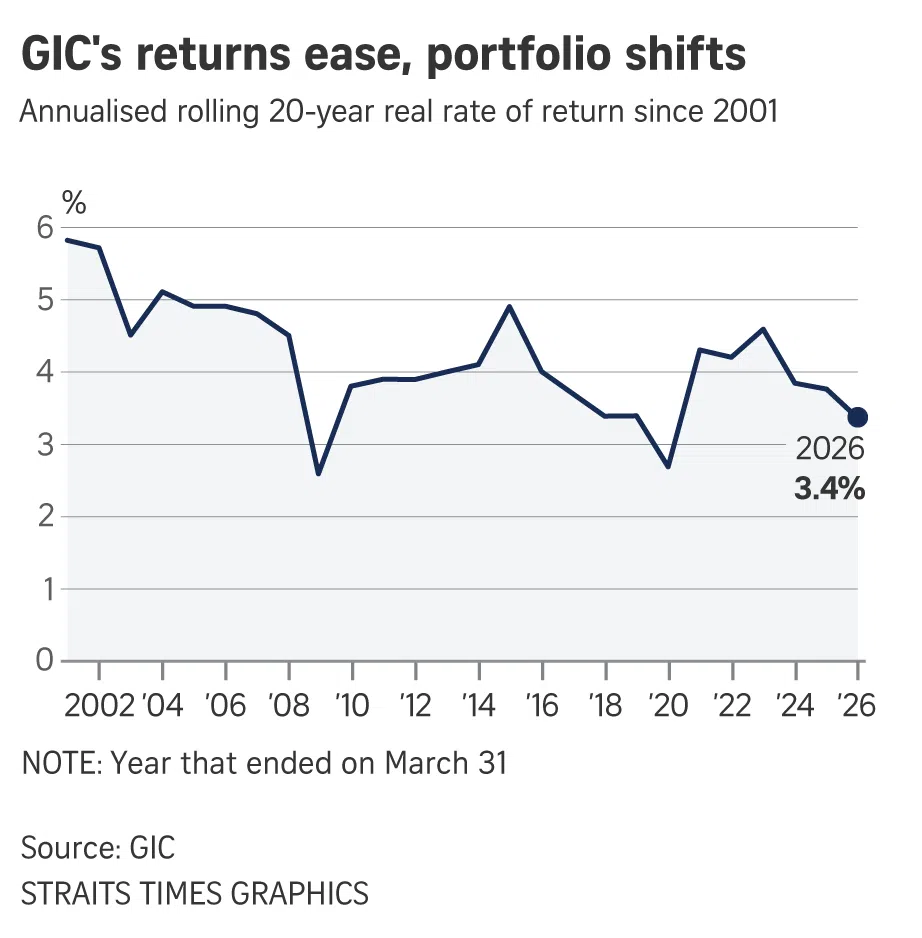
GIC did not provide a figure for its portfolio’s overall exposure to AI, as it reported a 3.4 per cent annualised real rate of return, after adjusting for global inflation, for the 20-year period that ended on March 31, 2026.
Investments in the Americas – at 53 per cent – accounted for the bulk of its portfolio. The Asia-Pacific region made up 22 per cent, while 19 per cent was attributed to Europe, the Middle East and Africa, and 6 per cent to the rest of the world.
Yeo said GIC’s AI exposure will likely be “significant” as it believes in diversifying its investments, which comes as a wider range of businesses adopt the technology.
GIC’s survey of nearly 200 North American enterprises, conducted in the first quarter of 2026, found that more than half of the respondents ranked AI within their top three priorities. It also found that enterprises were reaping cost savings, some to the tune of over 50 per cent, from AI adoption.
Even so, GIC is watching for near-term risks in the AI space, such as over-regulation, stretched valuations, and bottlenecks to growth and adoption.

Pharmaceutical giant Eli Lilly is among GIC’s investments in AI adopters.
PHOTO: REUTERS
Yeo said the “AI risk factor is the largest market risk factor out there, more so than any country or industry”.
He added that GIC is also focused on disruption risks as new capabilities emerge within the AI ecosystem.
“Valuations could erode and go down in that space as well, and that could be with some of the large incumbent companies,” he said.
Picking future winners
GIC said it will bring its expertise in investing in the technology industry, spanning more than four decades, to its AI approach.
It has around 70 investment professionals focusing on technology globally, across public and private markets, and dealing with early- and late-stage investments.
Its investment team looks for firms with structural advantages, such as proprietary data and strong governance around critical workflows.
It also prioritises firms that have management with a vision and the capability to execute, and evaluates whether they can build momentum around their offerings.
Yeo said: “The AI ecosystem continues to evolve, so we are never ever sure that the winner today will be the winner tomorrow, or in a few years down the road.
“So we focus on how the profit pools are shifting. We focus a lot on use cases. Where are actual use cases in AI being developed, how are companies utilising it, and what does it translate to in terms of profit pools across the entire value chain?”
For instance, GIC has invested in behind-the-meter solutions that provide power to energy-intensive data centres crucial to the adoption of AI.
“A lot of these behind-the-meter solutions are actually renewable energy solutions that we are investing in. That will supplement the energy demands drawn from the power grid,” Yeo said.
“Over the long term, we think that AI, renewable energy and sustainability are quite closely linked. It offers us that opportunity to look at sustainability-type solutions as the AI evolution continues,” he said.
Responding to a question on concerns that AI investments could be outpacing consumer demands and corporate profits, Yeo said GIC is also searching for non-AI opportunities, given it has an investment horizon of 20 years.
“As capital goes into the AI space, the non-AI space is getting neglected and valuations could be getting cheaper. For a long-term investor, if you look out 20 years, you don’t want everything in AI alone.”

