


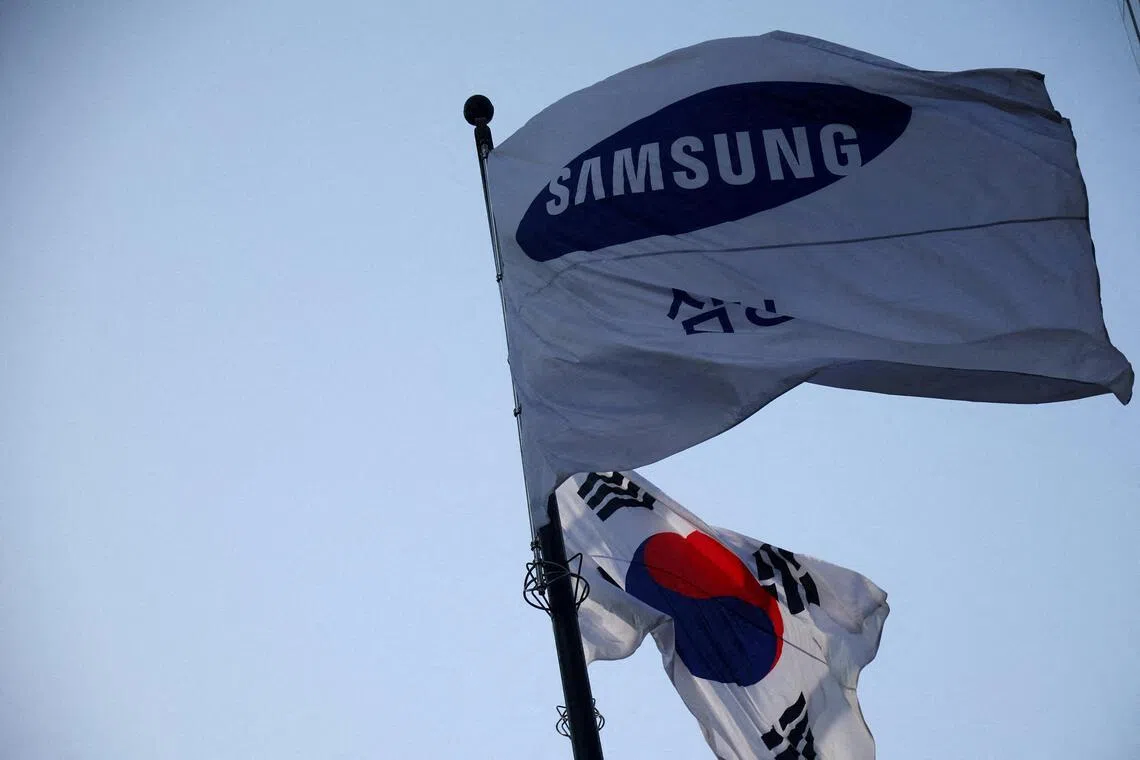
SEOUL – Labour unions are rallying across South Korea after Samsung Electronics caved in to protests and agreed to hand out bonuses of more than US$400,000 (S$516,400) to some of its employees.
On July 13, assembly-line workers at Hyundai Motor staged a three-day partial strike as they seek up to 30 per cent of consolidated profit to be set aside for bonuses. Meanwhile, unions at HD Hyundai Heavy Industries and telecom operator LG Uplus want payouts equivalent to at least 30 per cent of operating profit, while workers at Hanwha Aerospace and HD Hyundai Electric want to scrap bonus caps altogether.
In tech, thousands of employees at Kakao, which operates South Korea’s largest messaging service, went on strike for the first time in June, demanding that up to 15 per cent of operating profit be allocated for bonuses.
The union at Naver, the country’s top search engine provider, is forming a coalition with counterparts at multiple affiliates to strengthen their negotiating power.
What began with workers calling for Samsung and SK Hynix, the nation’s two biggest chipmakers, to share the banner profits they are reaping from the artificial intelligence boom is spilling over to industries that have little to do with AI. It is a reminder of the risks investors face in a country that is historically had one of the most militant labour union presences in the region.
Still, automation and AI are emerging as a key source of friction for some companies. Unions at Hyundai Motor and affiliate Kia are asking for job guarantees against the future deployment of the Atlas humanoid robot. The Hyundai union has said “not a single robot can enter the factory without agreement”, and demanded workers’ consent prior to investing in new technologies and cars.
That underscores the anxiety rippling across the globe in what Meta Platforms chief executive Mark Zuckerberg warned would be “the year that AI starts to dramatically change the way that we work”.
In Australia, some dock workers are demanding a shorter week for no loss of pay, arguing that they deserve to share the benefits of efficiency gains. Meanwhile, a key European union organisation is calling for legislation to regulate how AI is used and give workers a say in how the technology is implemented.
Back in South Korea, the national debate is focused on whether there should be a re-think over how corporate windfalls should be distributed. Workers and unions argue that bonuses typically reward senior managers and not employees facing the most uncertainty from AI disruptions and corporate restructuring.
“Due to the rigid labour market, labour protections make it difficult for the businesses to fire employees,” said Bumki Son, an economist at Barclays Bank. “This almost makes latest compensation package agreements as a free option for the workers – where they get protected on the downturn and get paid during the up cycle.”
Even within companies, tensions are brewing about differences in the concessions being won. At Samsung, employees that make smartphones, televisions and home appliances staged a protest last week over bonus disparities with their peers in the semiconductor division.
Meanwhile, business groups have voiced concerns, saying a recent legal amendment expanding workers’ rights has granted unions outsized influence and emboldened workers to threaten strikes. Opposition lawmakers are pushing for a revision to the law, including limits on the scope of collective bargaining and restricting disputes to working conditions.
The expanded union influence is already spelling financial challenges for some companies. The work stoppage at Hyundai could incur losses of more than 18.7 billion won (S$16.3 million) an hour, according to Yonhap News.
Separately, Samsung Securities downgraded its price target for Kakao by nearly 27 per cent, citing stalling restructuring efforts and tepid progress on its AI strategy.
“Improving profitability through corporate restructuring was the most compelling investment catalyst for Kakao this year, but prolonged labour conflict risks weakening that momentum,” analyst Donghwan Oh said in a note.
The disputes may also lead to changes in how companies operate.
SK Group chairman Chey Tae-won, who also heads South Korea’s chamber of commerce, has signalled that SK Hynix may need to revise its bonus structure entirely if massive payouts negatively impact shareholders, suppliers or the broader industry.
Ultimately, the risk is that there could be more frequent industrial action, according to Ko Ki-young, a professor at Hanshin University and a former Hyundai Motor executive on labor affairs.
Without consensus on fair profit-sharing, “we will continue to see costly, prolonged labour disputes,” he said. BLOOMBERG

