


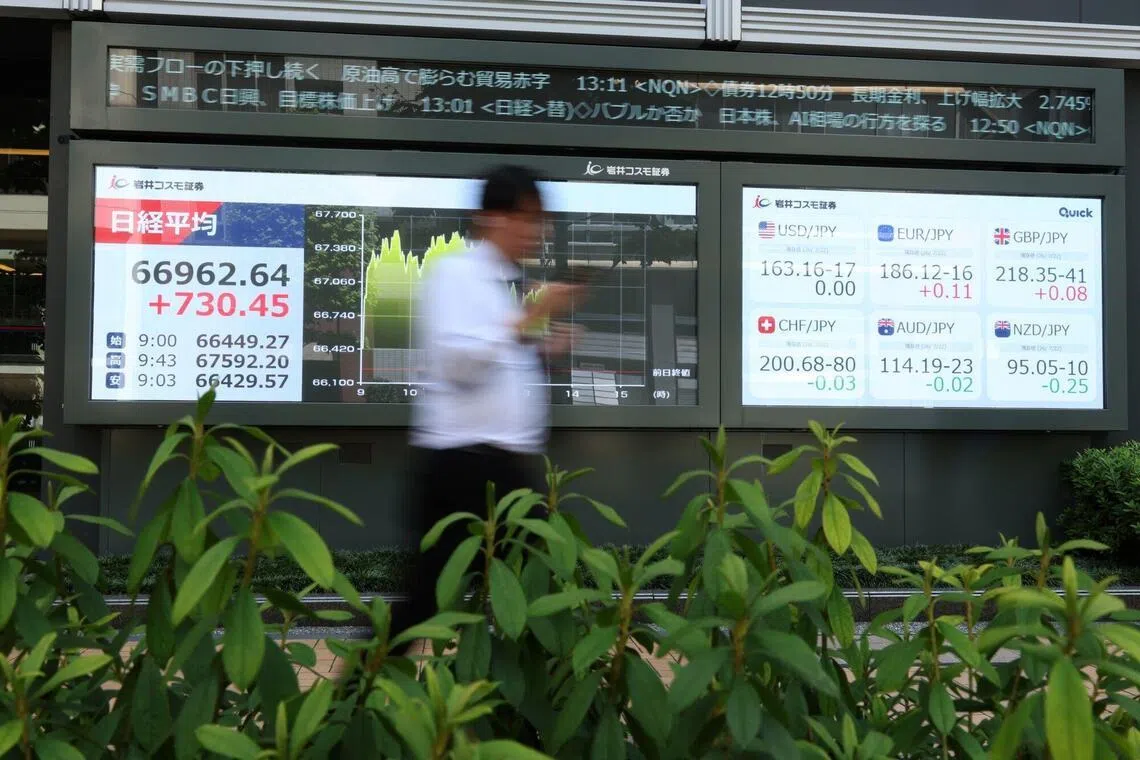
SINGAPORE – Stocks made lumpy gains on July 22 as the boost from a strong Wall Street session was capped by caution ahead of earnings reports from Big Tech while threats from Houthi rebels to expand the Middle East conflict pushed up oil prices.
American finance company MSCI’s broadest index of Asia-Pacific shares outside Japan was up 0.2 per cent as South Korea’s Kospi trimmed gains to 1.5 per cent, well off an earlier advance of more than 6 per cent.
Japan’s Nikkei 225 flitted between gains and losses, while S&P 500 e-mini futures slipped 0.2 per cent alongside a 1.2 per cent decline for stocks in Hong Kong.
Brent crude rose 1.3 per cent to US$92.22 a barrel after two oil tankers carrying Saudi crude to Asia reversed course in the Red Sea on July 21 following threats of attack from Yemen’s Iran-aligned Houthis.
“Equity markets shrugged off geopolitical risks, focusing instead on tech sector returns,” Westpac analysts wrote in a research report. “After large losses in recent days, semiconductor stocks bounced back.”
Market focus will turn to earnings from Alphabet, which is facing heightened scrutiny over the delayed launch of a key AI model, and Tesla, which is widely expected to report its first quarterly cash burn in over two years.
“Earnings season will be an important test on whether the narrow group carrying the market can keep doing so at the pace expectations now require,” wrote Laura Cooper, global investment strategist and head of macro credit at Nuveen.
“The second half likely requires AI spending to translate into earnings growth across the market and proof that credit can absorb another wave of supply without spreads giving way.”
Pharmaceuticals stocks in India slumped 1.5 per cent after US President Donald Trump said all generic drugs brought into the United States will carry a tariff of 0 per cent for two years from Aug 1, after which the rate will rise to 100 per cent for one year and 200 per cent thereafter.
The US dollar index, which measures the greenback’s strength against six currencies, held near a one-week high at 101.14. Against the yen, the US dollar was flat at 163.17 yen, after setting a four-decade high against the Japanese currency on July 21.
Japanese Finance Minister Satsuki Katayama said on July 22 that the government remains ready to take “decisive action” in currency markets if needed, while refraining from commenting on specific foreign-exchange levels.
The battered yen and soaring oil prices pushed Japan’s imports to a record high in June, though exports also topped expectations, helped by booming demand from AI-related data centres – and a weak currency that continues to boost overseas sales.
The jump in oil prices, which settled at a five-week high on July 21, did little to unsettle bond and currency markets ahead of central bank meetings next week.
Among them, the US Federal Reserve is set to keep its key interest rate steady for the rest of 2026, according to the median forecast of economists in a Reuters poll, though they said the chance of a rate hike is high.
Fed funds futures indicate that though one hike by December is probable, a hike of 50 basis points or more by the end of the year is a coin toss, the CME Group’s FedWatch tool showed.
The yield on the US 10-year Treasury bond was up 0.2 basis point at 4.628 per cent. Gold was up 1.2 per cent at US$4,124.74.
In cryptocurrencies, bitcoin was down 0.5 per cent at US$66,077.16, while ether was flat at US$1,923.25. REUTERS
Source : https://www.straitstimes.com/business/asian-stocks-cling-to-gains-as-us-rebounds-oil-rises

