


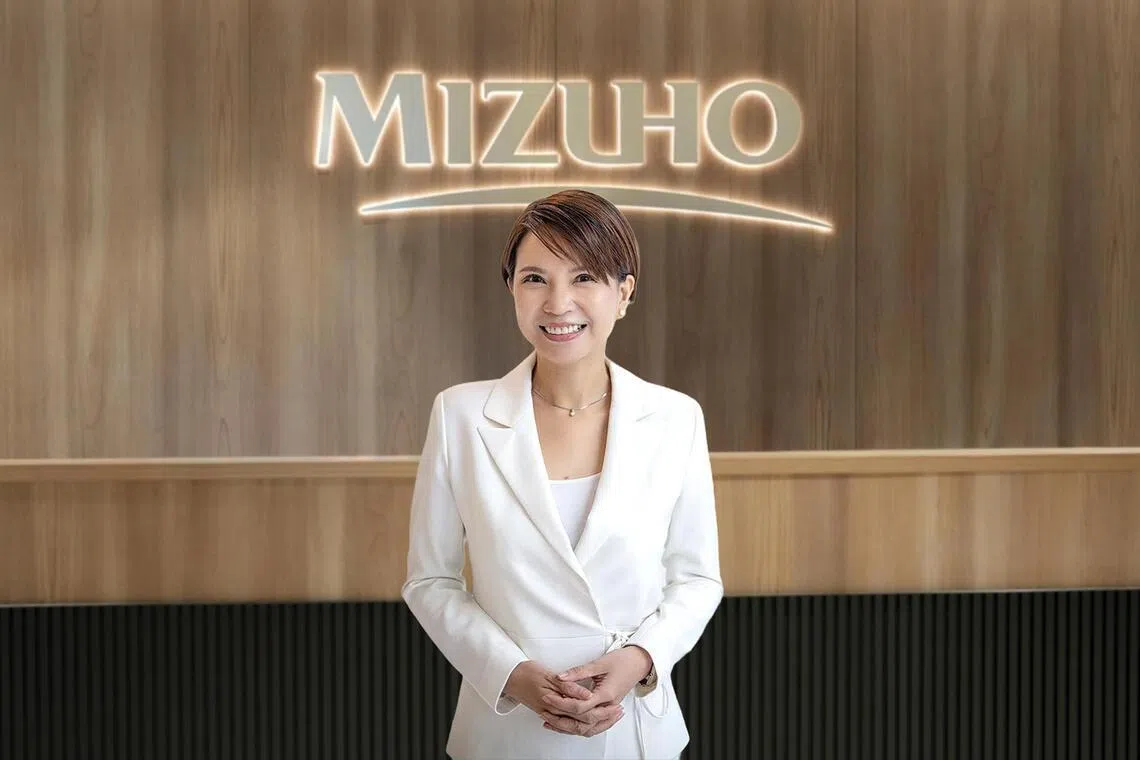
SINGAPORE – Singaporean workers have a distinct competitive advantage in today’s global workplace – one that draws on the strengths of Eastern and Western work cultures, says Josephine Lok, the first female chief executive of Mizuho Singapore.
In her nearly three years at the Japanese bank, she has learnt the value of long-term commitment. Japanese organisations may take longer to make decisions, says Lok, but “once they’re committed, they’re all out” – prioritising long-term relationships over short-term gains.
Japanese workplace culture, the Singaporean adds, favours alignment and consensus before making decisions, and values team achievement over individual glory.
Western workplace culture, by comparison, places greater emphasis on speed, individual accountability and open conversations, she says – with leadership often tied to individual visibility and charisma.
It is this contrast, Lok says, that gives Singaporean workers an edge – combining speed, agility and execution often associated with the West with Asian values of respect, trust and consensus-building.
“Singaporeans have a niche. We have Asian roots and Western efficiency,” the 50-year-old says in an interview with The Straits Times at The Ritz-Carlton, Millenia Singapore in late June, adding that this enables them to serve as effective cultural and business bridges.
“Our ability to balance speed with sensitivity is a distinct competitive advantage. I want to take the best of Singapore and Japan and combine it. I think that will make Mizuho Singapore very strong.”
Transforming for impact
One of the first things she noticed when she joined Mizuho Singapore was its Japanese-style security system, which the local office had adopted some 40 years ago.
The first employee to arrive each morning had to deactivate the alarm using a switch that was not intuitive. The last to leave had to walk around the office to confirm everyone was gone before reactivating the alarm.
The security procedures made sense historically in Japan, where Mizuho has many retail branches, including in remote locations.
“It may seem like a small issue, but the security system had wider implications,” says Lok.
Among its practical constraints: employees were less inclined to arrive early; cleaning activities had to start later and often coincided with peak office hours; and movement across floors was more restricted, limiting opportunities for spontaneous collaboration.
Lok says: “I asked: We’re in Asia Square in Singapore – a very safe country – with building security already in place, so why are we still doing this?”
As a result, she replaced the alarm systems and access cards with facial recognition.
She acknowledges it took time to convince the head office in Tokyo, but notes that it was ultimately supportive.
“Rather than making a small improvement, we leapfrogged to a completely new solution. When we made that change, some of our long-serving colleagues said, ‘I can’t believe we were actually able to change that.’”
That security revamp was part of a five-year transformation plan she introduced when she joined Mizuho Singapore following an eight-year stint at UBS and, before that, a six-year stint at Credit Suisse.
The first phase has been successfully completed, with the Japanese bank now in the second phase.
Lok says: “We strengthened our foundations in technology and infrastructure, modernised the office, and improved our processes over 16 to 18 months.”
Another initiative is the bank’s flexi-benefits programme, under which employees receive flexi credits that can be used for various well-being and lifestyle expenses.
When Lok first joined, however, the programme had many restrictions, such as separate spending limits for different categories.
“Why do we need all these restrictions? From the bank’s perspective, the impact is minimal regardless of how employees choose to use their credits,” she says.
Mizuho then worked with its insurer to remove those unnecessary limits, giving employees greater flexibility to use the benefits to best meet their needs.
Lok recognises that transformation is not only about change, but also about preserving and strengthening what already works. “At Mizuho, that’s our deeply rooted culture of care.”
Empowering staff to effect change
Lok makes a point of meeting new joiners quarterly to hear their ideas for change, always asking them two questions: What do they miss about their last workplace? What is their first impression of Mizuho?
She also rolled out the MizuhoCares programme, which encourages employees to identify opportunities and solve problems to create positive outcomes for colleagues, clients and the wider community.
“When we started, we sent out an e-mail every Friday. The goal was to build momentum and create a sense of anticipation, so that every Friday, people would expect an update and know that something new or a change was coming, she says, adding that the bank has highlighted 97 initiatives so far.
This also encourages long-term employees, who are accustomed to the way things have always been done, to think about what change could look like, she says.
“People are typically not very comfortable with change. Instead of driving change via enforcement, we focus on encouragement and engagement. Through initiatives like the Catalyst Award, we recognise employees who champion change and create positive impact, creating a culture where innovation and continuous improvement are celebrated.”
‘Self-doubt is a very natural thing’
Despite close to three decades of experience under her belt, Lok still faces moments of self-doubt. She confronts them head-on.
When she was offered the chief operating officer post at UBS in 2019, and later, the CEO role at Mizuho Singapore in 2023, both represented a significant step up from her previous positions. Like many people facing a major career transition, she wondered whether she was ready.
However, after going through both experiences, she realises that no one is ever fully prepared for a role of that scale. Instead, people grow into the role over time – learning, adapting and developing as they take on new challenges and responsibilities.
“I don’t see self-doubt as a very negative thing. As you doubt yourself, you get more humble and you start thinking about the areas you need to improve on. Self-doubt is a very natural thing as we are humans. When you are given something that is out of your comfort zone, of course it’s uncomfortable,” says Lok, adding that embracing it is key.
To women: Be open, don’t assume
Asked what leadership advice she would give young women, she says she believes the first step is to not limit their own thinking.
Women should not assume certain roles are out of reach because of their gender, or question whether they are suitable for promotion for the same reason.
Lok encourages young women, in particular, to remain open to opportunities and experiences that take them outside their comfort zones.
Early in her career at consulting firm Accenture, though based in Singapore, Lok spent significant time working overseas, with postings to places such as Australia, Thailand, Taiwan, Hong Kong and Xinjiang.
“I encourage young people to step out of their comfort zones and take on challenges, especially overseas assignments. I did that early in my career, before I had family commitments, and it was one of the best decisions I had ever made,” says Lok, who is married.
“It gave me new perspectives, accelerated my growth and shaped who I am as a leader today. When you’re starting out, there’s also more room to learn and make mistakes. People tend to be more forgiving because you’re still building your experience.”

