


In this series, business correspondent Timothy Goh offers practical answers to candid questions on navigating workplace challenges and getting ahead in your career. Get more tips by signing up to The Straits Times’ Headstart newsletter.
Does appearing busy matter more than actually being productive?
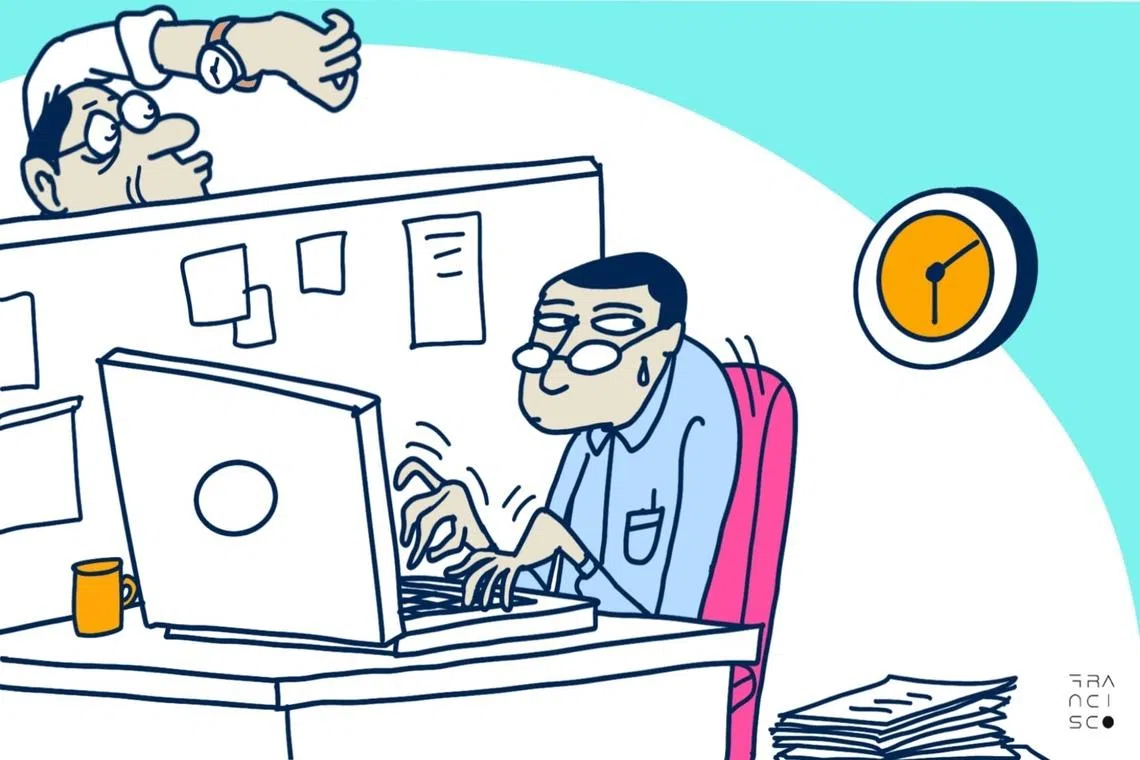
Pretending to look busy after finishing your work is often referred to as “productivity theatre”.
This is less an indication of laziness and more of an employee’s adaptive survival strategy used to navigate anxiety, preserve energy and manage professional impressions, says counselling psychologist Padma Jairam.
Padma notes that behavioural psychology’s theory of operant conditioning – a system of rewards and punishments – is apparent in many aspects of life, including the workplace.
In an ideal workplace, completing work quickly would be rewarded with rest or praise. But if efficient employees are instead rewarded with more work because they can get it done faster, they may eventually resort to “productivity theatre” or “task masking”.
“This is because to them, their efficiency appears to be punished with more work. Employees may come to believe that high efficiency results in an unreasonable and exhausting workload without additional pay,” says Padma.
“To exert what little control they have over their work and mental well-being, they may intentionally stretch out their tasks,” she adds.
Another explanation is “impression management”, or the conscious or subconscious process through which people try to influence how others perceive them.
Padma notes that the mindset from the Industrial Revolution – where time spent at work was equated with value created – still exists in some workplaces today.
This mindset ignores actual output and instead places undue emphasis on “face time”.
Therefore, employees who realise that finishing their work and leaving at 5pm may be perceived as lazy or lacking commitment may decide to stay until 7pm, even if it means typing meaningless e-mails.
In such cases, productivity theatre creates the impression, albeit a false one, of a committed employee because this is perceived to be a way of gaining favour with the boss, says Padma.
“So in a climate of layoffs and downsizing, participating in productivity theatre becomes pivotal if a boss equates looking busy with being productive,” she adds.
After a while, pretending to work while doing little of value can create internal psychological friction known as cognitive dissonance, or the mental discomfort experienced when actions clash with one’s values or beliefs.
“If your core value is one of being an honest, efficient employee, pretending to be busy and formatting a blank document for your boss’ optics takes a toll on you internally because the behaviour does not sit well with who you are,” says Padma.
Another possible consequence is burnout from boredom and the mental energy required to keep pretending.
The lack of meaning and sense of achievement from constant fake work can lead to burnout because people generally thrive under conditions of optimal stress – not too much and not too little.
“Having to constantly pretend to be busy and wonder whether a boss is watching can also create a sense of hyper-vigilance, increasing stress and anxiety,” says Padma.
Larson Ong, co-founder of creative agency Visual Studio Singapore, says that while employees do not need to look busy, they need to create value.
“As an employer, I would much rather see someone who finishes their work well than someone who stays at their desk pretending to be occupied,” he says.
Finishing one’s tasks also does not necessarily mean the workday is over, but can instead present an opportunity for growth.
Ong adds that young professionals can show initiative by asking how they can contribute or help, rather than pretending to be busy.
They can also use the extra time to learn new skills, improve processes or better understand other parts of the business.
“The most valuable employees are often those who keep learning, even when nobody asks them to,” Ong says.
Padma says that ideally, employees should find a workplace that aligns with their work ethic.
“If your brain is fried from a day of work, regardless of the time, then it is what it is. You need to rest,” she says. “And if ‘overtime’ is inevitable due to the boss’ perception of productivity, then the trick is to find a way to make those extra hours count for you.”
Using the extra time to organise and declutter one’s workspace can help reduce cognitive load and provide some movement after sitting for long periods.
Employees can also take a short mindful break, such as going for a walk or getting a snack, to recharge before returning to work.
“Ultimately, survival in a rigid workplace requires strategy. If you must play the part, ensure you are protecting your well-being while the clock runs down,” says Padma.

