


SINGAPORE – Lower-wage outsourced workers such as cleaners, security officers and landscape maintenance workers will enjoy more annual leave from 2029, when the minimum leave entitlement will be increased from seven to 10 days.
The increase in baseline annual leave, which will be implemented in phases, will benefit outsourced workers across five sectors: cleaning, security, landscape, lift and escalator, and waste management.
About 60 per cent of resident outsourced workers in these sectors will benefit from the annual leave increase, said the Ministry of Manpower (MOM) in a press statement on July 19.
An outsourced worker is employed by a third-party service provider and deployed to work at a client company’s premises.
Residents refer to Singaporeans and permanent residents.
To allow businesses time to adjust, the increase in baseline leave entitlement will be implemented progressively from 2029 onwards. This will allow employers and service-buyers to plan ahead and incorporate the change into their contracts, and better manage the operational and cost impact.
More implementation details closer to the implementation date.
The move comes after NTUC assistant secretary-general Melvin Yong called on the Government to increase the baseline leave entitlement for workers under the Progressive Wage Model in outsourced sectors from seven to 10 days during the Budget 2026 debate earlier this year.
Outsourced cleaners working at East Coast Town Council, Abdul Rahman Amil and Albert Lee, said they are happy with the new baseline and look forward to having more annual leave for vacation and rest. Amil is employed by Chang Seng Services, while Lee is employed by Cleaning Solutions.
MOM noted that the increase in baseline leave will help ensure that workers’ employment conditions remain protected even when their employers change.
The ministry added that the new baseline should not affect the annual leave increase that outsourced employees are currently entitled to under the Employment Act. This means workers who are already receiving leave benefits above the new baseline should continue to receive them according to their employment terms and the Employment Act.
Under the Employment Act, employees are entitled to a minimum of seven days of annual leave in their first year of service. This increases by one day per year of service with an employer, and can go up to a maximum of 14 days.
Minister of State for Manpower Dinesh Vasu Dash said this progression can be difficult to achieve and maintain for outsourced PWM workers though.
“Service buyers frequently switch providers, and each time workers are rehired on a fresh contract, their leave entitlements could be reset back to seven days.
“Despite performing the same role for many years, their service goes unrecognised, and their leave entitlements stagnate at the baseline of seven days.”
As such, the increase in baseline annual leave to 10 days “will ensure that these workers receive annual leave entitlements that reflect their work and years of service,” he said.
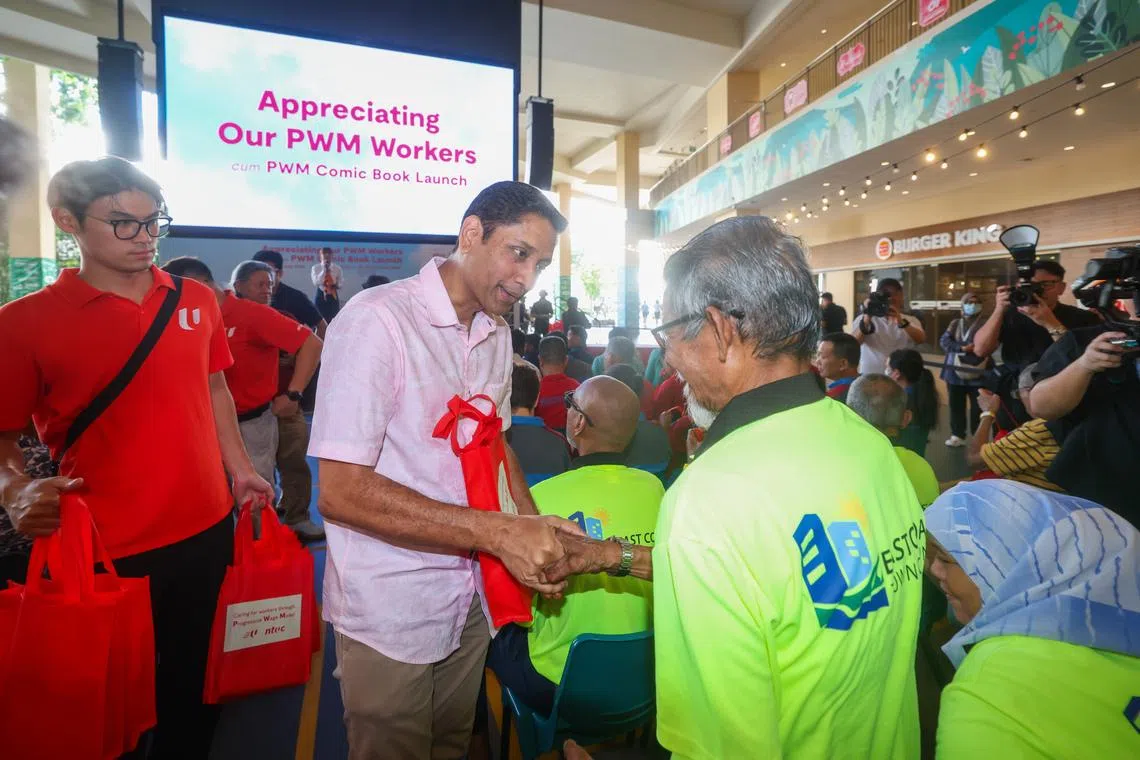
Minister of State for Manpower Dinesh Vasu Dash presents appreciation packs to workers during the launch of NTUC’s “Appreciating Our PWM Workers” campaign at HeartBeat@Bedok.
PHOTO: LIANHE ZAOBAO
Dinesh was speaking during an NTUC campaign launch to appreciate workers covered under the PWM at Heartbeat@Bedok on July 19.
Under the PWM, bosses must pay at least the PWM wage to eligible workers for their job level and meet their training requirements. This has helped ensure that these sectors can raise salaries for lower-wage workers at a sustainable pace.
The cleaning sector was the first to be introduced in the PWM in 2012. The pest management industry – the latest and 10th sector to be included in the PWM – was announced earlier this month.

