


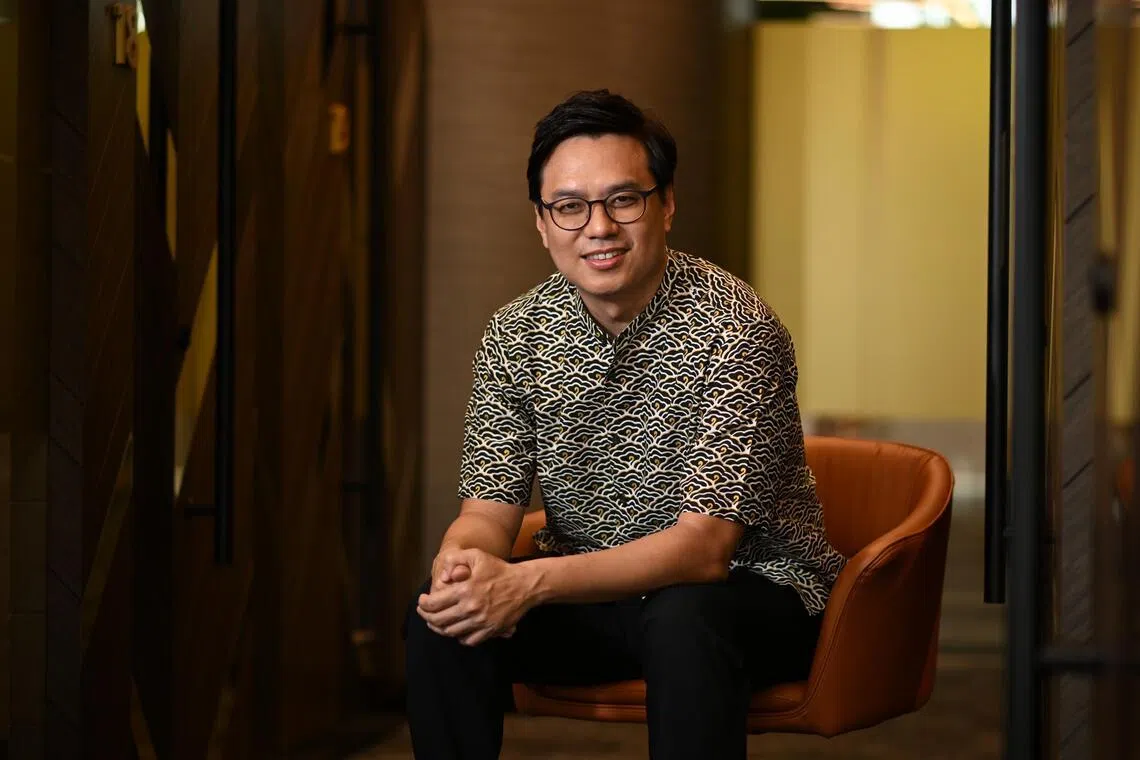
SINGAPORE – Chong Wee Yeat has had a storied, global career spanning momentous eras like the Sept 11, 2001, terrorist attacks and the 2003 severe acute respiratory syndrome outbreak.
But it was his penny stock-investing days in university – when he had to swallow losses – that strongly influenced his investing mindset today, teaching him to invest prudently.
“Like many first-time investors, my early forays were modest and not particularly successful,” the managing director and head of global banking at Maybank Singapore says of his undergraduate years at the National University of Singapore.
He started dabbling in the Singapore stock market after taking a financial investment module.
“I gravitated towards penny stocks, attracted by the promise of quick gains, but quickly learnt how volatile and unforgiving that space can be.”
The 49-year-old adds: “That early experience shaped how I think about investing today. If I were to invest in equities now, I would favour strong, fundamentally sound dividend-paying stocks that offer steadier returns and a clearer balance between risk and reward in the long term, rather than chasing short-term price movements.”
Now, Chong says, stability and steady, sustainable growth are important to him, especially since he has experienced global events that have rocked markets.
Across his career, he has had a front-row seat to unfolding global events. In 2001, he was in San Francisco when the Sept 11 terrorist attacks shook the United States.
“It was a formative period, one where I witnessed first-hand how global events can abruptly reshape markets and sentiment. I still keep newspaper clippings from that time as a reminder of how quickly certainty can disappear,” he says.
And in 2003, he was in Hong Kong and Guangzhou when SARS broke out.
Those experiences taught Chong about the fragility of normality and how easily markets and the status quo can be destabilised by uncertainty.
“Looking back, working across regions, cultures and moments of disruption has shaped how I view banking today – not just as a financial function, but also as a responsibility to support long-term, resilient and sustainable development,” he adds.
Chong is married with two teenage sons. He holds a bachelor’s degree in business administration and finance.
Do you invest in anything?
I am a firm believer in real estate, though I regret not starting to invest earlier, before the inexorable upswing in the market.
I invest in myself and my family, especially my children, including through insurance policies that double as protection and savings. Other than financially, I invest my time in self-improvement, health and fitness. I also read regularly.
I used to hold a portfolio of stocks. I liquidated them to pay for my wedding and matrimonial house.
What’s your approach when it comes to growing your money?
Earlier in my career, I was more willing to take risks. I invested in start-ups and higher-risk opportunities, driven by growth potential and the excitement of backing something new.
Those experiences were valuable learning moments, but they also taught me that risk and reward need to be approached with discipline and perspective.
Over time, my approach has become more measured. Today, my priority is capital protection first, followed by steady, sustainable growth – ideally at a pace that preserves purchasing power and counters inflation.
I am more focused on downside protection, resilience and long-term value creation than chasing outsize returns.
Ultimately, experience has taught me that growing wealth or a business is not about taking the biggest risks, but about making informed decisions consistently, managing downside well and allowing compounding to do its work over time.
Did you collect anything when you were younger?
When I was younger, I collected stickers – the kind where you completed an entire sticker book to win a prize, such as World Cup sticker sets. I remember completing one collection and winning a remote-controlled car. It felt like a big achievement at the time.
I grew up in a modest household, so toys were few and far between. When I later started earning during my time in the army, I would hand most of my pay to my mother. As a result, my hobbies tended to be simple and low-cost – playing basketball and football, or spending time on computer games with friends.
That said, I do still keep a small indulgence from those years: a few rare Lego collectible boxes that I bought back then and have never opened. They remain unopened to this day, less as collector’s items and more as reminders of restraint, patience and knowing when to hold back.
What has been your biggest financial mistake?
One of my bigger financial missteps was overinsuring. At one point, I accumulated multiple insurance policies without fully stepping back to assess whether they were cost-effective or made sense from a portfolio perspective. While each policy seemed reasonable on its own, collectively, they were inefficient. I’ve since learnt that insurance should protect against genuine risks, not become an investment substitute.
What has been your best financial decision?
From a purely financial standpoint, real estate has worked well for me. We bought our current home shortly after Covid-19 struck, when uncertainty weighed heavily on the market. Since then, its value has risen meaningfully.
Earlier in my career, I also purchased a property in the aftermath of the global financial crisis, around 2009 to 2010, when prices were similarly depressed. That investment appreciated over time as the market recovered.
Another decision that paid off, though not in a direct monetary sense, was volunteering for overseas postings earlier in my career.
Those experiences significantly broadened my perspective, strengthened my adaptability and enhanced my employability over time. The returns were not immediate, but they compounded in ways that shaped my career trajectory.
Moneywise, what were your growing-up years like?
I grew up as the youngest child in a family with five kids. My father’s construction business nearly collapsed after an employee was involved in an accident, primarily because my father had not purchased insurance in time. My mother owned a hairdressing salon and my eldest sister helped to take care of me when I was young.
From an early age, I helped with household chores and learnt to be self-reliant. We lived in a three-room HDB flat, with my three sisters sharing one bedroom, my parents in the other, and my brother and me sleeping on mattresses in the living room. When the older children started working, we eventually moved to a five-room HDB flat in Hougang.
Growing up, my family emphasised that success depends on hard work and excelling in studies.
Where’s home for you?
I live in an inter-terrace home in the central area that suits our family’s needs and allows for a bit more space and privacy. We chose a long-term home that we’re comfortable growing into, rather than something driven by size or prestige.
Do you drive?
We have an eight-year-old BMW X1 which primarily serves as our family car and is mainly driven by my wife.
Within Singapore, I prefer using public transport such as the MRT and ride-hailing services when needed. My daily MRT commute has become a form of “me time”.
What would your perfect day look like?
Waking up at home with a cup of coffee and reading about a Liverpool victory from the night before.
Money matters
What would you do if you suddenly had a windfall of $1 million?
I would allocate it accordingly: to my church, my family, paying off the mortgage and a little for a nice holiday.
If you suddenly had only $100 to your name, what would you do with it?
It depends on the state of the world we are in. If it is near doomsday, I will spend it on a sumptuous meal (to the extent possible) and share it with my loved ones.
Otherwise, I will spend it wisely so that I can live to fight another day.

