


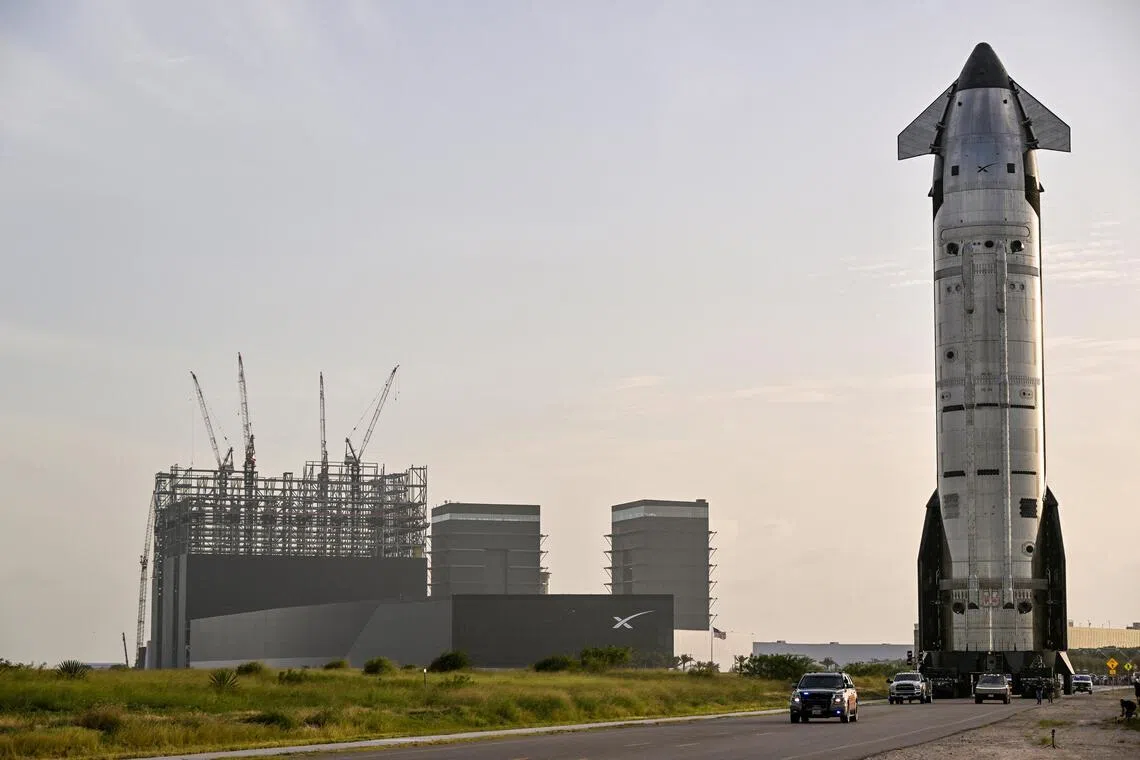
SpaceX will attempt a major test flight of its massive Starship rocket on July 16, a milestone for a vehicle that’s a critical part of Elon Musk’s plans for the space, satellite and artificial intelligence conglomerate.
The launch, targeted for 5.45pm local time (6.45am on July 17 Singapore time) from SpaceX’s Starbase facility in South Texas, marks the second flight of the latest iteration of the rocket, dubbed Version 3 or V3.
The rocket will be carrying to space upgraded Starlink satellites that are intended to burn up later in the atmosphere as part of the test mission.
The rocket is central to Musk’s ambitions to put data centres in space, expand the Starlink communications network and send humans to the moon and Mars. But it has faced a rocky development path marred by explosive setbacks, malfunctions and delays.
The Starship test is the rocket’s 13th flight and first since SpaceX’s blockbuster initial public offering in June that raised some US$86 billion (S$111 billion).
Shares of SpaceX soared shortly after their debut but more recently slumped, closing on July 15 near its IPO price of US$135. Despite the decline, Wall Street analysts still remain largely bullish on the stock.
Musk’s company has designed Starship to be fully reusable, something no other rocket maker has achieved, with both the Super Heavy booster and the Starship spacecraft intended to return to Earth intact after each launch so they can fly to space again.
Musk has predicted that SpaceX could achieve full reusability with the upgraded V3 rocket before the end of the year. SpaceX has spent more than US$15 billion developing Starship.
During the most recent test flight in May, Starship successfully deployed mock satellites, although the rocket’s booster spun out of control and one of its engines shut down early.
SpaceX has since made hardware and software modifications to correct these issues, according to a post on the company’s website.
“We believe that if SpaceX can keep all major engines healthy, execute the planned relight and landing sequence, and bring back stronger heat-shield and control-surface data, Flight 13 would represent a meaningful step beyond Flight 12,” said Raymond James analyst Brian Gesuale in a note on July 13.
Starship becoming operational “is the critical path to the SpaceX investment thesis,” he added.
A successful Starship test could also lead to the company attempting to reach orbit with the vehicle for the first time on the next flight, according to Stifel analyst Jonathan Siegmann.
SpaceX holds US$4 billion worth of NASA contracts for Starship to land astronauts on the moon as soon as 2028.
To do so, SpaceX will have to refuel the vehicle in space, launch it a dozen times or more in a row and ensure the vehicle is safe to hold humans – a demanding list of tasks for a vehicle which has yet to complete a full orbital mission.
The July 16 flight plan will look similar to previous test missions.
At lift-off, the Super Heavy booster will ignite 33 Raptor engines and send Starship on its way to space, where it will reach near orbital speeds. The booster will separate from Starship and then attempt to splash down in the Gulf of Mexico.
While in space, Starship will attempt a number of tests, including relighting one of its engines and deploying 20 Starlink satellites. These satellites will extend their solar arrays and attempt to connect to the broader Starlink network using laser-based communications.
About 20 minutes after deployment, the satellites should fall back to Earth, burning up in the atmosphere.
About an hour after liftoff, Starship is scheduled to splash down in the Indian Ocean. BLOOMBERG

