


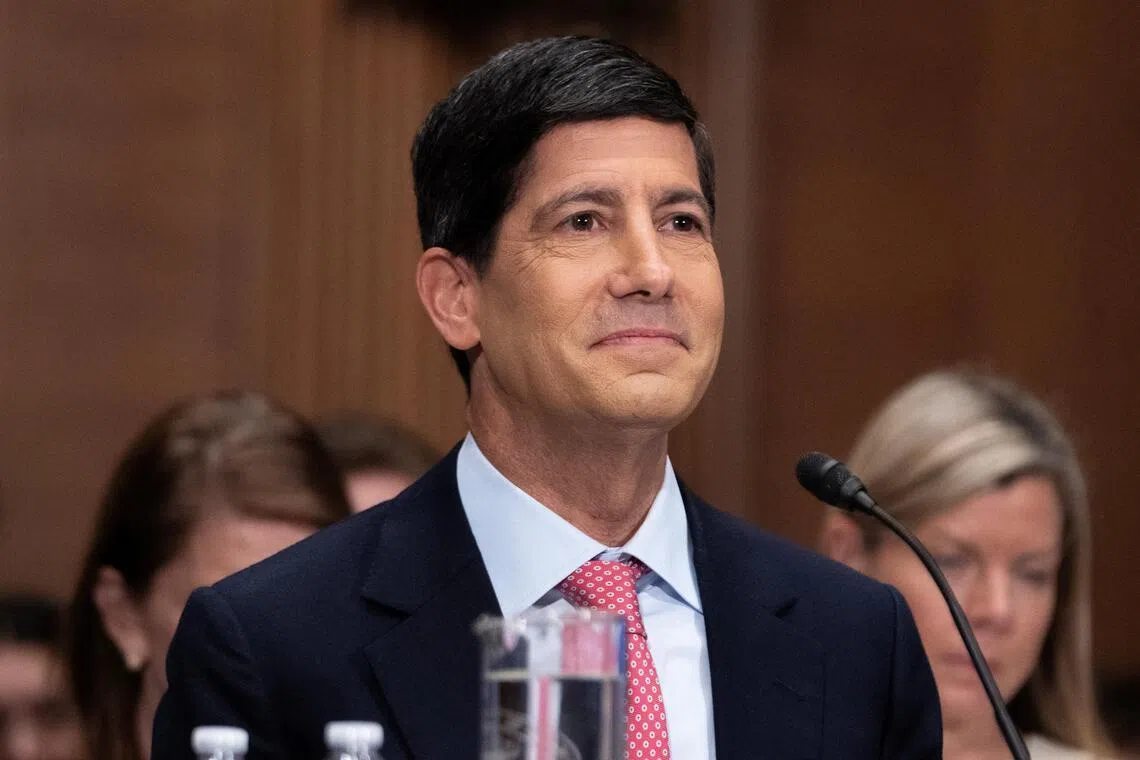
WASHINGTON – US Federal Reserve chairman Kevin Warsh pushed back on commentary that surging investment into artificial intelligence is stoking inflation, saying the boom won’t necessarily lead to persistent price pressures.
The remarks by Warsh came as Fed policymakers, Wall Street economists and businesses warn that the AI build-out has created a supply crunch for key resources and materials that is driving up costs for energy, labour, computer chips and software.
In an exchange with lawmakers on the impact of the boom, Warsh acknowledged that AI investment is already raising the prices of some goods and he repeated a vow to curb overall inflation. But he said higher prices in the near term are not necessarily inflationary, and the Fed’s policymakers will debate how long lasting that proves to be.
“This is one of the good family fights,” Warsh said on July 15 in response to a question during his testimony before the Senate Banking Committee. “I don’t view a one-time change in prices as necessarily being inflationary because I think there’s a supply response. In that way, this is different from a foreign conflict and what it might do, which tends to reduce the supply side of the economy.”
While Warsh has recently sounded like an inflation hawk, repeatedly promising to deliver price stability, his remarks signalled a willingness to be patient with sources of inflation that he believed to be temporary, including demand from AI investment.
“He definitely revealed a little bit more about his inflation framework,” said Derek Tang, economist at Monetary Policy Analytics. “The current inflation we’re seeing right now does not alarm him unless we see more second-round effects.”
Other Fed officials, including governors Christopher Waller and Lisa Cook, and New York Fed president John Williams, have in recent days spoken about the inflationary impact from AI.
In his second day of testimony on Capitol Hill this week, Warsh also told lawmakers he expects AI will lift productivity and wages over time, repeating a view he pushed in the lead-up to securing Trump’s nomination in January for the Fed role.
“Wages have moved up at a reasonable pace, but it’s likely that as productivity moves up more, we should see wages move more,” he said.
The Fed chairman spoke shortly after fresh data showed an underlying gauge of producer price inflation was softer than expected in June, suggesting broad based inflation remained in check during the month.
Like the first day of testimony on July 14, the second day covered a breadth of issues facing the Fed, including monetary policy and bank oversight, along with questions around corporate governance and the central bank’s independence.
Trump conversations?
In response to a line of questioning on Warsh’s communications with the White House, Warsh wouldn’t say whether he had spoken with President Donald Trump since being sworn in as Fed chairman in May. Instead, he doubled down on a message that he will defend the Fed’s independence from the White House and Trump.
The president was scathing in his criticism of Warsh’s predecessor as Fed Chair, Jerome Powell, for not cutting interest rates fast enough and has continued to say interest rates should be lower.
“I just don’t want to be in the business of sharing discussions that the president and I have,” Warsh said.
“They chose an independent guy to do an independent job, and that’s exactly what I plan on doing,” Warsh added. “The president never asked me to do anything inappropriate, and if he did, I wouldn’t do it.”
Earlier Warsh said he would defer to the central bank’s internal watchdog on a request from Democratic Senator Elizabeth Warren for a probe into Fed Vice chair for supervision Michelle Bowman.
Bowman attended a private meeting with bankers during the Fed’s so-called blackout period in June. Asked several times by Warren if he had discussed the incident with Bowman, Warsh declined to answer.
Inflation relief
The Fed chief on July 14 told the House Financial Services Committee that policymakers have no tolerance for high inflation and he repeated a vow to tame price growth. He added that policymakers still have work to do even after a government report showed consumer inflation in June was weaker than expected amid a pause in the US-Iran war. A resumption of hostilities has since sent oil prices surging again.
Minutes of the FOMC’s June 16-17 meeting reflected growing concern among policymakers over inflation just as worries over the labour market slightly receded. Officials voted unanimously at that gathering, the first under Warsh’s leadership, to hold the Fed’s benchmark interest rate in a range of 3.5 per cent to 3.75 per cent for a fourth consecutive time.
When asked how he plans to tackle inflation that has remained above the central bank’s target for years, Warsh said high inflation will not be a permanent feature during his term.
“We’re going to look at our tools in the changing economy, both balance sheet and interest rate, and see whether we need to adjust policy to take it head on,” Warsh said. BLOOMBERG

