


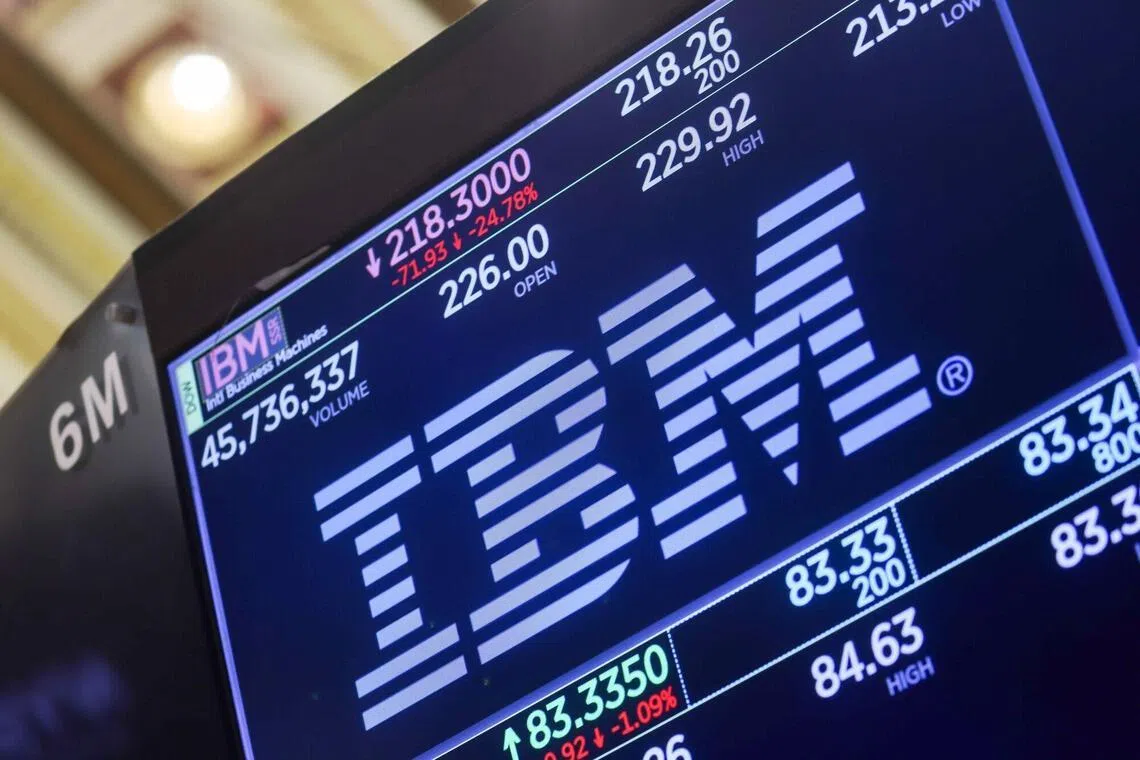
Washington – IBM shares plunged 25 per cent on July 14 after the US tech giant released disappointing preliminary second-quarter results, blaming a shift in spending by customers due to expected higher prices for memory chips and other AI-related infrastructure.
“We did not adapt and move quickly enough,” IBM chief executive officer Arvind Krishna said in a letter to investors. The company said revenue for the three months ending in June rose just 1 per cent to US$17.2 billion (S$22.2 billion).
A global rush by tech companies to build out artificial intelligence infrastructure has sent demand for servers, memory chips and storage soaring, driving up prices and creating supply shortages across the industry.
IBM said that toward the end of June, many of its big corporate customers rushed to buy up hardware to get ahead of expected price increases.
That shopping spree pulled spending away from IBM’s higher-margin mainframe computers, the powerful machines used by banks and large corporations to process millions of transactions, and related software.
IBM’s infrastructure business – which includes its flagship mainframe line – saw revenue fall 7 per cent.
Software revenue grew 5 per cent but still came in below expectations.
Cybersecurity concerns across the tech industry also distracted clients during the quarter, IBM said.
Those concerns were brought on by the release of Anthropic’s Mythos AI model, which has raised alarm bells for its capabilities to find weaknesses in computer networks that can be taken advantage of by hackers.
In response, companies have worked to build up their cyber defenses instead of spending on previously planned projects.
That news sent the share price of cybersecurity firms skyrocketing: CrowdStrike rose 12 per cent while Okta and Netskope surged about 11 per cent each.
The crash in IBM’s share price will increase talk of the consequences of the AI revolution on traditional software companies – known as Software as a Service, or SaaS firms – of which IBM is an important member alongside companies like Salesforce, Adobe and Intuit.
Shares in those companies were trading lower on July 14 after the IBM warning.
Earlier in 2026, Wall Street went into a brief frenzy, dubbed the “SaaS-pocalypse,” after analysts predicted that the sector was doomed due to the ability of AI models to provide everyday users the same capabilities.
On the positive side, IBM’s Red Hat unit, which sells open-source software, posted 11 per cent revenue growth.
The company’s server and storage business outside of mainframes surged 37 per cent as clients snapped up that equipment.
IBM’s miss was largely tied to the mainframe business, and interpreting it as a sign of weakness for the entire software sector is “a bit of a stretch,” said Kirk Materne, an analyst at Evercore ISI. The results instead stand to perpetuate “AI-Loser” fears around IBM, compounded by a Bloomberg report last week about Starbucks potentially replacing some IBM software, Citigroup analyst Mark Zhang said.
“While it’s fair to say that this kind of increased spending is impacting more broader tech,” the IBM results were “a little more specific,” said Susquehanna analyst Jamie Friedman, adding that it’s worth watching Accenture, Cognizant Technology Solutions and other similar companies for enterprise spending shifts. AFP, BLOOMBERG

