


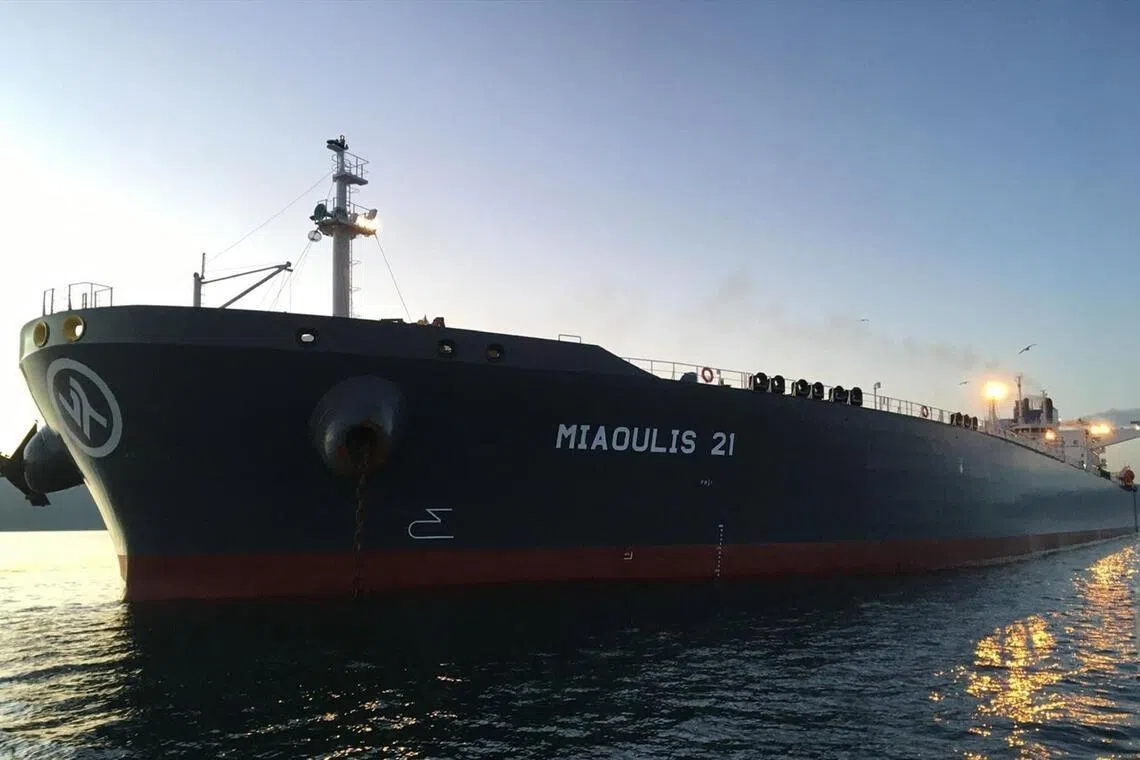
SINGAPORE – Two tankers carrying crude oil have arrived in Singapore after being stranded in the Middle East for months, pointing to the resumption of activity in a critical waterway since the US and Iran reached a peace agreement in June, ship-tracking data shows.
But analysts said the pickup in traffic in the Strait of Hormuz, through which around a fifth of the world’s oil and gas supplies usually pass, could be a brief respite.
United States President Donald Trump earlier this week declared that the temporary ceasefire between the US and Iran was “over” while leaving the door open to talks, as Washington and Tehran traded strikes in a battle over the strait.
The Strait of Hormuz had been effectively closed for months since the outbreak of the Iran war in February, until US and Iranian officials on June 14 announced a preliminary pact for the reopening of the waterway.
Some vessels that had been stuck in the Middle East have since taken the chance to leave the strait, bringing traffic to between one-fifth and one-third of pre-war levels, according to estimates cited by major news agencies.
Among them were two oil tankers bound for Singapore, which took as long as four months to arrive, global data and analytics platform Kpler told The Straits Times.
Fabian Ng, head of crude pricing for Asia at price-reporting agency Argus Media, said a crude shipment from the Middle East typically takes two to three weeks to get to Singapore under normal conditions.
Miaoulis 21, a Greece-flagged oil tanker, was carrying one million barrels of Basrah Medium crude, which can be refined into petrol, diesel, jet fuel and kerosene.
The tanker, controlled by French giant TotalEnergies, was loaded at a port in southern Iraq on Feb 26, two days before the US and Israel carried out their first strikes on Iran.
It then made several port calls in the Middle East, before passing through the Strait of Hormuz on June 21.
Miaoulis 21 arrived in Singapore and discharged its oil on July 4 at Aster Bukom complex, operated by Aster Chemicals and Energy, a joint venture between Indonesia’s Chandra Asri and commodities major Glencore, according to Kpler’s vessel tracking data.
Meanwhile, Liberia-flagged VL Prime was loaded with more than 1.8 million barrels of Upper Zakum crude at a port in the United Arab Emirates on April 10. The medium-sour oil is primarily used to produce high yields of diesel and jet fuel.
The tanker, controlled by South Korea’s Sinokor, then called at King Abdulaziz Port, one of the largest ports in the Persian Gulf, and subsequently, the Strait of Hormuz on June 24.
It arrived in Singapore and discharged its cargo at an ExxonMobil refinery on July 6, the tracking data shows.
Muyu Xu, a senior crude-oil analyst at Kpler, said: “There could be additional vessels carrying previously stranded barrels to Singapore, but we won’t be able to identify them until they reveal their final destination.”
However, she added that given the latest developments in the Middle East, the outlook for oil flows through the Strait of Hormuz could change again.
Cargo-tracking and energy market intelligence firm Vortexa has also spotted crude oil volumes which had recently transited the Strait of Hormuz and arrived in Singapore.
Vortexa senior market analyst Xavier Tang said: “The bulk of Singapore’s oil and gas imports from within the Strait of Hormuz are crude, followed by a few cargoes of fuel oil and naphtha.
“However, with the recent escalation of conflict between US and Iran, vessel traffic is likely to fall as the risks of transiting through the Strait of Hormuz have increased after Iran struck vessels at the waterway, raising war-risk premiums by at least 50 per cent.”
Tang noted that no liquefied natural gas (LNG) cargoes have arrived or are en route to Singapore.
LNG is primarily used for power generation in the Republic.
Supplies of the commodity have been squeezed as Qatar’s Ras Laffan plant – the world’s largest LNG export facility – suffered significant damage during the war, and operations at the site have been largely suspended since March.
Even so, Energy Market Authority chief executive Puah Kok Keong said in a recent interview that Singapore had secured enough LNG cargoes to make up for lost supplies from Qatar for the rest of 2026, ensuring it has all the gas the Republic needs.
Puah told Reuters that the replacement cargoes were from suppliers in the US, Australia and Africa.
Qatari crude accounted for around 15 per cent of Singapore’s crude imports in 2025, according to Vortexa and Kpler tracking data.
But no crude oil from Qatar was delivered to Singapore between April and June, as exports remain affected by the situation in the Middle East, Argus Media’s Ng said.
He also observed that China had stepped up purchases of oil from producers in the Middle East in recent weeks.
These purchases were mostly made through tenders issued by Abu Dhabi’s state-owned Adnoc, and producers Kuwait, Iraq, Qatar and Saudi Arabia.
Japanese and South Korean refiners also appear to be buying more crude from these producers.
Ng said these purchases usually transit the Strait of Hormuz, but producers have started to offer customers the option to load cargoes through ship-to-ship transfers outside the strait near Fujairah in the United Arab Emirates.
Producers have also offered to be responsible for the cost, insurance and logistics required to transport the crude oil to a buyer’s destination port.
Most Middle Eastern shipments to Singapore currently comprise of Murban and Oman crude, which are exported from ports outside of the Persian Gulf. This means the shipments do not pass through the Strait of Hormuz on their way to the Republic.
There has not yet been an uptick in purchases from the Middle East from Singapore-based refineries, but this could come as prices become more competitive.
Ng said: “Middle East crude prices have come under pressure since June from the additional volumes being made available by producers.
“This could encourage refiners, including those in Singapore, to favour such shipments over alternative options from the US.”
Oil prices are expected to remain turbulent.
Prices jumped by more than 6 per cent on July 8 after Trump ordered new strikes on Iran, but settled lower on July 9 on worries that rising inflation and other economic concerns could ultimately weigh on oil demand.
Oil tanker traffic through the Strait of Hormuz was at a near standstill on July 9, according to ship-tracking data.

