


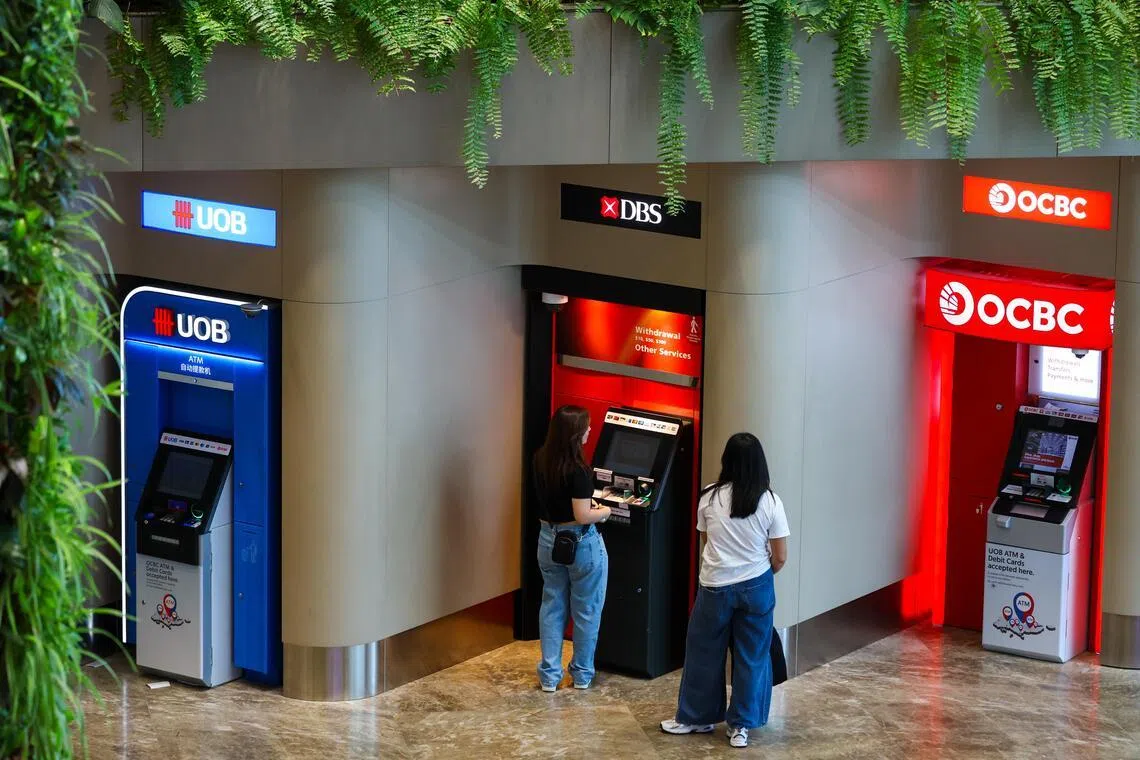
SINGAPORE – DBS, OCBC and UOB shares climbed to fresh highs this week, buoyed by expectations that interest rates will stay higher for longer and growing investor optimism ahead of the banks’ second-quarter earnings reports in early August.
DBS vaulted past the $70 mark for the first time on July 9, while OCBC broke through $27 and UOB surpassed $44.
Analysts expect strong wealth momentum and attractive dividend yields to continue supporting the share prices of Singapore’s three banks.
Jayden Vantarakis, head of Asean equity research at Macquarie Capital, said the interest rate environment in the second quarter is more favourable for the banks as compared with the previous quarter.
The US Federal Reserve’s pause on interest rate cuts during its June 2026 meeting supported the banks’ net interest margins (NIM) – the difference between the interest they earn on loans and the interest they pay on deposits.
“The macro backdrop has improved relative to the end of first quarter in 2026,” said Vantarakis.
Hence, Macquarie has turned more bullish on the banking sector, upgrading DBS and UOB to “outperform”, joining OCBC. The firm holds a price target of $70.86 for DBS, $27.76 for OCBC and $45.16 for UOB. In terms of upside potential, its preference ranking is UOB, followed by OCBC, and then DBS.
Separately, RHB maintained its buy call on OCBC, with a price target of $29.80, citing dividend yields, a strong balance sheet and positive earnings momentum backed by a solid wealth business.
The bank said it expects OCBC’s second-quarter profit after tax and minority interests to grow by a mid-single-digit percentage from a year earlier, but the quarter-on-quarter rise could be more modest.
It also noted that the pressure on OCBC’s NIM could ease, as the year-on-year change in benchmark interest rates has become narrower than before. OCBC’s cut to the interest rate on its flagship savings account in May should also help.
Overall, RHB said even though the banking sector’s valuations appear rich, it expects further upside driven by the Singdollar’s strength, safe haven and wealth inflows into Singapore as well the equity market reform agenda.
OCBC also pointed out that the banks are benefiting from the wealth inflow as Singapore deepens its role as a financial hub.
As earnings remain healthy, share buyback and good dividend payout will continue to attract funds to the sector, said OCBC head of equity research Carmen Lee.
“Banks have also essentially become giant REITs, offering sizeable dividends which translated to attractive dividend yields of 4 to 5 per cent,” said OCBC’s group research analysts, likening banks to real estate investment trusts, which are required to pay back 90 per cent of profits to investors.
“Even at higher (share price) levels, estimated dividend yields of 4 to 5 per cent are still highly appealing to long-term investors looking for predictable and steady income streams, as well as foreign investors looking for investment opportunities in Singapore,” the analysts noted.
Meanwhile, from Oct 5, local bank stocks could become more attractive to retail investors who have been deterred by their high share prices.
The Singapore Exchange announced on July 1 that the standard board lot size will be cut from 100 units to 10 units for instruments priced above $10, and up to $100. The initial reduction will apply to 11 stocks, including the three local banks.
Macquarie Capital’s Vantarakis said smaller board lots would lower the minimum investment required to buy pricier stocks, making them more accessible to retail investors – all else being equal.
Shekhar Jaiswal, head of equity research at RHB Singapore, said the board lot reduction should be a net positive for trading activity, particularly for higher-priced counters such as DBS, OCBC and UOB.
“We expect the more immediate impact to be felt in the number of trades and market breadth rather than in a direct share price rerating,” said Jaiswal.
But the board lot change should not be viewed in isolation.
“When considered alongside the broader equity market reform agenda, including the Equity Market Development Programme and improved market-making incentives, the cumulative effect could create a more sustained uplift in both participation and liquidity over time,” he noted.
While analysts are mostly bullish on banks, Vantarakis cautioned that their performance are still exposed to macroeconomic and market risks. Lower interest rates could squeeze net interest income, while weaker market conditions may dampen revenue from wealth management, he said.

